

Key facts: Stamford
- Stamford lies near the southwestern tip of Connecticut on Long Island Sound, with several small islands offshore [1].
- Hurricanes have made landfall on the Connecticut coast in 1938, 1954, 1960, 1985 and, with Sandy, in 2012 [1].
- The Mianus River runs down through Stamford and Greenwich to reach the Sound [2].
- Standard homeowners policies generally exclude flood damage; flood insurance is separate [3].
Coverage
Stamford and neighboring covered communities
Coverage is by ZIP code; your call confirms your address. Covered places in and near Stamford include:
- StamfordSix Stamford ZIP codes are covered.
- Greenwich, Old Greenwich, Cos Cob and RiversideCovered ZIP codes to the west along the shore.
- Darien and New CanaanOne covered ZIP code each to the east and north.
- NorwalkFive covered ZIP codes further east; see our Norwalk page.
- Not listed?Ask on the call. If your address is not covered, you will be told so and not passed to anyone.
Stamford homes
How Stamford's housing shapes water damage
Stamford sits close to Connecticut's southwestern corner on Long Island Sound [1], and it has grown into a city with two very different kinds of housing. Downtown and around the harbor, residential towers and mid-rise apartment and condo buildings have gone up over recent decades; the city issued permits for thousands of new housing units in the 2010s alone [1]. Further north and along the shore, there are neighborhoods of colonials, capes, split-levels and older houses on larger lots.
The water damage problems differ accordingly. In towers, it is mostly about supply lines, appliances, fire sprinkler lines and leaks that move from one unit to another. In houses, it is about basements, burst pipes in cold weather, roof leaks and, near the water and rivers, storm flooding.
Restoration in each setting starts the same way, by stopping the water and mapping where it went, but the coordination is very different. A condo job involves building management, the association and neighbors. A house job usually involves only the family and their insurer.
Common jobs
Water damage Stamford homeowners call about
The situations that come up most often in the city.
Unit-to-unit condo leaks
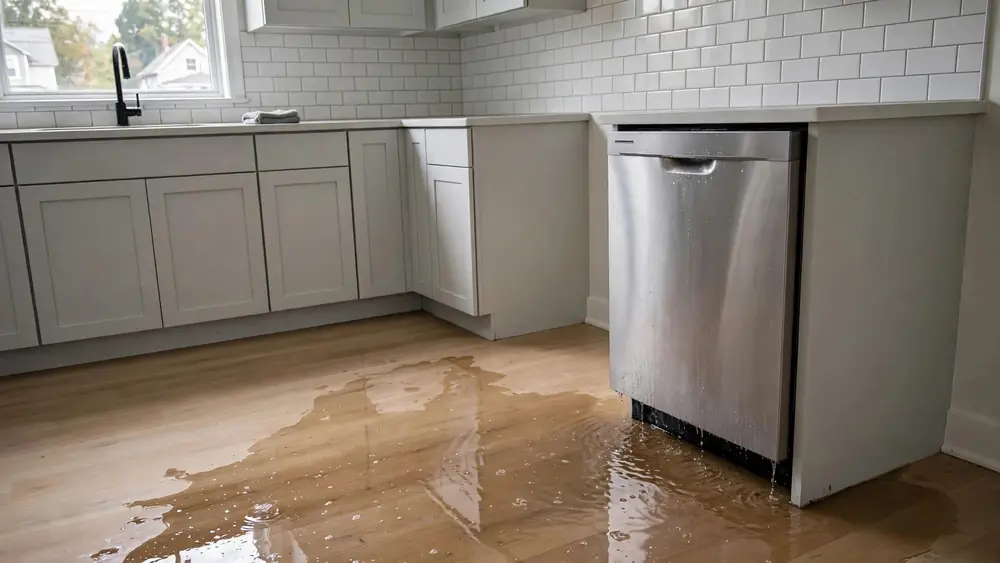
A failed dishwasher or toilet line in one unit damages ceilings in the units below.
Finished basement flooding
Groundwater or a failed sump pump floods a finished lower level in a single-family home.
Shoreline storm water
Coastal storms push water into low-lying homes near coves and points.
Frozen pipes in exterior walls
Cold snaps freeze lines in older houses and in rooms over garages.
Ice dam roof leaks
Snow on roofs melts and refreezes at the eaves, pushing water into ceilings [4].
Sprinkler and riser leaks
In high-rises, a broken sprinkler head or riser can release a large volume quickly.
High-rises
Water damage in Stamford condos and apartment towers
In a residential tower, water moves down. A supply line that bursts behind a refrigerator on one floor can reach two or three units below within minutes, traveling along slab penetrations, plumbing chases and electrical conduits. The first step is always to stop it: close the unit shutoff, or have building staff close the riser.
Restoration then has to work within building rules. Management may need to approve access times, elevator use and where equipment can run. The association's master policy and each owner's unit policy may both be involved, along with any tenants' renters policies. A restorer who documents each affected unit separately, with readings and photos, makes it easier to sort out who covers what.
Drying in concrete-framed buildings is different from wood-framed houses. Concrete slabs hold water and give it up slowly, and the drywall and flooring above the slab dry faster than the slab itself. The contractor will want to confirm the slab is dry enough before new flooring goes down.
The shoreline
Coastal storms and Stamford's waterfront neighborhoods
Stamford's coastline is a series of points and coves, with islands such as Cove Island just offshore [1]. Hurricanes have reached the Connecticut coast in 1938, 1954, 1960, 1985 and 2012 [1]. Storm surge, the rise in sea level pushed ashore by a storm's winds, is the main flood threat in these areas [5].
When seawater enters a house, everything it touches is treated as contaminated, and salt residue has to be rinsed from surfaces that are kept. Electrical systems, furnaces and water heaters exposed to saltwater usually need careful inspection or replacement. Follow evacuation orders and do not return until officials say it is safe [6].
Rivers
Stamford's rivers and low-lying streets
Streams and rivers run south through Stamford to the Sound. The Mianus runs down through Stamford and Greenwich to the shore [2], and smaller rivers and brooks cross the central and eastern parts of the city. Homes in low areas along these rivers and their tributaries can see basement water during heavy rain, especially when the ground is already saturated.
River flooding is surface water from outside the house, which is generally covered by flood insurance rather than standard homeowners policies [3]. It is also contaminated water, so cleanup follows the same caution as any floodwater [7].
A Stamford condo job
How a condo water damage job usually runs in Stamford
- 1
Stop the water
Close the unit valve or call building staff to shut the riser.
- 2
Notify management and neighbors
Building management, the units below and the association need to know.
- 3
Document each unit
Photos and moisture readings in every affected unit and common area.
- 4
Extract and remove
Water extracted; wet pad, baseboards and saturated drywall removed as needed.
- 5
Dry within building rules
Equipment placed where allowed, with access times agreed with management.
- 6
Check readings daily
Each unit tracked separately until dry.
- 7
Split the paperwork
Each owner and the association receive documentation for their own claims.
Housing types
How Stamford's housing types handle water damage
General patterns; your building may differ.
| Housing type | Typical water problems | Restoration notes |
|---|---|---|
| Residential tower | Appliance and supply line leaks, sprinkler breaks, unit-to-unit damage | Management coordination, slab drying, multiple claims |
| Older multi-family near downtown | Plumbing leaks, basement seepage, roof leaks | Multi-unit mapping, plaster and older materials |
| Colonial or cape with basement | Groundwater, sump failure, washing machine leaks | Finished basement tear-out and drying |
| Split-level | Lower level partly below grade, prone to seepage | Drying lower level walls and floors |
| Shoreline home | Storm surge, wind-driven rain | Contaminated water cleanup, salt rinsing |
Basements
Stamford basements and seasonal water
Most single-family homes in Stamford have basements, and many are finished as family rooms, offices or gyms. Groundwater rises in spring and after long rains, and older foundations can seep at the floor-wall joint and through cracks. A sump pump, if there is one, keeps up until the power goes out or the pump fails.
Finished basements turn seepage into a bigger job, because carpet, pad, drywall and insulation hold water against the concrete. Our flooded basement cleanup and sump pump failure cleanup pages cover both.
Winter
Winter freezes and ice dams in Stamford
Stamford is milder than inland Connecticut, but winter cold snaps still freeze pipes, particularly in rooms over garages, in exterior kitchen walls and in houses left empty during holidays. Keep heat steady, open sink cabinets on cold nights and drip faucets during extreme cold [8].
Ice dams are the other winter problem. Heat escaping into the attic melts snow on the roof, the meltwater refreezes at the cold eaves and the ice ridge forces water back under shingles and into ceilings and exterior walls [4]. The damage often shows up as stains along the top of exterior walls. Restoration means removing wet insulation and drying the affected ceilings and walls.
Stamford checklist
First steps for Stamford homeowners and condo owners
In the first hour, if it is safe.
- Stop the waterClose the main or the unit shutoff, or call building staff.
- Protect peopleKeep away from wet ceilings and electrical fixtures.
- Notify othersNeighbors below, management or the association, and your insurer.
- PhotographThe source, the water and every affected room.
- Move valuablesElectronics, documents, art and rugs out of the wet area.
- Call for helpA restorer for the water, a plumber for the source.
Mold
Mold prevention in Stamford homes
Humid summers along the Sound and finished basements make mold a real concern after any water damage. The EPA advises drying within 24 to 48 hours and keeping indoor humidity below 60 percent [9]. In condos with central air, keeping the system running at normal settings can help once the source is fixed, but ask the contractor first if ducts or air handlers got wet. See mold prevention after water damage.
Permits
Stamford permits and contractor checks
Drying and removal of damaged materials usually do not require a building permit; rebuilding, electrical and plumbing work often do. The city's building department handles permits, and condo associations frequently have their own rules for contractors working in the building, including insurance certificates and approved hours.
For home improvement work in Connecticut, check that the contractor is registered with the Department of Consumer Protection [10].
Downtown
Downtown and the South End
Downtown Stamford and the South End have seen much of the city's newer residential construction, alongside older mixed-use buildings. In newer buildings, leaks are usually from appliances, plumbing fixtures or sprinkler systems, and they spread between units. In older buildings, aging plumbing and roofs are the bigger issues. The South End's location near the harbor also brings it closer to coastal flood risk during strong storms.
North Stamford
Larger lots in north Stamford
North of the Merritt Parkway, North Stamford covers the city's largest land area but is its least densely populated part [1]. It is wooded and suburban, with larger houses, and some properties rely on private wells and septic systems rather than city water and sewer. Water damage here often involves finished basements, well pump or pressure tank failures, and frozen pipes in houses with long plumbing runs. Septic homes can see backups when the system is overloaded or the leach field is saturated after heavy rain; our sewage backup cleanup page covers those.
Shippan and the points
Shippan, the Cove and other waterfront areas
Waterfront neighborhoods such as Shippan Point and the area around Cove Island are where storm surge matters most. Houses there may have flood vents, raised utilities and flood insurance requirements. After a storm, check lower levels carefully, including crawl spaces and garages, and treat any seawater as contaminated. If you are in a mapped flood zone, review your flood insurance well before hurricane season [3].
Stamford symptoms
What Stamford homeowners notice and what it usually means
A quick reference before you call.
| What you notice | Likely cause | What to do first |
|---|---|---|
| Ceiling stain under the unit above | Appliance, toilet or shower leak upstairs | Call building staff and the neighbor |
| Water along the basement wall after rain | Groundwater or a downspout dumping at the foundation | Check gutters and the sump pump |
| Stains at the top of exterior walls in winter | Ice dam forcing meltwater under shingles | Remove snow from the roof edge safely; call a roofer and restorer |
| Wet floor in a room over the garage | Frozen and burst pipe in a cold floor | Close the main valve |
| Water entering through the garage after a storm | Storm surge or street flooding | Stay out until safe; treat water as contaminated |
| Water spraying from a ceiling sprinkler head | Damaged or frozen sprinkler | Alert building staff to close the system |
Neighborhood mix
Glenbrook, Springdale, the East Side and the West Side
Between downtown and North Stamford lie neighborhoods such as Glenbrook, Springdale, Belltown, the East Side, the West Side and Westover [1]. Housing there ranges from early twentieth-century two-family houses to mid-century capes, ranches and split-levels. Common water problems are basement seepage after heavy rain, sump pump failures, water heater and washing machine leaks, and winter freezes in pipes along exterior walls.
Two-family houses in the older parts of these neighborhoods behave like small multi-family buildings: a leak upstairs often damages the unit below, and shared basements are common. Split-levels have a lower level partly below grade, which is where groundwater and drain backups usually show up first.
Sprinklers
Fire sprinkler leaks in newer Stamford buildings
Newer apartment and condo buildings have fire sprinkler systems throughout. Sprinkler heads can be knocked off by furniture or a ladder, freeze in unheated areas such as garages or balconies, or fail with age. A discharging sprinkler head releases a large volume of water very quickly, and it keeps flowing until building staff close the zone valve.
If a sprinkler goes off in your unit without a fire, get out of the spray, alert building staff immediately and move valuables if you can do so safely. Do not try to stop the head yourself. The water is generally clean at first but has sat in the pipes and may be discolored. Restoration follows the same steps as any multi-unit leak, with extra attention to the units below.
Wells
Well pumps and pressure tanks in Stamford homes
Where homes rely on a private well, the water system includes a pump, a pressure tank and often treatment equipment in the basement. A pressure tank that ruptures, a fitting that fails on the line from the well, or a treatment system that leaks can put a lot of water on the basement floor, and a well pump keeps refilling the system until power to it is shut off.
If you are on a well and find water in the basement, switch off the well pump breaker as well as closing the main valve. A well contractor repairs the system; the restorer handles the water. Well equipment that sat in floodwater should be checked, and many health departments advise testing well water after flooding.
Garages
Garages, rooms over garages and attached spaces
Many Stamford houses have attached garages with a bedroom or family room above. Pipes that run through the garage ceiling or along its walls to reach that room are a classic winter failure, because garages are unheated and garage doors leak cold air. When those pipes burst, water comes through the garage ceiling and often into the room above as well.
Insulating the garage ceiling and the pipes in it, keeping the garage door closed in cold weather and adding a low-temperature alarm help. After a burst, the restorer dries the floor above, removes wet garage ceiling drywall and insulation, and checks the framing between the two spaces.
Renters
For renters in Stamford apartment buildings
Many people in downtown Stamford rent. If water damages your apartment, tell the building manager or landlord right away, in writing, with photos. The landlord or building owner is generally responsible for the structure and for arranging drying and repairs, while your belongings are covered, if at all, by your own renters insurance. Keep a list of damaged items and receipts for anything you need to replace, and ask management how long drying equipment will need to run in your unit. If the apartment cannot be lived in for a while, ask both the landlord and your renters insurer what help is available for temporary housing, and get any arrangement for temporary housing confirmed in writing.
Getting help
What to have ready when you call from Stamford
Have your ZIP code, the type of home and a short description of what happened. In a condo or apartment building, mention the building, the floor and whether management has been told. In a house, mention whether the water is in a finished basement, from a burst pipe or from outside. Your call is connected to an independent local restoration contractor who can talk it through on that same call.
If you have flood insurance or a condo master policy, have the details nearby. They do not change the drying work, but they help the contractor understand who will need documentation.
Insurance
Insurance after water damage in Stamford
Condo owners often have three layers to think about: the association's master policy, their own unit policy and possibly a tenant's renters policy. Single-family owners have their homeowners policy and possibly flood insurance. Sudden water damage is commonly covered, flood from outside usually needs flood insurance, and sewer or sump backup often needs an endorsement [11]. The Connecticut Insurance Department can help with questions [12].
FAQ
Questions from Stamford residents
Water from the unit above is leaking into my condo. Who fixes it?
Stop the source with building staff first. Then the association, the owner of the leaking unit and your own insurer may all be involved, depending on the bylaws and policies. Document everything in your unit.
My basement floods after heavy rain. What should I check?
Gutters, downspouts, grading and the sump pump. Then have the basement properly dried so mold does not start.
Is seawater flooding treated differently?
Yes. It is contaminated, leaves salt residue and can damage electrical and heating equipment. Cleanup involves removal of soaked porous materials, rinsing and thorough drying.
Are ice dams common in Stamford?
Ice dams happen in snowy winters, especially on older houses with limited attic insulation and ventilation.
Does homeowners insurance cover river flooding?
Generally no. River and storm surge flooding usually need separate flood insurance.
Are all Stamford ZIP codes covered?
Six Stamford ZIP codes are covered. Your call confirms whether your address is served.
Who works on Stamford homes and condos?
An independent restorer serving Stamford and nearby shoreline towns. This site connects the call; the contractor talks through your house or unit and you decide whether to hire them.
Nearby
More around Stamford
Back to all of Connecticut. Nearby pages: Bridgeport, Danbury, New Haven, New London and Groton, Norwalk, Waterbury.
Related help for Stamford: water extraction, structural drying, sewage backup cleanup, fire damage restoration and smoke damage cleanup. First time dealing with this? Read the first hours after water damage.
Sources and citations
- [1]Wikipedia — Stamford, Connecticut
- [2]Wikipedia — Mianus River
- [3]Wikipedia — National Flood Insurance Program
- [4]Wikipedia — Ice dam (roof)
- [5]Wikipedia — Storm surge
- [6]Ready.gov — Floods
- [7]U.S. EPA — Flooded homes: cleanup and safety
- [8]Ready.gov — Winter weather
- [9]U.S. EPA — A brief guide to mold, moisture and your home
- [10]Connecticut Department of Consumer Protection
- [11]Wikipedia — Homeowner's insurance
- [12]Connecticut Insurance Department