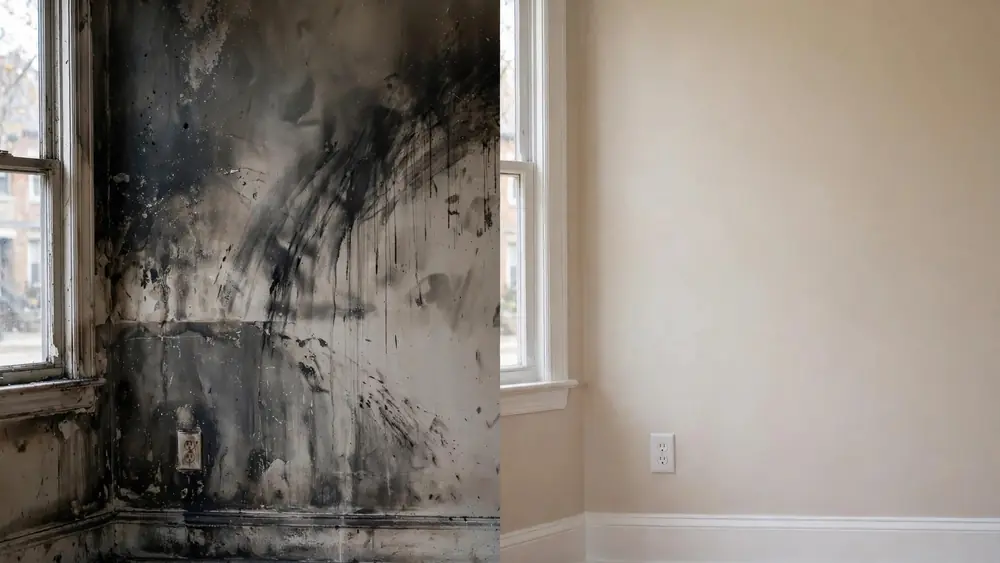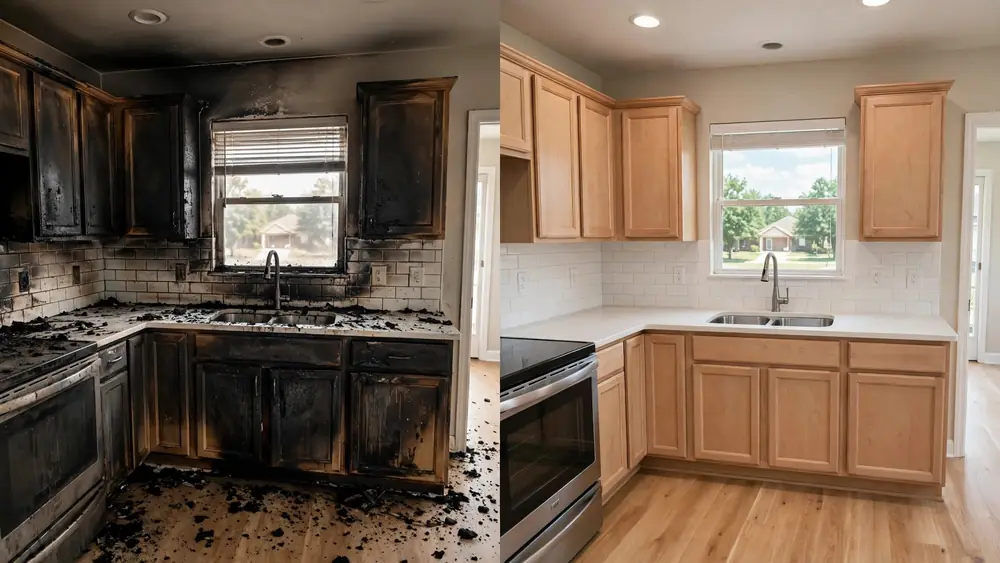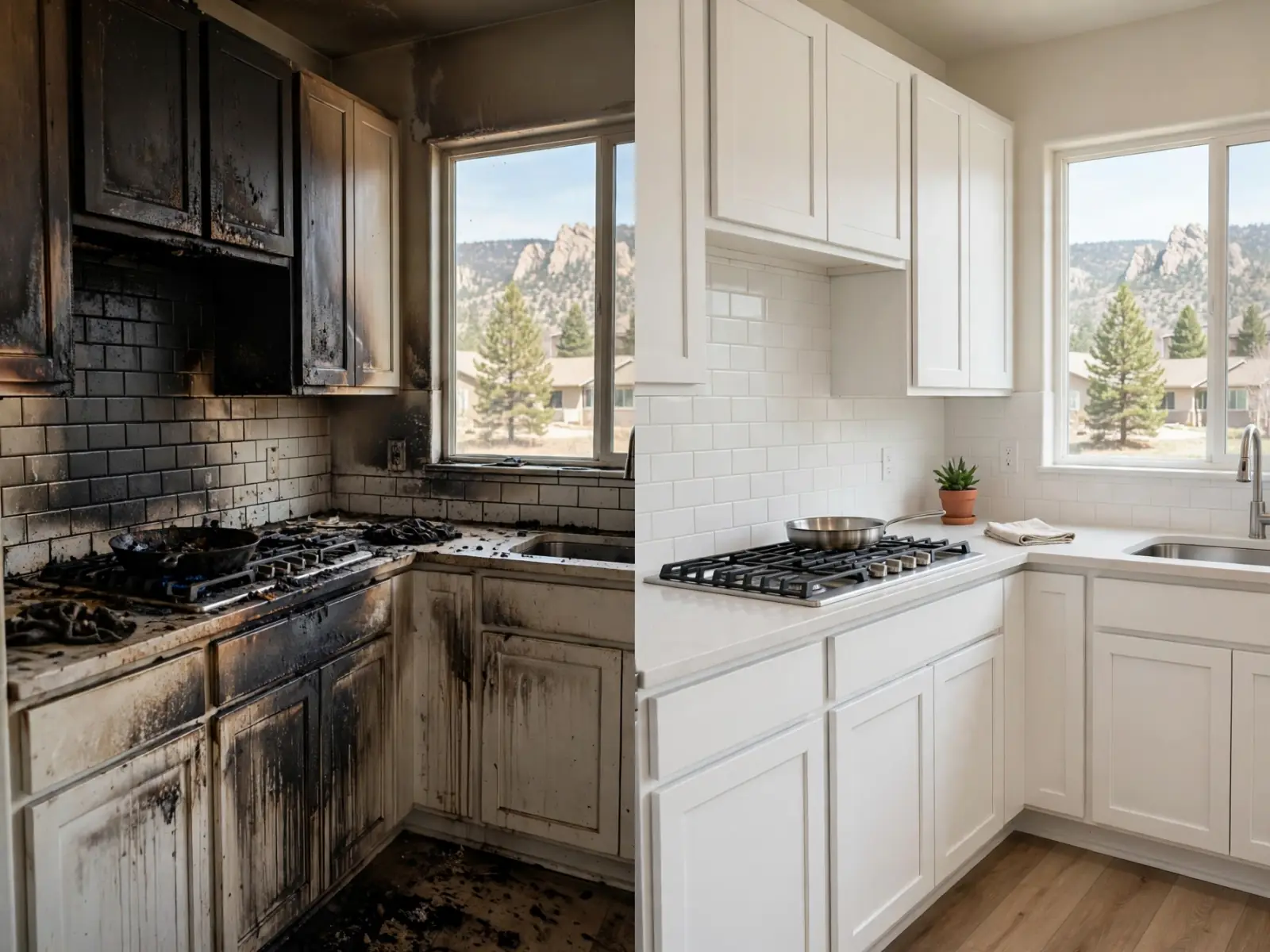
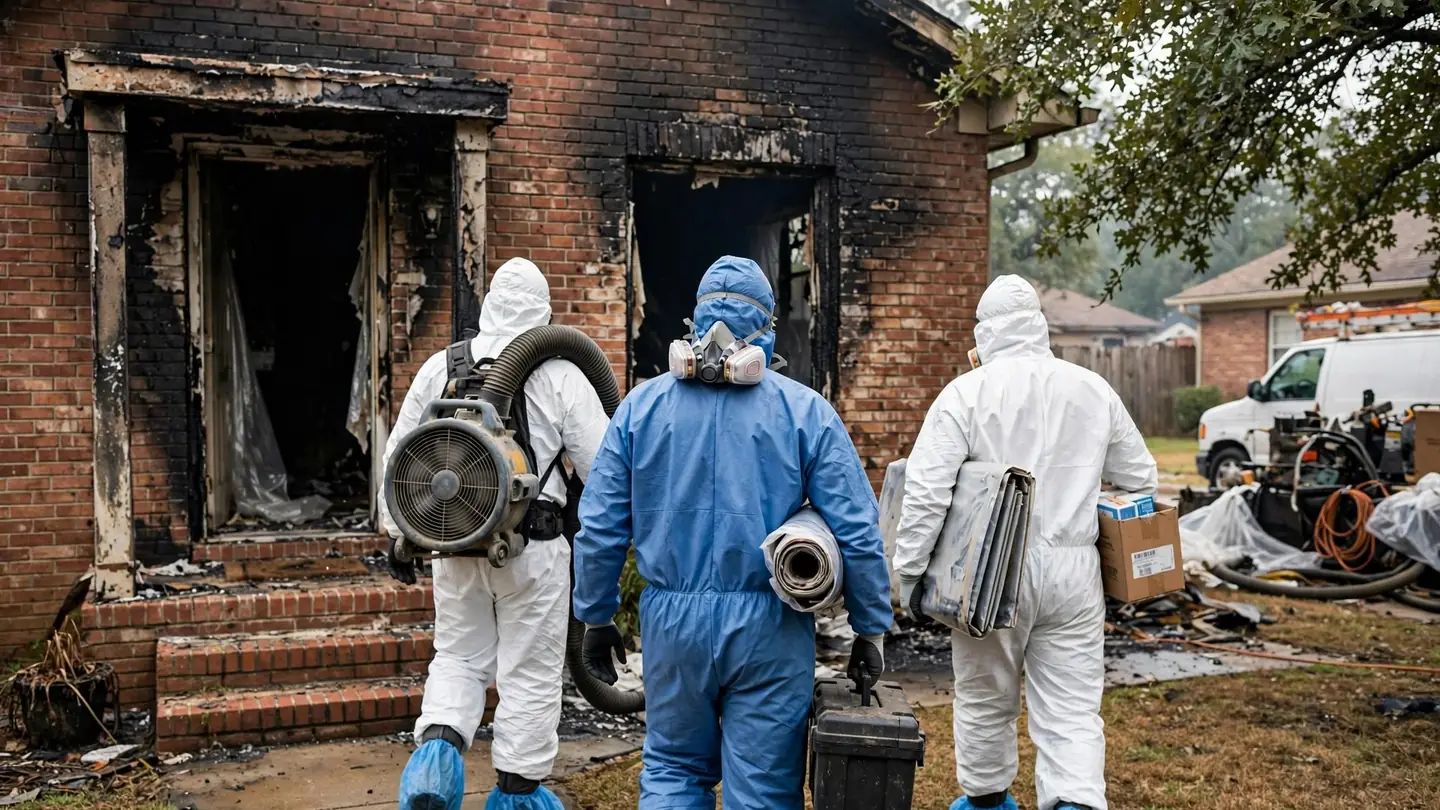
Key facts: Fire Damage Restoration
- The ANSI/IICRC S700 standard covers fire and smoke restoration, from assessment to odor and contents [1].
- Ready.gov advises staying out of a fire-damaged home until the fire department says it is safe to return [2].
- EPA advises drying water-damaged materials within 24 to 48 hours, which also applies to firefighting water [3].
The short answer
Why fire jobs are three jobs in one
The burned area is often the smallest part of the loss. Smoke moves through stairwells, attics and ductwork and settles on cooler surfaces far from the flames. Hose water soaks walls, floors and the rooms below, and it starts its own clock for mold.
That is why board-up and tarping and water removal usually come first, followed by smoke damage cleanup. Cleaning before the building is dry and secure tends to mean cleaning twice.
The process
How the work usually runs
- 1
Secure
Openings are closed against weather and entry, and the roof is tarped if needed.
- 2
Assess
The contractor separates what must be removed from what can be cleaned, and records it for the claim.
- 3
Dry
Firefighting water is removed, then the structure is dried with meters guiding the work.
- 4
Clean
Residue is removed with methods matched to what burned, starting with dry methods on soot.
- 5
Deodorize and rebuild
Odor sources are removed before any sealing, and repairs follow. Pre-1978 homes may need lead-safe work practices.
Questions
Common questions after a fire
Can I clean soot off the walls myself?
It is easy to make worse. Wiping or wet cleaning first can smear residue into paint. The guidance from most restorers is to leave it until the type of residue is known.
Will the smell go away by airing the house out?
Rarely. Odor comes from residue in porous materials and cavities, so it has to be removed at the source.
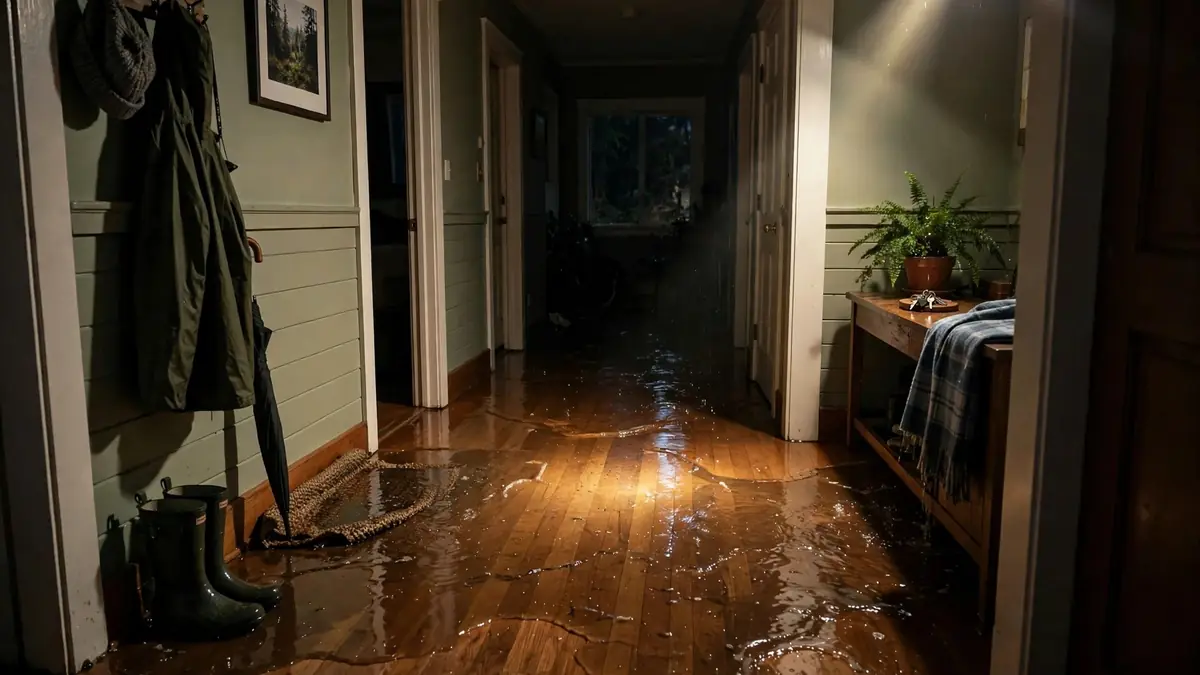
Water left behind by firefighting
First days
What to do while the job gets organized
Get the fire report details from the fire department, then call your insurer. Ask what the policy provides for temporary housing. Do not turn on utilities until a qualified person has checked them, and throw out food exposed to heat, smoke or soot.
Retrieve medications, identification and important documents only when officials say you may enter. If a building is unsafe, ask them to retrieve what they can.
Belongings
What can be cleaned and what cannot
Many hard items clean well: dishes, metal, glass and sealed furniture. Soft goods vary, and clothing and textiles often respond to specialist laundering. Electronics need careful evaluation, since soot can be corrosive. Paper, mattresses and items burned or soaked with contaminated water often cannot be recovered.
On bigger jobs, belongings may be packed out, cleaned elsewhere and returned. Ask for an itemized inventory with photos, and keep your own list as well.
Checklist
Questions for a fire restoration contractor
- Do you follow the IICRC S700 standard?
- How will you identify the type of residue before cleaning?
- How will odor be removed, and will anyone need to leave during treatment?
- If my house was built before 1978, how will you handle lead paint?
- Will you document damage in a way my adjuster can use?
Air quality
Why ducts and filters matter
If the system ran during or after the fire, residue may be inside it. Keep it off until it has been checked, and replace filters. Duct cleaning makes sense when soot is actually present, so ask for evidence such as photos from inside the ducts. Related reading: smoke damage cleanup.
Is this what you need?
What fire damage restoration covers beyond the burned room
Most homeowners search for this in the first day or two after a fire, wanting to know whether the house can be saved and what happens next. In many fires it can, though the answer depends on structural safety, how far smoke travelled and how much water was used. A structural concern is for an engineer or building official, not a cleaning crew.
Even a small kitchen fire can leave residue across the home, because hot air carries smoke to cooler rooms. So assessment should include rooms that look untouched.
Compare
Three kinds of damage from one fire
| Damage | Where it shows | Usual approach |
|---|---|---|
| Heat and flame | Framing, wiring, finishes near the fire | Removal and rebuilding |
| Smoke and soot | Walls, ceilings, ducts, contents | Dry cleaning, then wet cleaning, then odor work |
| Firefighting water | Floors, walls, rooms below | Extraction and drying |
Paperwork
Records worth keeping from day one
- The incident or fire report number
- Photos of each room before anything moves
- A list of belongings, with ages if you know them
- Receipts for hotels, food and temporary repairs
- Names and dates of everyone you speak with
Questions
More questions about fire damage
Is my house safe to live in?
Only the fire department or a building official can say. Do not rely on appearance, since hidden wiring and framing damage may remain.
How long does fire restoration take?
It varies widely. A small cleaning job may be short, while structural rebuilding involves permits and trades, so ask for a written schedule after assessment.
Who deals with the soot on my belongings?
Many contractors offer contents cleaning, either on site or through pack-out. Ask how items are tracked and returned.
Guides
Guides for this job
Size of fire
How a kitchen fire differs from a full structure fire
A stove fire put out with a lid, or a small fire contained by a sprinkler or an extinguisher, may leave only one room burned, but grease-laden smoke can travel further than people expect. The work is mostly cleaning, with a small amount of replacement around the range, the cabinets and the hood. Extinguisher powder needs its own cleanup too, since some types can be corrosive to metal and electronics.
An attic or garage fire is a different job. Garages hold paint, fuel and plastics, so residue can be heavy and sticky, and shared walls can pass heat into the living space. Attic fires are often fought from above, which sends a great deal of water down through every ceiling beneath.
A full structure fire can involve partial demolition, engineering review, permits and many trades. In those cases the contractor's early work is often stabilization and sorting out what remains, and the rebuild may take far longer than the cleaning.
From the curb
Entering a fire-damaged building for the first time
Ready.gov advises checking with the fire department before going back in, and that step comes before everything listed here.
- 1
Get the all-clear
Ask specifically whether anyone may enter, for how long and which parts of the building are off limits.
- 2
Ask about the utilities
Find out whether power, gas and water were shut off and by whom. Ready.gov says not to reconnect utilities yourself.
- 3
Dress for it
Wear sturdy closed shoes, long sleeves and gloves, along with a fitted respirator if you will be inside for long.
- 4
Take someone along
A second person helps with lifting and looks out for hazards. Leave children and pets elsewhere.
- 5
Walk slowly and look up
Floors and ceilings may have weakened, and wet plaster can fall. Back out if anything looks wrong.
- 6
Film as you go
Record each room before you touch or move anything, including the insides of closets and cabinets.
- 7
Take only the essentials
Collect medication, identification, keys and important papers, and leave the rest for later.
What burned
How the material that burned affects the work
Contractors ask what burned because the fuel shapes the residue, the odor and sometimes the safety steps.
Wood and paper
These tend to leave drier, powdery soot that can often be vacuumed before any wet cleaning.
Plastics and synthetics
Furniture foam, electronics and vinyl produce heavier, sticky residue that smears and may etch surfaces if left for long.
Cooking oils and meat
Kitchen fires deposit a thin film that is often barely visible and carries a strong, stubborn smell.
Wiring and appliances
Electrical fires raise questions about hidden damage along the circuit, so an electrician should inspect far beyond the burned spot.
Stored chemicals and fuel
Pool chemicals, solvents and fuels in a garage or shed may need special handling, so tell the fire department and the contractor what was stored there.
Older building materials
Asbestos and lead in fire-damaged homes
Older houses may contain asbestos in siding, flooring, pipe wrap, ceiling texture and insulation. Fire can disturb these materials, and so can the demolition that follows. If your home is decades old, ask whether suspect materials will be tested before any tear-out, and who will carry that testing out. Rules on sampling and removal vary, with many states and towns requiring licensed workers.
Lead paint is a similar issue in homes built before 1978, and it matters most when walls and trim are being disturbed or sanded. The contractor should explain how that dust will be kept contained. If anyone in the household is pregnant or there are young children at home, mention it early on so plans for access can take it into account.
Who does which part
The trades on a typical fire job
Several specialists may work on the same house. Knowing who does what makes it easier to follow the schedule.
| Role | What they do | When they appear |
|---|---|---|
| Fire department | Controls the scene, and issues the report | First day |
| Building official | Decides on occupancy and permits | Early, and at inspections |
| Structural engineer | Reviews damaged framing or walls | Before demolition, on larger fires |
| Restoration contractor | Handles securing, drying, cleaning and odor work | Starting in the first days |
| Electrician and HVAC technician | Inspect and repair systems | After the structure is safe |
| Contents specialist | Packs, cleans and tracks belongings | Once access is allowed |
| General contractor | Handles rebuilding | After cleanup, unless the same firm does both |
Inside the walls
Why electrical and mechanical systems need their own inspection
Heat can damage wire insulation well away from where anyone saw flames, and water can leave corrosion behind in panels, boxes and devices. Have a licensed electrician look at the system before it is used again, rather than relying on whether the lights come on. Gas lines, water heaters and furnaces should be inspected by the relevant trade for the same reason.
Heating and cooling systems are often a route for smoke. EPA's guidance on ducts notes that sealants may have a place in fire-damaged ductwork, but only after proper cleaning, and it says that wet or moldy fiberglass duct material should be replaced rather than cleaned. That is a useful standard to hold a duct proposal up against. A reasonable proposal says what was found, what will be replaced and what will be cleaned.
Your safety during the job
Staying safe around a house under repair
A home under repair has hazards that were not there before. A few of these catch owners off guard.
- Run any generator outdoors, more than 20 feet from openings, in keeping with CDC's carbon monoxide advice.
- Replace smoke alarms and carbon monoxide alarms that went through the fire, and test them when you move back in.
- Keep clear of open floor areas, ladders and stacked debris when you visit.
- Ask the crew before entering rooms where cleaning products or odor treatments are in use.
- Tell the crew about anyone in the home with lung or heart trouble, so plans can allow for it.
- Do not eat or store food in the home until it has been cleaned and cleared.
Living elsewhere
Temporary housing during fire repairs
Plan for the possibility that you may be away for a while, even if the damage looks limited. For immediate shelter, food and medicine, Ready.gov suggests contacting a relief group like the Red Cross. After that, your insurer is the next call. Many homeowners policies include additional living expense coverage, and renters policies often do as well. Ask what it covers, how long it runs and which receipts it needs.
Tell your mortgage company about the fire too, as Ready.gov advises, because insurance payments on a structure often pass through the lender. Also let your children's schools, your employer and the post office know about your temporary address. Mail can be forwarded, so you do not need to visit a damaged building to collect it.
Sorting belongings
Deciding what to keep after a fire
Do not throw anything out until it has been recorded. Ready.gov says to hold on to damaged goods until an inventory is done, so walk through and photograph them, even when an item is plainly ruined. A pile of debris that nobody documented is hard to prove later.
Food deserves caution. Throw out anything exposed to heat, smoke or soot, including canned goods that got hot and items in open packaging. Medicines exposed to heat or smoke should be replaced too, so ask your pharmacist how to get new ones. Family photographs and important papers may be worth specialist attention, even when damaged. Keep them flat and dry, and avoid separating stuck pages or prints until you have advice.
Sentimental items may matter more to you than anything of market value. Say which they are up front, and ask that those items be handled separately.
Reviewing the scope
Reading a fire restoration scope of work
Before signing, read the written scope and look for these points. Vague language in any of them is a reason to ask more questions.
- Rooms named one by oneEach room should be listed, including those with light smoke only, along with attics, crawlspaces and garages.
- Cleaning method statedThe document should say how residue will be removed, and not just that it will be cleaned.
- Odor plan in orderSource removal should come first, followed by any sealing or air treatment, with re-entry conditions stated.
- Contents handlingIt should explain what is packed, where it goes and how you get it back.
- Water and dryingLook for readings and targets if the fire involved water, and not merely a line for equipment.
- Boundary with rebuildIt should say where this contract stops and rebuilding starts, and who pulls the permits.
- Change processHidden damage often turns up. The scope should explain how changes are approved in writing.
Other people's property
When a fire affects neighbors or tenants
A fire seldom stays neatly within one household. Smoke can enter the next unit through shared attics and pipe chases, and water may run down to the floor below. Each household generally deals with its own insurer, while the building owner or association handles common areas and the structure. Share what you know, and keep your own records in case the responsible party is disputed.
Fire investigators may want to look at the area of origin before cleaning starts. Your insurer may also send its own investigator. Ask them when the scene can be released, and hold back from clearing the burned area until they say so, because evidence removed early can complicate a claim.
Getting back in
How to judge when a house is ready for you
A house is ready when officials have cleared occupancy, systems have been inspected, and the smell is gone with the heating on and the windows closed. Spend an hour there before moving back, and go through closets and basements as well. If the smell returns or surfaces leave marks on a clean cloth, tell the contractor before you sign off.
Keep your full file for years: the fire report, contractor records, inspection sign-offs and the final scope. A future buyer may ask about the fire, and those records show what was done. When you come back, it helps to learn the lessons as well. Check your alarms, plan your escape routes again and store a digital copy of important documents, which Ready.gov suggests doing before a fire ever happens.
Practical answers
Questions that come up later in a fire job
Must I hire whoever my insurer recommends?
Often the choice is yours, though policies vary. Ask your insurer what applies. A call to (833) 610-0241 can connect you with an independent contractor for a second conversation.
Why is the crew removing things that look undamaged?
Porous materials may hold residue or water out of sight. Ask for the reason on each item, and for photos before removal.
Can a house be demolished if the fire looks small?
That decision belongs to the owner, the insurer and officials, based on structure and code requirements. Appearance alone does not settle it.
Is there a right season to rebuild?
Rebuilding can go ahead in most weather once the building is closed in. What matters most is that it stays dry, so keep tarps maintained during any delay.
Should I repaint as soon as cleaning finishes?
Wait until the contractor confirms the surfaces are clean and any sealer has been applied. Paint on its own does not deal with residue.
What if I smell smoke months later?
Warm weather can bring it out. Call the contractor, and ask them to check attics, ducts and any cavity that was left closed.
Fire reports
Using the fire report on your claim
Your insurer will ask for this document early on. A few points help.
- Ask the fire department how to request the report, as many have their own process.
- Check names, dates and the address for mistakes, and ask for corrections if needed.
- Give a copy to your contractor as well, so the scope reflects what burned and where.
Service areas
Fire Damage Restoration service areas
Where you live changes fire damage restoration. See Oregon, Connecticut, Delaware, Kansas, Louisiana, New Hampshire, Chicago, Dallas, Colorado Springs, Cedar Hill, Lake Stevens, Norcross, Port Charlotte, Prosper, Atlanta, Indianapolis.
Urgent?
If this is happening right now
Go straight to the first steps: emergency fire damage services.