
Key facts: Why Sump Pumps Fail
Compare
Failure signs and what to do about them
| Failure | Sign | Fix |
|---|---|---|
| Power loss | Pump silent | Backup system |
| Stuck float | Motor will not start | Clear and retest |
| Clog | Runs with little flow | Clean the pit and inlet |
| Frozen discharge | Runs without moving water | Protect or reroute line |
| Age | Noise, frequent cycling | Replace |
How a sump system sits in a basement

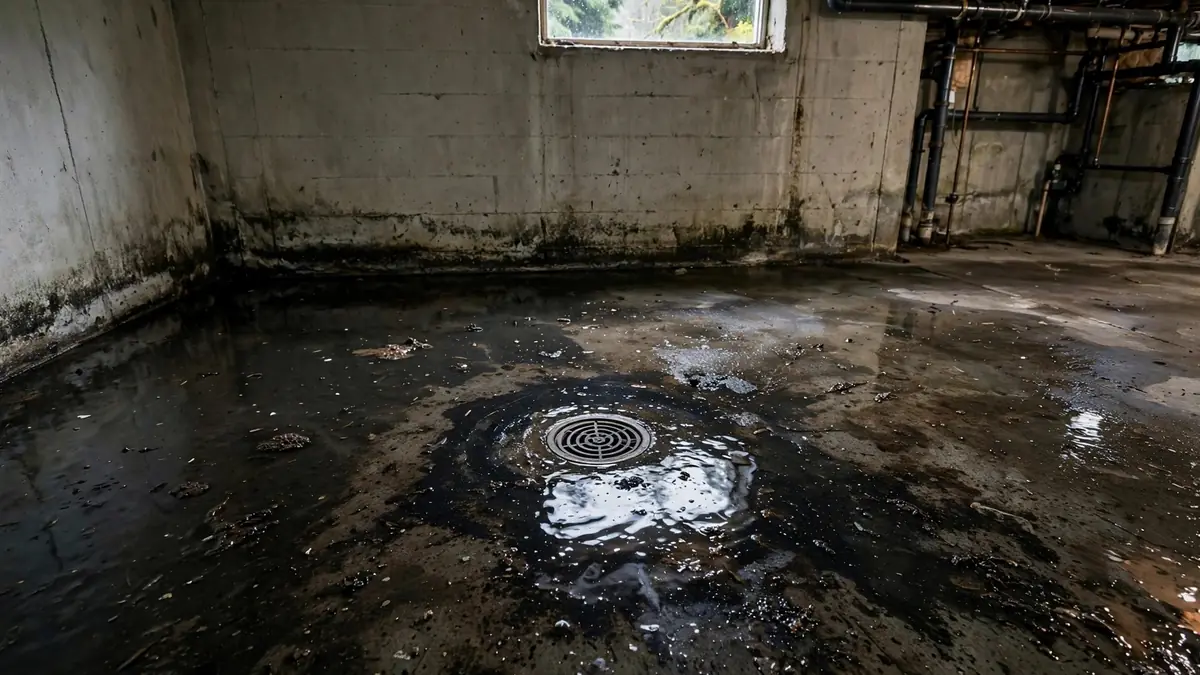
The basement you are trying to avoid
Test
The simple bucket check
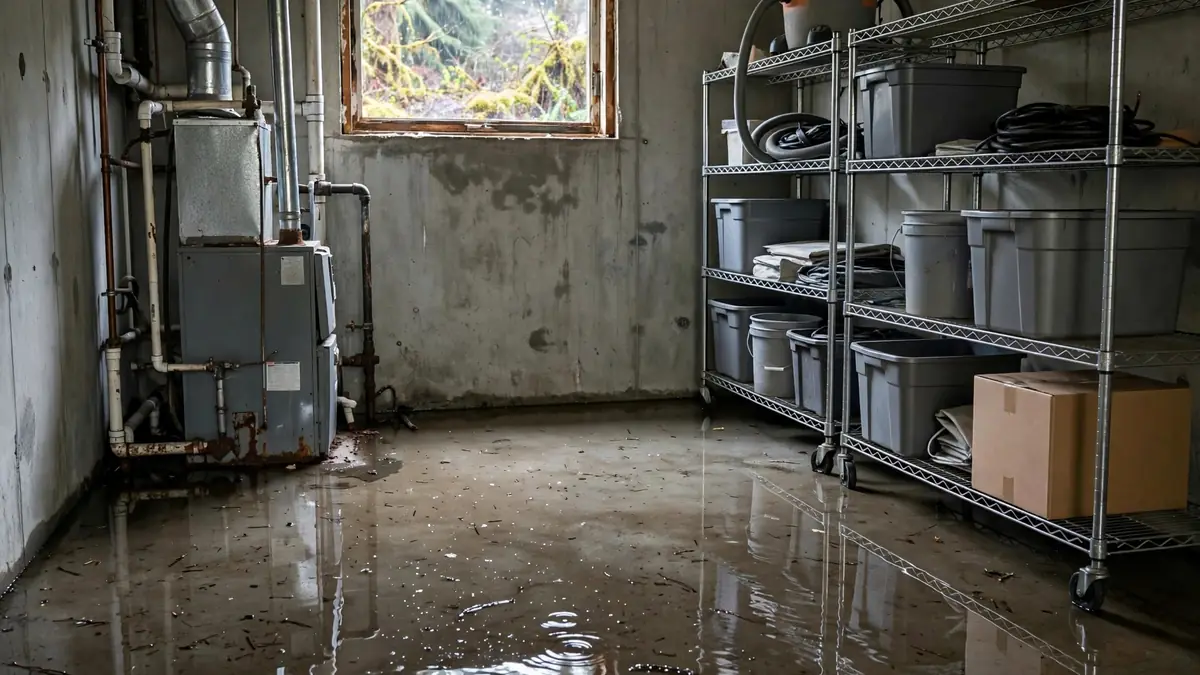
Pour a bucket of water slowly into the pit. The float should rise, the pump should start, and water should leave quickly. Then check that the outside discharge runs well away from the foundation. If your basement floods anyway, see flooded basement cleanup.
Answer first
The main reasons pumps quit
Sump pumps usually fail for ordinary reasons. The power goes out or the pump gets unplugged. The float sticks or its switch stops making contact. Debris clogs the pump or the discharge line is blocked or frozen. The motor wears out. Or the pump was simply the wrong size or installed poorly, so it can't keep up during a big storm.
North Dakota State University Extension points to two common mechanical failures: damaged or rusted bearings in the motor, and a float switch that does not make good electrical contact and so starts slowly or not at all. Pentair, a pump maker, describes the float switch as the most common point of failure in its troubleshooting guidance, though no independent statistics back up a precise ranking of causes.
The nasty part is timing. A pump can sit idle for months, then be asked to run hard during the worst storm of the year, which may also be the moment the power goes out. A pump that was never tested may have been broken for a long time without anyone knowing.
Beyond the basics
Failures you might not have thought of
Everyone thinks of a power cut. These causes get less attention, and each one has a simple check.
- Check valve failureA check valve stops pumped water from draining back down the pipe. When it fails, the same water can cycle back and the pump runs more than it should. Listen for a loud thump or for water falling back when the pump stops.
- Float tangled against the pit wallA pump that has shifted in its basin can trap the float against the side, so the switch can't move freely. It takes one look with a flashlight to see this.
- Extension cords and shared circuitsPentair notes that a long extension cord or a circuit shared with other appliances can cause low voltage. A tripped breaker on a shared circuit can also shut down the pump with no warning.
- Tripped GFCI outletsIf your pump is on a GFCI outlet, a trip will stop it silently. Check the outlet's indicator and reset button, and consider an alarm.
- Air-bound pumpAir trapped in the housing may keep the impeller from moving water, leaving a pump that hums or runs without pumping much.
- Silt and gravel in the pitDebris can reach the intake or the impeller. NDSU says a pump that sounds like it's pumping gravel may need replacing.
- Undersized pump or tired pumpA pump that keeps up during normal rain may be overwhelmed in a major storm, especially if it runs constantly.
- Freezing or a blocked outletIce or a buried outside pipe can leave the pump running with nowhere to send water.
- Pit too smallA small basin fills quickly, so the pump cycles on and off often, and this can wear it out faster.
Testing
A fuller test than one bucket
NDSU Extension recommends a dry test and a water test. Unplug the pump before reaching into the pit or clearing anything, and plug it back in afterward.
- 1
Confirm power
Make sure the pump is plugged in and the outlet works. Check that the cord is not damaged.
- 2
Open and inspect the pit
Remove any lid, then look in with a flashlight for debris that could clog the pump.
- 3
Do the dry test
Lift the float for about 10 seconds. NDSU says the pump should turn on and run smoothly, and a brief dry run will not damage it. Lower the float slowly and see if the pump stops.
- 4
Do the water test
Pour water in about as fast as it normally flows in, until the float starts the pump. Watch the float, listen to the motor, and make sure it cycles on and off at least twice.
- 5
Go outside
While the pump runs, check that water is actually leaving the discharge pipe and draining away from the house. Make sure the line is not plugged.
- 6
Test the backup
NDSU says to test it the same way as the primary. To test a battery backup, follow the maker's instructions.
- 7
Write the date down
A note on the pit lid helps you remember. Test before the wet season for your area, and more often if the pump runs a lot.
Backups
Understanding backup options
Each backup has its strengths and limits. The right choice depends on your home, your power reliability, and how much water you get. Ask a licensed plumber about what suits your pit.
| Backup type | Covers | Limits to ask about |
|---|---|---|
| Battery-powered backup pump | Power loss and primary failure, if installed in the same sump | Battery upkeep is essential; run time and pump capacity are limited |
| Water-powered backup | Power loss, using municipal water pressure | Depends on your water supply and pressure; may not suit wells; local plumbing rules may apply |
| Generator | Runs the primary pump during an outage | Must run outdoors, far from windows and vents, per EPA and Ready.gov; someone must be there to run it unless automatic |
| Second AC pump | Primary pump failure or very heavy inflow | Does nothing in a power cut on its own |
| High-water alarm | Tells you there is a problem | Does not move any water; needs a way to reach you when you are away |
Pump types
Pedestal or submersible, and how long pumps last
NDSU describes the two main types. Pedestal pumps keep the motor about a foot above the pit, where it isn't meant to get wet and where the switch is easy to see. Submersible pumps sit on the bottom of the sump, out of sight, and some have an adjustable on/off distance while others don't.
No pump lasts forever, and age alone is a reason to pay attention. How long one lasts depends on how often it runs, the water quality and the quality of the pump. Rather than rely on a set number of years, look for noise, slow starts, trouble with the float, rust, or a history of constant cycling. Many people replace pumps before they fail, especially when a flooded basement would be hard to live with.
When replacing a pump, ask a plumber to look at capacity, the check valve, discharge routing and the size of the pit. Installing a new pump on an old, undersized setup does not fix everything. The sizing questions depend on how much water comes in, so bring along what you've noticed during heavy rain.
Outside
Discharge line problems outside the house
A healthy pump still fails its job if the water does not get away. Walk the discharge route in each season.
- Find where the pipe comes out, and make sure it is not plugged by dirt, leaves or nests.
- Check that it sends water away from the foundation and does not let it run right back to the wall.
- In freezing climates, look for low spots where water can sit and freeze. Ask about a freeze-resistant outlet if yours has frozen before.
- Check that any flexible extension has not been crushed by a mower or disconnected for yard work.
- Check how discharge is allowed in your community. NDSU notes that some cities have sanitary-sewer rules, and many places limit connecting sump pumps to sewers or sending water onto a neighbor's property.
- Make sure that gutters and downspouts are not sending roof water back to the same spot next to the foundation.
Right now
What to do when the pump stops during a storm
Water near electrical equipment changes everything, so make safety the first call.
- 1
Stay out if water reaches electrical equipment
Do not walk into a basement with standing water if outlets, cords, the panel or appliances may be in contact with it. Ready.gov warns to stay away from damp electrical equipment.
- 2
Check the simple things from a dry spot
Is the breaker tripped? Is the outlet GFCI reset? Is the neighborhood's power out?
- 3
Reduce incoming water
Hold off on laundry and long showers if your drains and pit are connected. Check gutters and downspouts if you can do so safely.
- 4
Start the backup
If you have a generator, use it only outdoors and away from doors, windows and vents, and connect it the way the maker says.
- 5
Move belongings up if safe
Lift items off the floor only if you are not standing in water near electrical equipment.
- 6
Record what happens
Photos, the time the water appeared and the height it reached will help with any claim and help anyone figuring out what went wrong.
Afterward
After the flood: cleaning up and working out why
Do not assume that sump water is clean. It starts as groundwater but picks up soil from around the foundation, and it may mix with whatever was on the floor. If a sewer backup or outside flooding is involved, treat it as contaminated. Flooded basement cleanup explains what usually stays and what goes, and the categories guide explains why the source matters.
Dry out quickly. EPA's window for drying is 24 to 48 hours, and basements tend to be slow because they are cool, humid and in contact with soil. Pull cardboard boxes and fabric off the floor, and don't restart gas appliances or a furnace that got wet until a technician has checked it.
Have the pump examined before relying on it again. Ask what failed and save the part. If a pump burned out, a new one on the same setup may fail the same way. A contractor drying the room can tell you what got wet, while a plumber can tell you why the pump failed, as the plumber or restoration guide explains.
Coverage
Insurance and sump overflow, in general terms
Sump overflow is a common coverage gap. Many standard homeowners policies treat water backing up from a sump or drain separately, and coverage may need an endorsement. Flooding is a separate question again, and is usually excluded from standard homeowners policies. Flood coverage comes from separate policies, and FEMA describes a wait of about 30 days on federal flood policies.
Read your policy before storm season and ask your agent how it treats a sump failure, an outage, and groundwater. Ask for any limit on your backup coverage in writing. Coverage details vary, and this is general information rather than insurance advice. See working with your insurance adjuster for what to do after a loss.
Maintenance
A seasonal checklist
Set reminders for these. They take very little time, and most of them require only your eyes and a bucket.
- Before your wet seasonDo the full dry and water test, test the backup, and walk the discharge line. NDSU recommends checking before spring thaw in its region.
- During heavy rain periodsCheck that the pump is cycling and that the pit is not close to overflowing. If the primary has been running a lot, make sure a backup is ready.
- Before going on a tripTest the pump, confirm the alarm can reach you, and ask someone to check on the house.
- Before freezing weatherMake sure that outside lines can drain, and disconnect any extension hoses that can hold water.
- Regularly for battery systemsFollow the maker's instructions for checking the battery. NDSU stresses that battery maintenance is very important.
- Once a yearClean debris from the pit, check the pump's intake screen if it has one, and check the check valve. Unplug the pump first.
Reducing the damage
What not to store near the pit
Even a tested pump can fail. Reducing what sits in the way of water limits the damage when it does.
- Keep valuables, documents, photos and electronics well off the floor or on another level.
- Use plastic bins with lids in place of cardboard boxes.
- Keep shelving legs on blocks when possible, and leave a gap from foundation walls.
- Keep paint, fertilizer, pesticides and fuel far from the floor, since they can contaminate floodwater.
- Do not finish a basement around a pump without planning for access. A closet with a removable panel is better than a built-over pit.
Listen
What the pump sounds like
Your ears can pick up trouble before the pit overflows. Unplug the pump before doing any hands-on inspection.
| Sound or behavior | May mean | Next step |
|---|---|---|
| Silent while the pit fills | No power, tripped outlet, stuck float or dead motor | Check power first, then the float |
| Humming, no water moving | Jam, air lock or failing motor | Unplug it, check for debris, then call a plumber |
| Rattling or grinding like gravel | Worn parts or debris in the impeller | NDSU says it may need a new pump |
| Loud thump on shutdown | Water slamming back at the check valve | Ask a plumber to look at the valve |
| Rapid on and off | Float setting, small pit or failed check valve | Check the float and watch a full cycle |
| Runs nonstop in dry weather | Stuck switch, high water table or a leak feeding the pit | Investigate the source of the water |
Under load
Why heavy rain finds the weak spots
Most of the year, a sump pump has an easy job. It handles a small amount of water, then rests. A big storm changes that. Groundwater rises, the pit fills faster, and the pump may have to run for hours. Any weakness that didn't matter on a quiet day, such as a tired motor, a small discharge pipe or a partial clog, suddenly matters a lot.
Outdoor conditions make it harder. Saturated soil gives water nowhere to go, so discharged water may flow back toward the foundation if the line ends too close to the house. Snowmelt can do this too, especially if the ground is still frozen and the discharge outlet is iced over. That's why a spring test matters in cold regions, and why testing at a slow time doesn't prove the pump can keep up in a heavy storm.
Long runs also heat up pumps, and they may trip protective switches or fail. If your pump ran for an unusually long time during a storm, look at it closely once things calm down. Have it checked if it sounds different afterward.
Choosing
Questions for the plumber who installs or replaces a pump
A quick conversation gets you a better setup than simply swapping in the same model.
- How much water does my pit actually take in during a storm, and what capacity fits that?
- Is my pit big enough, and is the float free to move inside it?
- Should the pump have its own circuit, and is a GFCI needed in this location?
- Where should the discharge end, and what are the local rules?
- Is the check valve in good shape, and can it be serviced?
- What backup do you suggest for my home, and how long would it run?
- Can you add a high-water alarm, and how would it notify me?
- Does a permit or inspection apply to this work where I live?
Bigger picture
Is a sump pump even the real problem?
A pump that runs constantly may be the symptom of a bigger issue. Clogged gutters, short downspouts and soil sloping toward the house can send far more water to the foundation than it should ever receive. Fixing these outdoor problems usually reduces how hard the pump has to work, and they are often simple jobs.
Other water problems can look like a pump failure. Water coming up through a floor drain may be a sewer backup, which your sump won't fix. Water coming through walls may be getting in above the level the drain system can handle. A leak in your home's plumbing can even feed the pit. Before replacing equipment, find out where the water is coming from.
If your basement keeps getting wet, keep a simple log. Note the rain, how the pump behaved and where the water appeared. It gives a plumber or waterproofing contractor something more useful than a general complaint, and it helps you judge what they say.
Questions
Sump pump questions homeowners ask
Does my insurance cover this?
Often only with a specific endorsement, so check your policy.
Do I need an alarm?
A simple water alarm is a useful early warning, especially if you travel.
How often should I test my sump pump?
Test before your wet season and more often if the pump runs frequently. NDSU's method involves lifting the float briefly and then running water through until the pump cycles at least twice.
Why does my pump run all the time?
The water table may be high, or the float could be stuck. A failed check valve can also return water to the pit, and an undersized pump can struggle. Ask a plumber to take a look if the pattern is new.
Why is the pump humming without pumping?
It may be jammed, air-bound or failing, or the discharge may be blocked. Unplug it before looking at it, and call a plumber if a simple check does not find the cause.
Will a battery backup keep up as well as the main pump?
Often not for long, because run time and capacity are limited. Check its rating and how long it runs, and consider what happens during long outages.
Can I pump into the sewer or my yard?
Rules vary by city, and many limit discharge to the sanitary sewer. Check with your local government or a plumber before changing the route.