Key facts: Sewage Backup Cleanup
The short answer
Why this is not a mop-and-bucket job
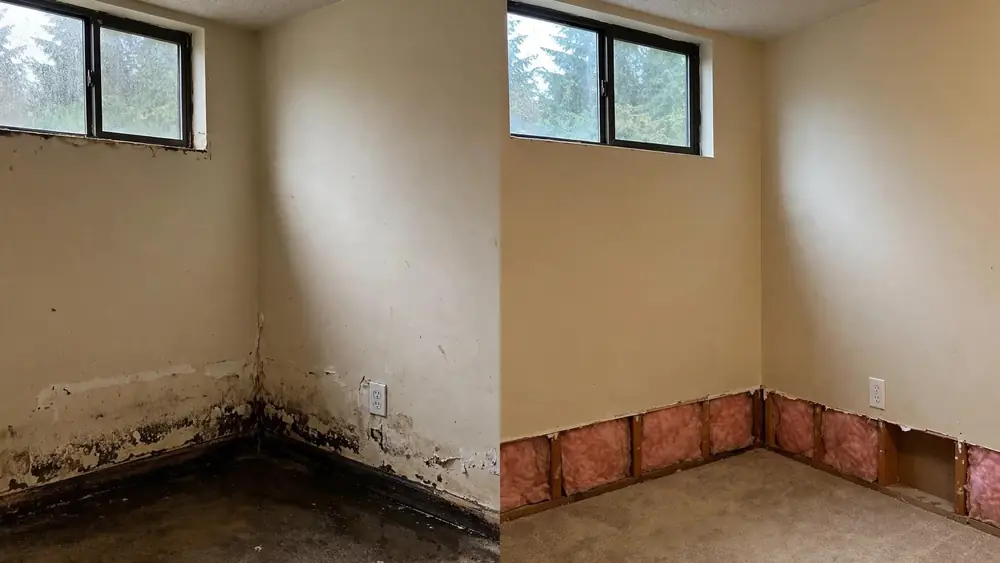
Sewage carries bacteria and other pathogens, and it soaks into anything porous. Carpet, pad, drywall near the water line and insulation are generally removed rather than cleaned. Hard surfaces get cleaned, sanitized and then dried.
Two trades usually share the job. A plumber or sewer contractor clears the blockage, and a restoration contractor deals with the building. Where you are not sure who owns the failed section of line, your city or sewer utility can often say.
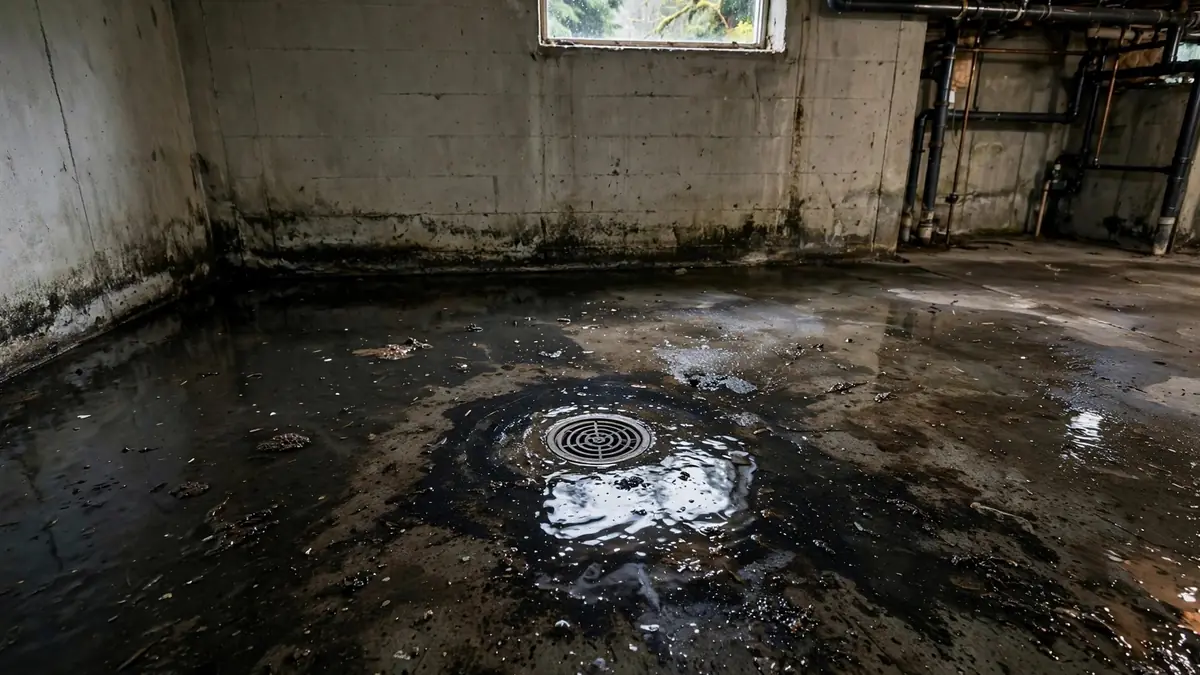
How a sewer backup reaches the house

The process
How cleanup usually goes
- 1
Stop the source
Stop running water, and get the line cleared.
- 2
Contain
Work areas are separated so contamination does not spread on foot.
- 3
Remove
Sewage is pumped out and porous materials are bagged and recorded.
- 4
Sanitize and dry
Surfaces are cleaned, then structural drying finishes the job.
Coverage
Check your policy for backup coverage
Sewer backup is often excluded from a standard homeowners policy unless you have added an endorsement. Read our insurance adjuster guide, and call your insurer early. Older combined sewers can also back up during heavy rain, as described on our Kansas page.
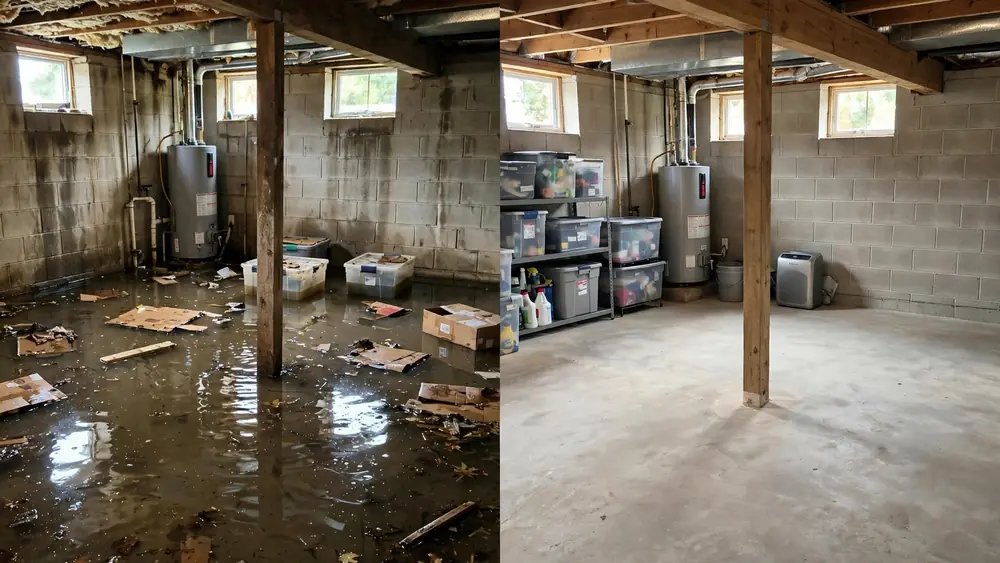
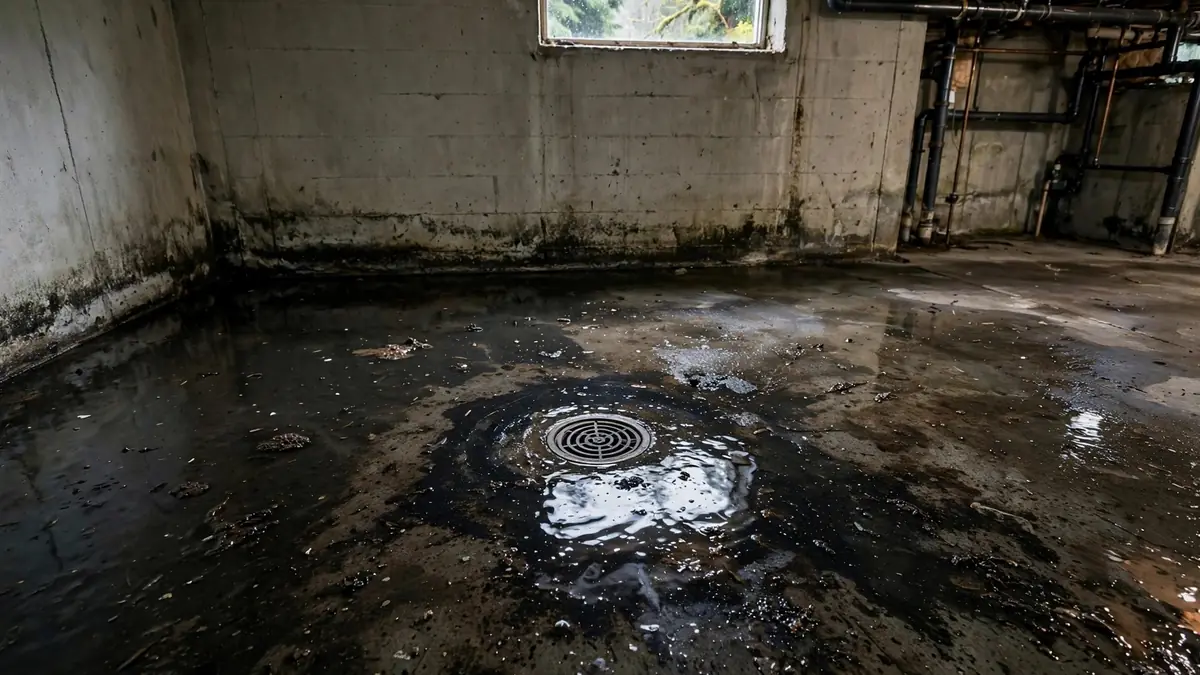
An affected basement
Causes
Why sewers back up
Tree roots, grease, flushed wipes and collapsed pipes block private lines. Heavy rain can overwhelm public systems, especially older combined sewers that carry stormwater too. If several drains back up at once, the problem is usually in the main line rather than one fixture.
A plumber or sewer contractor may run a camera to find the cause. Keep that footage or report, as it can help with a claim.
Checklist
If it just happened
- Keep everyone out, especially children, pets and anyone with health concerns.
- Stop using water anywhere in the house.
- Turn off power to the area if you can reach the panel without crossing wet floors.
- Take photos from a safe distance.
- Wash thoroughly after any contact, and ask a doctor if you have an open wound exposed to it.
Belongings
What can be saved
Hard, nonporous items can often be cleaned and disinfected. Mattresses, upholstered furniture, stuffed toys and paper goods that touched sewage are generally discarded. Photograph everything before disposal, and ask your insurer whether they want to see the items first.
Prevention
Reducing the risk
Avoid pouring grease down drains, and flush only toilet paper, even with wipes labeled flushable. Ask a plumber about a backwater valve if your area has combined sewers. For water that is less contaminated, see water damage categories explained.
Is this what you need?
How to tell a sewage backup from other water
Sewage tends to come up through the lowest drains, such as basement floor drains, showers and toilets. Gurgling fixtures and a foul smell usually arrive first. Water from a clean supply line has no such smell, and it usually comes from a wall or ceiling.
When several fixtures back up together, suspect the main line. Stop using water, because whatever you send down may come back up.
Compare
What generally happens to materials
| Material | Usual outcome | Reason |
|---|---|---|
| Carpet and pad | Discarded | Cannot be reliably made sanitary |
| Drywall near the water | Cut out | Porous, and holds contamination |
| Concrete and tile | Cleaned and sanitized | Nonporous, if sealed |
| Solid wood furniture | Assessed case by case | May be cleanable if sealed |
Questions
More questions about sewage
How serious is the health risk?
Sewage can carry bacteria, viruses and parasites, so anyone with health concerns should stay away and seek medical advice after exposure.
Who pays when the city sewer backs up?
It depends on your policy and local rules. Ask about a backup endorsement and report the event to the utility.
Can the smell be removed?
Yes, usually, once contaminated materials are gone and surfaces are cleaned and dried.
Guides
Guides for this job
Stop the inflow
Using the house while the line is blocked
When a sewer line is blocked, every gallon sent down comes back up at the lowest opening. These steps keep more from arriving.
- 1
Shut down the water users
Stop washing machines, dishwashers and any irrigation that drains into the house line. Do not flush.
- 2
Tell the household
Everybody needs to know, including children, or someone will run a sink out of habit.
- 3
Find the cleanout
An outdoor capped pipe near the foundation, or a capped fitting in the basement, is where the plumber will often start. Do not open it yourself, as it may be holding back a column of sewage.
- 4
Call the utility if neighbors are affected
Several homes backing up may point to the public main, which the utility should know about.
- 5
Plan for the toilet
Arrange access to a bathroom elsewhere, since the problem may take time to fix.
- 6
Stay away from the flooded area
Wait for protective gear and proper equipment, and stay out of any standing sewage.
Water sources
Telling the three common backups apart
Where the sewage appears helps in identifying what failed and whose line it is.
Single fixture
One slow sink or toilet usually means a branch clog near that fixture. It rarely floods a room, but it can overflow when the fixture is in use.
Lowest drains at once
When a basement floor drain, shower and toilet act up together, the main house line is suspect. Using a washer upstairs often brings up water below.
During heavy rain only
Rain that overloads a public or combined sewer can push water back through the house connection, even when the house line is clear.
Septic system
Slow drains throughout the home, wet ground above the drain field and odors outdoors suggest a septic problem. Call a septic professional instead of a sewer cleaner.
Whose line is it?
Who is usually responsible for each section of pipe
Rules vary by city, so confirm with your local utility. This is the common arrangement.
| Section | Usually responsible | Who to call |
|---|---|---|
| Drains inside the home | Owner | Plumber |
| Building sewer to the property line | Owner, in many places | Plumber or sewer contractor |
| Lateral under the street | Varies widely by city | Utility first |
| Public main | Utility or city | Utility emergency line |
| Shared lateral on a condo or duplex | Association or co-owners | Manager, then plumber |
| Septic tank and field | Owner | Septic contractor |
Personal protection
What CDC says to wear and how to clean up afterward
Protection here is not optional, even for a brief look. Keep these points in mind if you must go near the area.
- Wear the basicsCDC calls for rubber boots, gloves and goggles whenever sewage is involved. Long sleeves help too.
- Wash after contactUse soap and water after any cleaning, and always before eating.
- Deal with cuts right awayWash open cuts or sores exposed to floodwater with soap and water, and apply antibiotic ointment. Seek medical attention if you are hurt or become sick.
- Keep laundry separateWash worn clothing in hot water with detergent, apart from clean laundry.
- Leave shoes at the doorBoots and shoes should stay near the affected area so contamination is not carried across the home.
- Watch your handsDo not touch your face, phone or food while you are working around it.
The building
What gets removed and why
CDC advises removing drywall and insulation contaminated by sewage or floodwater, and parting with anything that will not clean up and dry fast. EPA's brief guide also says that sewage or other contaminated water is a case for professional help. This is why a sewage job can look severe even if the water was shallow. The material is not only wet; it has absorbed something that cannot be rinsed out of it.
Walls are usually cut above the highest level the water reached, with some margin to allow for wicking. Baseboards, door casings and hollow-core doors may also go. Subfloors raise the hardest question. Solid wood may be cleaned and treated if it was not soaked for long, while particleboard tends to swell and hold contamination. Contractors commonly talk in terms of the Category 3 language in the water damage categories guide when explaining these calls.
Ask to see the affected materials and photos before they go in a dumpster. Your insurer may want the same evidence.
Finish line
How a sewage job is checked before rebuilding
Before walls go back up, the area should pass more than a visual check.
- 1
All visible matter gone
Nothing should remain on floors, wall bases, pipes or framing, including in corners and under stairs.
- 2
Surfaces washed
Hard surfaces should be washed with detergent and rinsed first, because sanitizers work poorly on dirty material.
- 3
Sanitizer applied properly
Products should be used according to their labels, with contact time respected and with no mixing of chemicals.
- 4
Material dried
Moisture readings need to reach the target for each material before closing anything up.
- 5
Smell gone
An area that still smells after cleaning probably has contaminated material left in it.
- 6
Records handed over
You should receive the scope, drying logs and notes on what was removed, along with any testing.
Clean-water zones
Keeping the rest of the home clean during work
A sewage job can make a clean part of the house dirty. Good practice uses plastic containment on doorways, negative air where needed and a defined route for workers and waste. Ask the crew how they will get material out, particularly when the only route is through finished rooms. Floors along that route should be protected.
The heating system deserves attention too. If a furnace or return duct sits in the affected space, it can pull odor and contaminated particles through the house. Ask whether it should stay off during the work. On the drinking water side, you should not need any change if a backup is only in your drain system, but consult your local health department if a well or a broken water line may be involved.
Food, dishes and toys
Household items people ask about first
Food that touched sewage has to go, including anything in cardboard or in containers with screw caps. Dishes and metal utensils can be washed thoroughly, then sanitized. Children's items need extra care. CDC says that toys that cannot be cleaned, such as stuffed animals, should be discarded, and it describes a bleach solution of 1 cup per 5 gallons of water for those that can.
Clothing and bedding that were only lightly splashed may respond to a hot wash, kept apart from other laundry, while items that sat soaking are often a loss. Important documents can sometimes be recovered by specialists, so bag and freeze valuable papers if advised to, instead of tossing them. Photograph everything that you plan to discard.
Prevention at the fixture
Small habits that protect your line
Most private line trouble builds slowly. These habits, together with a periodic check, reduce the odds of a repeat.
- Put a strainer in kitchen and shower drains, and empty it into the trash.
- Let cooking grease cool in a can and throw it out instead of rinsing it away.
- Keep trees with aggressive roots away from the sewer lateral, and find out where it runs before planting.
- Have an older line scoped with a camera if you have had repeat clogs.
- Know where your cleanout is, and keep it clear and accessible.
- Disconnect any sump pump or downspout that illegally drains into the sewer, as they add to the load during storms.
- Make sure a backwater valve is serviced if you have one, since a stuck flap gives false confidence.
Backwater valves
What a backflow device does, and when it may not help
A backwater valve is a one-way flap on the sewer line that closes when water tries to return toward the house. It is often installed where the public system backs up in heavy rain. It will not help when the blockage is on your side of the valve, because wastewater from your own fixtures then has nowhere to go. While the valve is closed, avoid using water in the house for the same reason.
Installation generally means opening the floor or digging outside, and it may need a permit. Some towns have programs to encourage these devices, so ask your utility or public works office. A licensed plumber can tell you whether your layout is suitable, and whether the line needs repair first.
At the call
What helps the contractor when you phone
Phoning (833) 610-0241 reaches a referral line for independent contractors. They can plan better if you know these details.
- Has the blockage been cleared, or is it still coming up?
- How much of the floor is covered, and how long has it been there?
- Which materials did it touch, such as carpet, drywall or a finished stairway?
- Is there a safe way in that avoids walking through the contaminated area?
- Are there older adults, children or people with health concerns in the home?
- Have you spoken to your insurer, and did they ask you to keep anything?
Sewage specifics
Further questions after a sewage backup
Can I just use bleach and a mop?
Not for anything beyond a very small spill on a hard surface. Bleach does not reach what has soaked into porous materials, and mopping tends to spread contamination.
Can my family sleep at home during a backup?
It depends on the location and the extent. Upstairs bedrooms in a home with a contained basement backup may be fine, but with no working toilet, or with odor throughout, a short stay elsewhere makes more sense.
Does gray water count as sewage?
Wash water is less contaminated when fresh, but it worsens with time and can be treated more strictly after it sits. Toilet water that has come up from the main line is treated as sewage.
Should I run fans to clear the smell?
Not until cleanup is done. Fans can spread contaminated particles and aerosols through the house.
How long before the room is usable again?
Only after materials are removed, surfaces are cleaned and sanitized and readings show they are dry. Ask for a clear sign-off.
Do I need to report it to anyone?
If the public sewer is involved, tell the utility. Some utilities have a claims process with short deadlines, so ask them about it soon.
Hidden paths
Places sewage reaches that are easy to miss
Sewage does not stay on the floor. It wicks up drywall and wood, runs under cabinets and tubs and enters floor registers. Basement stairs may have soaked stringers. Check storage rooms and furnace closets, and look at any wall that touches the affected floor on its far side. Floor drains may need flushing and cleaning too, since residue collects there.
A sewage smell in an upstairs room may have nothing to do with the backup. A dry P-trap in an unused sink or floor drain lets gases rise from the line, and pouring in water can fix that one. A plumber can tell the two situations apart. Sewer gas can make people feel sick, so do not simply ignore it.
Before and after clearing
What each trade does once a line is blocked
The order of events between a plumber and a restoration crew tends to follow this pattern.
| Stage | Who leads | What you should see |
|---|---|---|
| Blockage found | Plumber or sewer contractor | Snake or camera results, and a cause in writing |
| Line cleared | Plumber or sewer contractor | Water drains, with a test run |
| Waste removed | Restoration contractor | Protective gear, sealed bags, photo records |
| Clean and sanitize | Restoration contractor | Washing first, and a product label on request |
| Dry and verify | Restoration contractor | Moisture readings and a drying log |
| Rebuild | General or repair contractor | Permits if needed, and new materials |
Paying attention afterward
Health and home checks in the weeks after
Watch for fever, stomach trouble or skin infections in anyone who was exposed, and tell a doctor about the sewage contact. Keep the area ventilated once it has been cleared, and follow up on any return of smell. Musty or sour odors usually point to something left behind, such as a wall base or a stair stringer that was missed.
Have the line looked at again if the cause was roots or a partly collapsed section. Clearing a clog does not fix a damaged pipe, and a repeat backup is likely if the pipe itself is the problem. Ask the sewer contractor for a camera recording, and whether repair or lining is advisable.
Common mistakes
What makes a sewage backup worse
People usually mean well when they do these. Each one tends to spread the problem.
- Running a shop vacuum indoors, which can blow fine contaminated droplets out through the exhaust.
- Dragging soaked carpet through the house, instead of bagging it where it lies.
- Using the toilet to get rid of the water that came up.
- Mixing bleach with other cleaners in an attempt to make them stronger.
- Closing up walls before readings show they are dry.
Service areas
Sewage Backup Cleanup service areas
Where you live changes sewage backup cleanup. See Oregon, Connecticut, Delaware, Kansas, Louisiana, New Hampshire, Chicago, Dallas, Colorado Springs, Cedar Hill, Lake Stevens, Norcross, Port Charlotte, Prosper, Atlanta, Indianapolis.
Urgent?
If this is happening right now
Go straight to the first steps: emergency sewage backup services.