
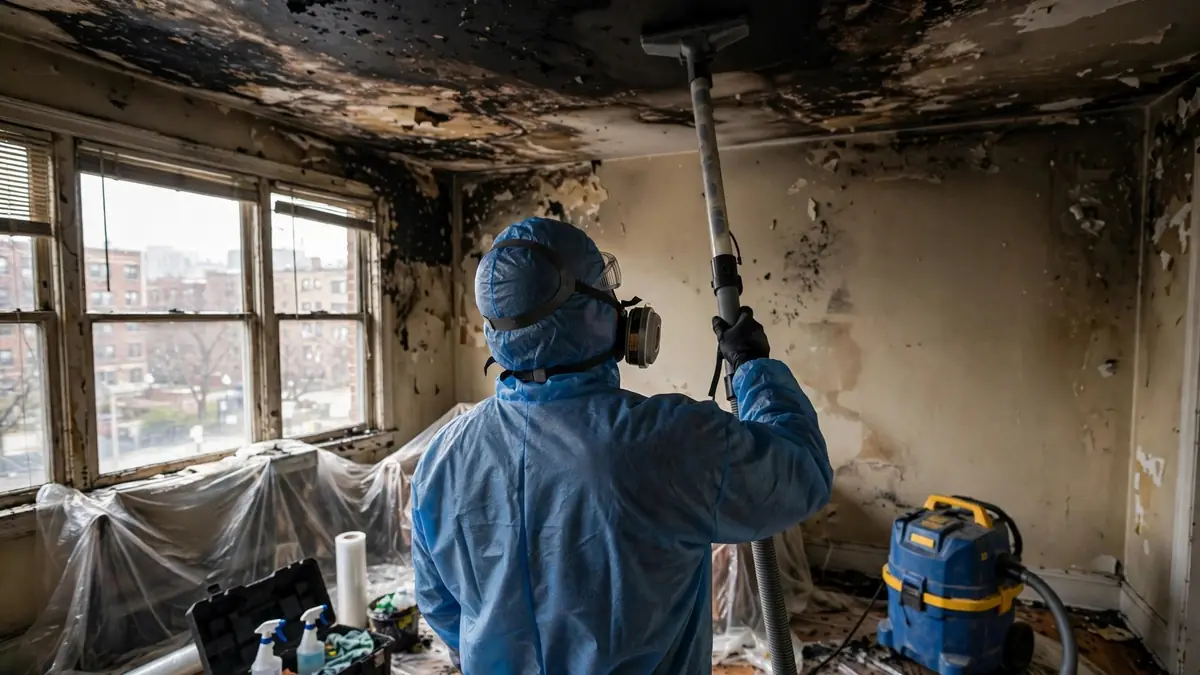
Key facts: Why Smoke Smell Lingers
- Odor comes from residue, so source removal comes before any deodorizing.
- EPA says ozone strong enough to treat odor is a health hazard [1].
- Warm weather can release odor that seemed gone.
Compare
Odor treatments, ranked by what they really do
| Approach | What it does | Limit |
|---|---|---|
| Removing residue | Takes away the source | Takes labor |
| Removing burned material | Deals with the worst sources | Requires repairs |
| Sealing cleaned surfaces | Locks in what remains | Only after cleaning |
| Air scrubbing | Cleans the air | Does not clean surfaces |
| Sprays and candles | Masks smell | Temporary |
Taking residue off before it is sealed in
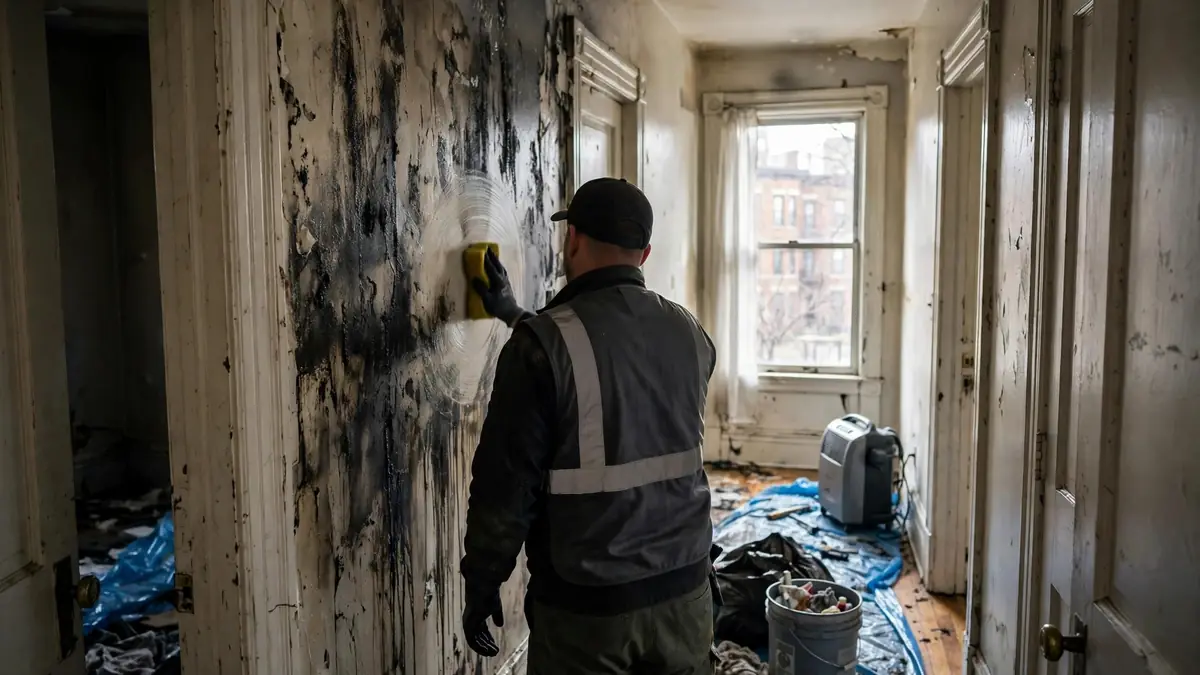
Hidden sources
Hiding spots for smoke residue
Check insulation, duct interiors, closets, the backs of cabinets and soft furnishings. Filters may need changing several times. See smoke damage cleanup.
Answer first
Why the smell does not simply air out
Smoke smell lingers because smoke is not only a gas. It is a mix of fine particles, oily residues and chemical vapors that settle on and soak into everything they reach. Those deposits keep giving off odor long after the air has cleared, so the smell comes back once a window is shut or the room warms up.
Opening windows removes the odor that is in the air at that moment. It does not touch the source. That is why a room can seem fine after a breezy afternoon, then smell strongly the next morning. The only lasting fix is to remove the residue, or remove the materials holding it, and then deal with whatever is left.
What burned matters a great deal. A house fire involves plastics, wiring, foam, finishes and synthetic fabrics. A kitchen fire leaves greasy, sticky residue. Wildfire smoke may come from outside and travel through vents and gaps, even when there has been no flame in the house at all. Each one calls for its own approach, so a single product is unlikely to fix all of them.
Absorption
Why some materials hold on to odor
Materials differ in how much smoke they take in, and in how hard it is to get back out.
- Fabrics and foamCurtains, cushions and mattresses have huge surface areas and take in odor quickly. Many fabrics respond to specialist cleaning, while foam can be harder.
- Carpet and padFibers trap particles and the pad underneath can hold odor well away from the cleaning tool.
- Unsealed wood and framingOpen grain soaks up vapors, which is why bare attic framing and studs near a fire can continue to smell.
- Drywall and flat paintPaint and paper are more porous than they look, so residue can be deep enough that wiping alone does not remove it.
- InsulationIts fluffy structure traps particles and vapor, and it is hidden from view. It can act as a slow, steady source of odor.
- Plastics and vinylThese can absorb odors and may discolor. Residue can also stay on textured surfaces.
- Glass, metal, sealed tileThese do not absorb much, but acidic residue left on them can etch or corrode with time.
Odor rebound
Why it comes back on warm or humid days
Many people notice a smell that seemed to have gone returning on the first hot day. Warmth increases how quickly trapped vapors come out of materials, and humid air can make them easier for you to notice. Heating season has a similar effect: the first time a furnace runs after a fire, it can warm up dust and residue in the ducts.
Your own nose plays a part too. People get used to a smell within a short time, and then smell it again after a day away. A return from a trip is often when someone realizes that the problem was never solved. So trust the first impression you get on walking in, and ask someone who has not been living there what they notice.
If the smell gets stronger after rain or when the air conditioner runs, the source may be near a vent, in a damp area, or in a material that was wetted during firefighting. Smoke and moisture can be two problems in one location.
The sequence
Removing the smell in the right order
Good results come from doing these steps in order. Sealing or deodorizing before cleaning usually wastes effort.
- 1
Make sure it is safe
Get clearance for any fire-damaged building. Keep people with breathing problems out while the work is underway.
- 2
Remove the burned and badly damaged materials
Charred wood, ruined insulation and other sources must go. Nothing else will work if they stay.
- 3
Clean contents and surfaces
Dry methods go first for dry soot, followed by wet cleaning where appropriate. The residue type determines the method. See smoke damage cleanup.
- 4
Clean the HVAC system
Have ducts, the air handler and coils inspected. Change filters more than once as cleaning kicks up dust.
- 5
Clean the hidden spaces
Check closets, cabinet interiors, attics, wall cavities near the fire, light fixtures and vents.
- 6
Deodorize what is left
Once the residue is gone, a contractor may use specialist treatments aimed at remaining vapors.
- 7
Seal where needed
A suitable sealer on cleaned framing or walls can lock in faint remaining odor, as long as the surface really was cleaned first.
- 8
Test in normal conditions
Close the house up for a day, run the heat or air conditioning, then come back in with a fresh nose.
Ozone
Ozone: useful in limited cases, and risky in the wrong hands
EPA is clear that ozone is a lung irritant, and that the ozone machines marketed as air cleaners pose health risks. The agency reports that ozone at safe levels has little ability to remove indoor pollutants, that it does not remove particles such as soot, and that its reactions can create irritating byproducts. Federal agencies have not cleared them for occupied rooms.
EPA also notes that high ozone levels may be used in some situations, including fire restoration, but only if people and pets are completely out of the space. Ozone can also damage rubber, fabric and other materials. Colorado's health department likewise advises the public to avoid air cleaners that produce ozone.
So don't buy an ozone machine for your bedroom. If a contractor proposes ozone, ask what cleaning will be done first, how long the space must remain empty, how it will be aired out afterward, and what materials could be affected. It should never be a stand-in for cleaning.
Reality check
Comparing common odor fixes
Here is what common products and methods can and cannot do. Ask any contractor which of these they plan to use, and why.
| Method | What it can do | What to watch for |
|---|---|---|
| HEPA air cleaner | Captures fine particles in the air | Does little for odors on its own; state health guidance pairs it with carbon |
| Activated carbon filter | Adsorbs odor-causing vapors in the air | Saturates and needs replacing; does not clean surfaces |
| Thermal fogging | A contractor may use it to reach small gaps with a deodorizer | Needs specific ventilation and handling, and the space must be empty |
| Hydroxyl generators | Some contractors use them for odor treatment | Ask how it fits with cleaning; results vary |
| Ozone | High levels are used in some empty-building restoration work | EPA warns of health risks; never in occupied rooms |
| Sealing primer | Locks odor in cleaned framing or walls | Only works over cleaned surfaces and not on wet materials |
| Vinegar, charcoal, baking soda bowls | May absorb small amounts of odor in the air | Very limited; do not treat this as a fix |
| Scented sprays and candles | Cover the odor for a short time | Add more chemicals to the air; candles are not a good idea in a recovering home |
Ducts and filters
HVAC systems keep moving the smell around
Your heating and cooling system pulls air from every room and passes it back through shared ducts. If smoke reached the return air during the fire, residue may be in the ducts, on the coil and in the air handler. Run the system and the odor travels with it, so a room with no visible soot can smell because of what comes out of its vent.
Colorado's health department suggests considering a MERV 11 or higher filter if your system can take it, and replacing filters as they clog or monthly for up to a year after the surrounding area is cleaned. It also suggests considering duct cleaning. Check with an HVAC technician before upgrading, because a denser filter can restrict airflow on some systems.
If the fire was significant, ask whether the system should run at all until it has been checked. A clean-up that ignores ducts tends to re-contaminate rooms that have just been cleaned. Keep a record of filter changes, since dirty filters soon after cleaning can tell you whether the source still exists.
No fire in your home
Smoke from elsewhere: neighbors and wildfires
You can have a real smoke odor problem without a fire inside your walls.
- Wildfire smokeFine particles enter through gaps, vents and open windows. State health guidance recommends HEPA filters for particles and activated carbon for odor-causing compounds, and running them until smells go away.
- A neighboring unit or attached homeSmoke can travel along shared attics, plumbing chases and wall cavities. Check spaces next to the shared wall.
- Furnace or chimney puff-backAn oil burner or blocked flue can put soot through the house. Have the equipment checked before relighting. A sudden soot problem with no flame is worth an urgent inspection.
- Cigarette residueLong-term smoking leaves a sticky film on walls, ceilings and ducts. It is a different residue from fire, but it follows the same remove-then-seal logic.
- Candles and fireplacesFine soot can settle in lines along walls and carpet edges. Check that fireplaces draw correctly.
Contents
Clothes, furniture and keepsakes
Many belongings can be rescued, but the order matters. Remove them from the smell first, because a clean item put back in a smoky room will pick the smell back up. Contractors often clean contents off-site or in a separate clean area, then store them until the house has been finished.
For clothes, wash or dry-clean according to the care label, and do not dry anything in a machine until you are sure the odor has gone, since heat can make it harder to shift. Items with heavy soot should be shaken out outdoors or vacuumed first, wearing a mask, since water can drive soot into fibers. Consider a specialist for wedding dresses, leather, furs, antiques and artwork.
Electronics are worth a separate word. Soot can be corrosive and can settle inside devices. Keep them unplugged until someone has checked them. Papers and photos may need conservation advice if they are irreplaceable, and it is worth photographing or scanning them as soon as you can. A sensible rule of thumb: start with what cannot be replaced.
Health
When the smell is telling you more than you think
Don't treat a smell as just an annoyance if people feel unwell. Lingering smoke residue may contain irritating chemicals, and exposure can bother the eyes, nose and throat. People with asthma, heart disease or lung disease, along with children and older adults, are most likely to feel the effects. For labored breathing, chest pain or other severe symptoms, seek medical care. Mention the fire to a doctor.
A strong odor may also be a sign that a material is still off-gassing or that a fire-damaged item was missed. If symptoms improve when you leave the house, take that seriously. Staying with family or asking your insurer about temporary housing may be appropriate while the source is dealt with. The first 24 hours guide has more on that part of the process.
Hiring
Questions for a contractor about odor
Answers to these will tell you whether someone is treating the cause or the symptom.
- How do you identify the type of residue, and what cleaning method follows from it?
- What will be removed, and what will be cleaned in place?
- Are the ducts, attic and wall cavities in your plan?
- Do you follow the ANSI/IICRC S700 fire and smoke standard, or another named reference?
- What deodorizing methods will you use, and what are the safety steps for each one?
- What happens if the smell comes back after you finish?
- How long must the household stay out, if at all, and when is it safe to return?
- How will you document what was done in each room?
Proof
How to know it worked
There is no widely used home test for odor, so use a simple human test.
- Close all windows and run your HVAC normally for a full day.
- Leave for several hours, then walk back in and pay attention to the first few seconds.
- Open closets, cabinets and drawers, and sniff inside.
- Ask a friend who did not live through the fire to walk through.
- Check again after the first hot, humid spell, and again at the start of heating season.
- Look at a fresh HVAC filter a few weeks later for unusual dark deposits.
Residue types
What the kind of smoke tells you
Contractors often sort residue by what burned, since this affects both smell and cleaning. These are general descriptions rather than lab results.
| Likely source | What it can look and feel like | Why it lingers |
|---|---|---|
| Wood, paper or other natural materials | Dry, powdery, grey or black | Fine dust travels widely, into small gaps |
| Plastics and synthetics | Black, smeary and sticky | Film resists wiping and can smear when touched |
| Kitchen protein fire | Thin yellowish film, little visible soot, very strong smell | Hard to see, so surfaces get missed |
| Furnace or oil puff-back | Fine, oily black soot, often throughout the house | Oily film spreads through ducts and sticks to surfaces |
| Wildfire smoke | Fine dust, ash on sills and filters | Enters through gaps and vents, and can persist in fabrics and HVAC |
Protein smoke
Kitchen fires deserve special attention
A burnt pot of food can create one of the most stubborn odors of all. Protein smoke can leave a thin, nearly invisible film on cabinets, walls and appliances. People often believe that a kitchen fire was too small to matter, since no walls burned, then spend months trying to get rid of a sour, sharp smell.
The cleaning method makes a difference. Because the film is hard to see, it's easy to miss the insides of cabinets, the tops of door frames, light fixtures and range hoods. Grease can also hold the smell, so filters and fan housings have to be cleaned or replaced. If a home-cleaning attempt has not fixed the smell after one careful pass, ask for advice, as repeatedly wiping surfaces without the proper product may smear the residue instead of removing it.
Search
A room-by-room sweep for residue
Bring a flashlight and a white cloth or dry cleaning sponge, and look at these places. Wear gloves, and keep away from any area you've been told not to enter.
- Living areasTops of curtains, lampshades, and upper walls and ceilings, where smoke rises and settles.
- BedroomsClosets, mattresses and pillows. Fabrics can hold smoke even when they look clean.
- KitchenInside cabinets, the range hood, the back of the refrigerator and the tops of cupboards.
- BathroomsExhaust fans, shower curtains and towels. Fans may have pulled smoke into their housings.
- Attic and basementInsulation, exposed framing and stored items, especially near the fire.
- Mechanical spacesFurnace, air handler and return grilles, along with filters.
- Garage and vehiclesCars parked nearby can draw in smoke, and seats and carpets can hold the smell.
Follow-up
If the smell comes back after the job
A returning smell doesn't always mean the job failed, though it does mean something remains.
- 1
Write down the conditions
Note the time, weather, whether the heat or air conditioning was running, and where it was strongest.
- 2
Check the easy things
Change the HVAC filter and clean or empty anything you brought back into the home.
- 3
Isolate the source
Take contents out of a room or close it off, and see whether the smell changes.
- 4
Call the contractor back
Share your notes and ask about the areas that have not been addressed. Check what your written agreement says.
- 5
Bring your insurer in on an open claim
If a problem persists, ask how to raise it and supply your notes.
- 6
Ask about another approach
Sealing or further cleaning may help, but only if the plan explains why this time will be different.
Questions
Stubborn smoke odor questions
How long will it last without treatment?
It can persist for a long time and tends to return with heat and humidity.
Is it safe to stay there?
If smell is strong or you have symptoms, stay elsewhere and ask a doctor.
Will painting over the walls fix smoke smell?
Ordinary paint will not. A specialized sealing primer can help after thorough cleaning, but paint alone over residue tends to let odor bleed through, and new paint may not bond well to dirty surfaces.
Do air purifiers remove smoke smell?
They can help with what is in the air. Look for activated carbon as well as HEPA filtration. They do not remove residue from surfaces, so they support cleaning and do not replace it.
Does vinegar work?
Bowls of vinegar or baking soda might slightly reduce odor in a small space, but will not remove residue. For anything beyond a very minor kitchen incident, they are not a real fix.
Why does only one room still smell?
Something in that room, or something connected to it by a duct or wall cavity, probably still holds residue. Check the closets, the vent and the wall shared with the fire area.
Can I wash soot off walls myself?
Light residue from a minor incident can sometimes be cleaned, but wiping heavy soot with water can smear and set it. Ask for advice before you start on anything beyond a small area.