Key facts: Board-Up and Tarping
The short answer
Why it comes first
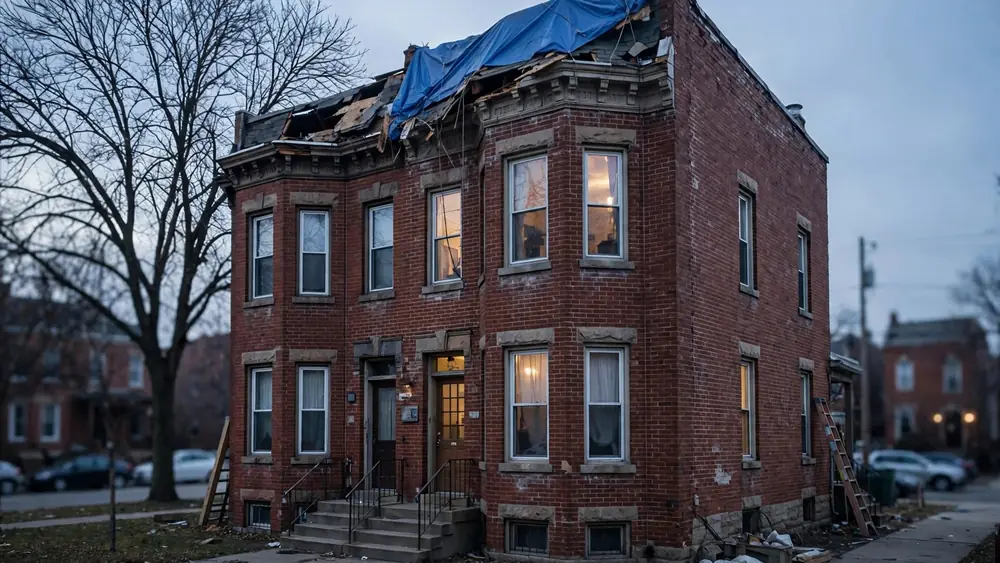
An opened roof lets each new rain add water damage to what the fire or storm already did. Open windows also invite theft and weather. Closing the building first stops the loss from growing while bigger decisions get made.
Screws into framing hold better in wind than nails into trim. On older houses, careful fastening can help preserve original window sashes for later repair. Nobody should climb a damaged roof without proper training and gear.
A tarped roof after fire
Next steps
What follows the plywood
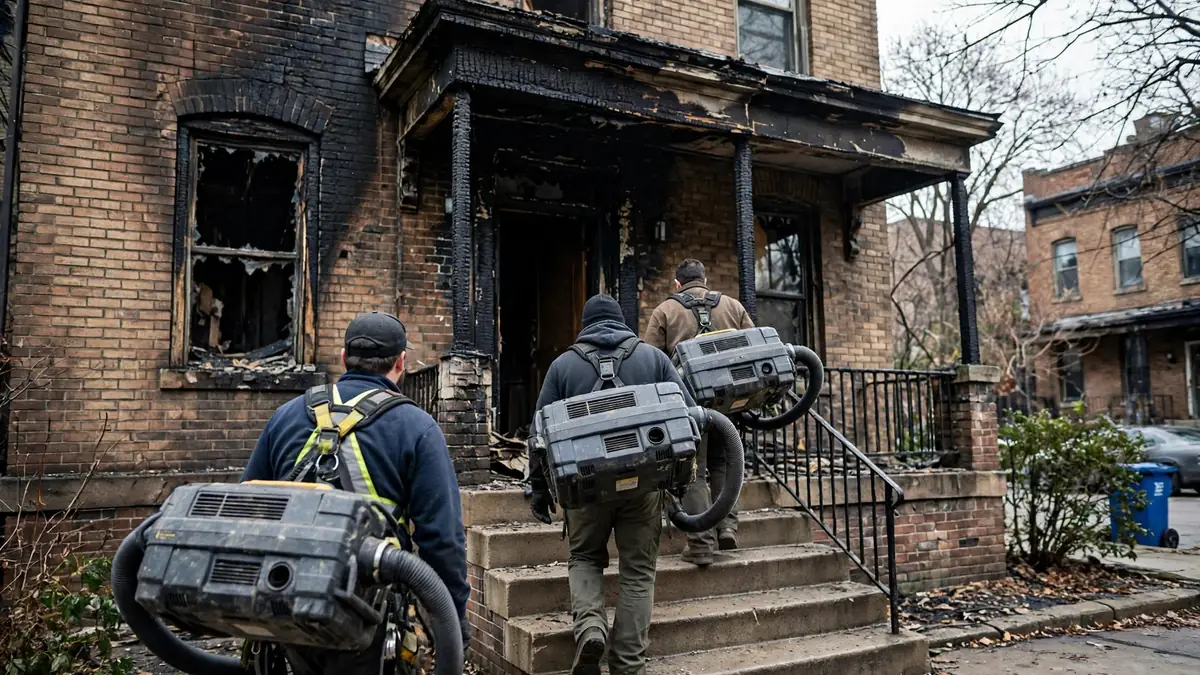
Once the building is secure, the work moves to fire damage restoration or, after a storm, water damage restoration. Keep receipts for this work, and share photos with your adjuster.
Plywood going on
What happens
How the work is done
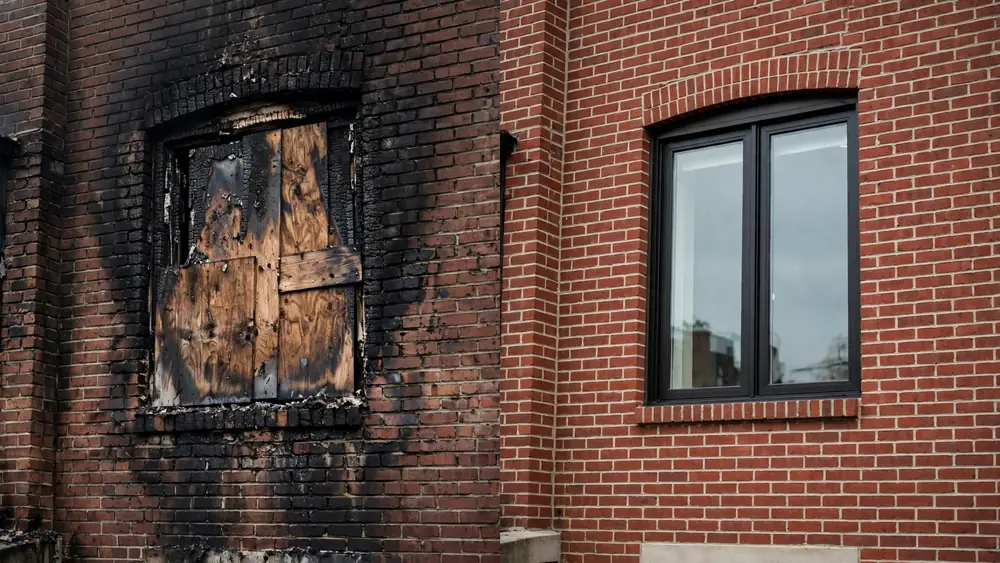
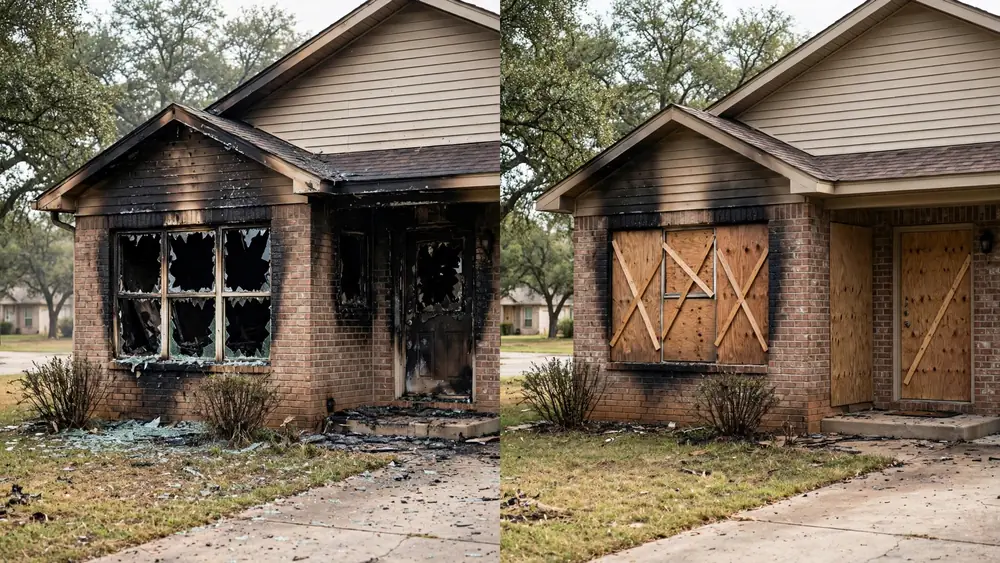
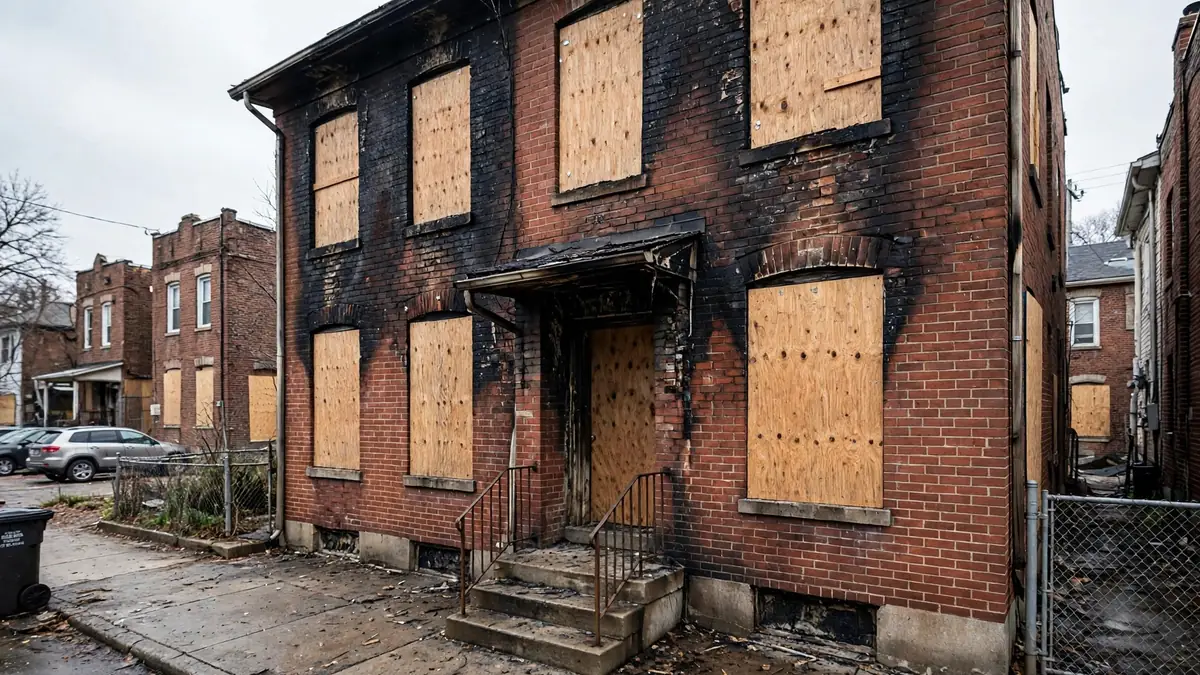
The crew measures each opening, cuts plywood to fit and fastens it to solid framing so it will not loosen in wind. Doors may get a hinged panel so workers and owners can enter while the rest stays locked. Glass and debris are cleared from sills to keep edges from cutting the sheet or people.
On roofs, heavy tarps are stretched past the damage and over the ridge, then anchored with battens so wind cannot get beneath them. Sandbags may be used on roofs that should not take fasteners.
Checklist
Before the work starts
- Take photos of every opening and roof area you can see from the ground.
- Remove valuables if officials allow you inside.
- Tell the crew about any pets, tanks or hazards.
- Ask for a written description and receipt for your claim.
- Find out who keeps the key to any new lock.
Afterward
Looking after a closed-up house
Check the house after storms, and keep an eye on tarp edges for flapping. Tell your insurer if the home will be vacant, because vacancy can affect coverage. Have utilities reviewed before anyone turns them back on. Boarded windows also block light and airflow, so damp rooms may need a drying plan.
Storms
When wind is the cause
After hurricanes and hail, roofers may be scarce and people may knock on your door offering help. Check credentials, avoid signing anything under pressure, and call your insurer first. Our Port Charlotte and Louisiana pages discuss storm patterns there.
Is this what you need?
When a house needs boarding up or tarping
You likely need this when a window, door or roof section is open to weather or entry. A cracked pane that still seals may wait for a glazier, but a hole in the roof should not wait for the next forecast. Temporary protection is also what insurers commonly expect while a claim is reviewed.
Ask how panels will be attached. Careful placement can protect window frames and siding you want to keep.
Compare
Choosing the temporary fix
| Problem | Usual fix | Check afterward |
|---|---|---|
| Broken window | Fitted plywood | Fasteners after wind |
| Damaged door | Panel with secure access | Who holds the key |
| Open roof | Heavy tarp with battens | Edges and pooling |
| Fire-damaged wall | Bracing and sheeting | Official safety review |
Questions
More questions about board-up
How long can a tarp last?
It is a short-term fix. Sun and wind wear it down, so plan the permanent repair and check it regularly.
Can I do it myself?
Ground-level windows may be manageable. Roofs, heights and fire-weakened structures are better left to professionals.
Do I need permission to board up after a fire?
Check with the fire department that the scene has been released first.
Guides
Guides for this job
Opening by opening
What each kind of opening needs
A standard window is the easy case: one sheet, cut slightly larger than the opening, fixed into the surrounding framing. Bay windows are harder because each angled face needs its own panel, and the small roof above the bay may be damaged too. Sliding glass doors are wide enough that a single sheet may not span them, so two panels are usually joined over a stud or a backing board.
Skylights belong with roof work rather than window work. Plywood over the curb stops the rain only if the tarp or membrane laps above it, since water running down the slope will otherwise slip underneath. Garage doors that have buckled are often braced from inside and sheeted, because the track and springs can still hold stored tension. Nobody without garage door training should release that tension.
Basement hopper windows get forgotten. They sit low, they are easy to climb through, and rain collects in the window well. Mention them when you call, along with any pet doors, attic vents and crawlspace hatches that were knocked open.
Materials
What a sound temporary closure is made of
Ask about the materials before work begins, because a closure is only as good as its weakest part.
- Exterior-grade plywood or OSBThick enough to resist a shoulder or a gust, and cut to lap past the opening on every side. Thin paneling and cardboard do not count as a closure.
- Screws rather than nails where possibleThey grip better and back out cleanly, which leaves less patching on trim you plan to keep.
- Through-bolts on some jobsLong bolts running through a brace inside the opening avoid any holes in brick or stone, and they cannot be undone from outdoors.
- Reinforced tarp with sealed edgesWoven, heavy-duty sheeting with hems and grommets outlasts the thin kind sold for covering a woodpile.
- Wood battensStrips rolled into the tarp edge and fastened spread the load. Grommets alone tend to tear in wind.
- Hasp and padlock on the access panelOne opening should still work as a door, with the keys tracked on paper.
Roof work
How a roof tarp keeps water out
Water moves downhill, so the top edge of the tarp decides whether the job works. A sound installation carries the sheet up and over the ridge and down a little way on the far side, leaving no seam for water to enter from above. Where a damaged area sits low on a long slope, the tarp still normally runs all the way up, even though the hole is far below.
The bottom edge has a different job. It needs to shed water past the eave rather than funnel it into the soffit or the gutter. Slack is the enemy on both slopes, because a loose sheet slaps in the wind and works its fasteners free, and a dip holds a pool heavy enough to stress weakened decking.
Roof covering changes the method. Asphalt shingles accept battens with little fuss. Clay and concrete tile can crack under foot and may need to be lifted or walked on with care. Metal panels are slippery, and fasteners through them create new leak points, so sandbags or clamps are sometimes chosen. A flat roof has no ridge to lap, which is why temporary membrane or a sealed patch is often used in place of a tarp.
Water that has already entered does not leave when the tarp goes on. Wet attic insulation and sagging ceiling drywall keep holding it, and a ceiling leak can continue dripping for a while after the hole is closed.
Why it happened
How the cause changes the closure
The steps look alike from the street, but each cause raises its own questions.
After a house fire
Firefighters often break glass and cut roof vents on purpose, to release heat. Those openings can be larger than the fire damage suggests, and framing near them may be charred. The crew needs clearance from the fire department before fastening anything.
After wind or hail
Damage is spread across the roof and may include lifted shingles that look fine from below. Debris on the ground can hide nails, and neighbors may all be calling at once.
After a fallen tree
The tree normally has to come off first, and that is a job for a tree service. Limbs may be holding up damaged framing, so removal and covering need to be sequenced together.
After a break-in
The building is sound but the door or window is not. Police may want to see the scene first, so ask before anything is repaired. Then the concern is a closure that cannot be pried.
After a vehicle strike
A car through a wall can disturb a load-bearing section. Bracing may be needed first, and a building official or engineer may have to look at it before the opening is sheeted.
The call
What to have ready when you phone
Calling (833) 610-0241 puts you through to an independent local contractor. A few details help that person plan what to bring.
- 1
Where the building is
Give the full address, plus the side of the house facing the street if that helps locate the damage.
- 2
What is open
Count the broken windows and doors, and describe any roof hole in rough terms, such as the size of a door or the size of a car.
- 3
How high it is
Say whether the opening is on the ground floor, the second floor or the roof, and how steep that roof looks.
- 4
Who released the scene
Tell them if fire or police officials are still there, or have already said the site can be touched.
- 5
What the weather is doing
Rain or wind in the forecast changes the order of the work, so check before calling.
- 6
Who can sign
If you rent, your landlord or property manager usually has to approve any work on the structure.
Who decides
Who to ask about which question
Several people have a say in a damaged building, and asking the right one first avoids rework.
| Question | Ask | Why them |
|---|---|---|
| Can anyone go inside? | Fire department or building official | They control access to an unsafe structure |
| Is the wall or roof about to fail? | Building official or structural engineer | A closure crew does not certify structure |
| Does the power need cutting? | Electric utility or electrician | Wires may be damaged or still live |
| Is this work covered? | Your insurer or adjuster | Coverage turns on your policy wording |
| Is a permit required? | Local building department | Rules vary between towns, and temporary work is often treated differently |
| Can the panels stay up on this street? | Landlord, association or historic commission | Some places have their own rules on appearance |
Rentals and shared walls
Board-up in apartments, duplexes and storefronts
In a rented home, the building belongs to the landlord, so damage to the structure is usually theirs to close, while your belongings are a matter for your renters policy. If you cannot reach the owner and rain is coming in, write down each attempt and tell the fire department or the city what is happening.
Attached buildings add a complication, since a hole in one unit can let water, cold air or people into the next. Tell the contractor about shared walls, common stairs and shared attics, which often connect units in older buildings.
Business owners have other concerns. A storefront panel has to deal with the sidewalk and with fire exits, because an exit door must not be closed off while people are inside. Ask the local fire marshal if you plan to keep working in part of the building, and keep customers out of any section that has not been cleared.
Stay safe
Hazards to stay clear of while waiting
Waiting is hard when rain is on the way. These risks are the ones to respect.
- Do not lean a ladder near a wire that a storm or a fire may have damaged, and report any downed line to the utility.
- Keep off a roof you cannot inspect from below. Burned or soaked decking may look whole and still give way.
- Run a generator outdoors only, more than 20 feet from windows, doors and vents, as CDC advises, because carbon monoxide has no smell.
- Watch for broken glass in carpet and in garden beds, and wear hard-soled shoes.
- Do not reconnect utilities yourself, which is plain advice from Ready.gov after a home fire.
- Stay out from under a ceiling that bulges. Trapped water can bring it down without warning.
Short window
Protecting the house until a crew arrives
If you can do it from the ground and without entering an unsafe structure, a few modest steps help. Move furniture away from a broken window, set buckets under drips and pull rugs out of the path of water. Taping a cracked pane can keep the pieces from falling, though it does nothing to secure it.
Do not wait for an adjuster's visit before closing the building. Insurers commonly expect prompt steps to limit further loss, and photographs taken first show what the storm or fire did. Keep any damaged parts you remove, such as a broken sash or torn flashing, until your claim is settled or your adjuster tells you they are not needed. Ready.gov makes a similar point after a home fire: do not throw out damaged goods until they have been inventoried.
Storm season
When many roofs are damaged at once
After a major storm, local crews may be stretched thin, and out-of-area workers often arrive within days. That does not make them bad, but it does call for care. Ask for the company's full name, a local contact and proof of insurance. Be wary of anyone who wants a signature on a long-term contract just to put a tarp up. A temporary closure and a full roof replacement are separate decisions and do not need to be signed together.
After some declared disasters, the federal government has run a temporary roofing program through the Army Corps of Engineers, known as Operation Blue Roof. It runs only when activated for a specific event, so check with your local emergency management office to see if it applies to you.
Good closure, bad closure
How to check the finished work
You do not need a ladder to judge much of it. From the yard, every panel should sit flat, with no gaps a hand could fit through and no flapping corners. On the roof, look for a tarp that is smooth and that runs over the ridge, with battens that are straight and evenly fastened.
Indoors, check for new drips during the next rain, and look for daylight around panels. Walk the perimeter and try each panel by hand from the ground. A closure you can move is a closure someone else can move. Take dated photographs of the finished work from each side, since those show what condition the property was in if anything changes later.
Taking it down
What happens when the panels and tarps come off
Temporary work ends in stages. Roofers generally pull tarps section by section as they work, so the structure is never fully exposed. Window panels usually stay until the replacement units are ready to go in, which can take a while when custom sizes or historic sashes are involved.
Ask who will remove the closure and who fills the fastener holes. Those details are easy to leave out of a first conversation. Screw holes in trim are simple to patch, but holes through a tile roof or stucco need proper sealing or they become the next leak. Once the panels are off, walk through the building with fresh eyes, since rooms that were dark may reveal staining or mold that nobody could see earlier.
Vacant buildings
Keeping an empty, closed-up house in good order
A boarded house can sit for weeks while a claim and a rebuild get sorted out. These habits limit further trouble.
- Visit on a set schedule and after each storm, and keep a dated note of what you find.
- Ask your insurer in writing how long the home can sit empty, since vacancy clauses are common.
- Have the water shut off and the lines drained if the heat will be off in freezing weather, on the advice of a plumber.
- Remove anything flammable left behind, and take valuables off the site as soon as officials allow.
- Tell neighbors who to call, and ask them to mention anyone they see around the property.
- Clear mail and flyers, since a pile signals that no one is around.
- Check the air inside. Closed rooms hold moisture, so a musty smell calls for a look at mold prevention after water damage.
Practical answers
Board-up questions owners ask on the phone
Does plywood damage my window frames?
It can if panels are screwed into the trim, but fixing into solid framing or using an inside brace limits this. Tell the crew which frames you want kept.
Will rain stop the tarp crew?
Light rain may not stop the work, but wet roofs are slippery, and lightning or strong wind can push it back. The contractor decides based on safety at the site.
Will I be able to get into my house afterward?
Usually, through one panel fitted with a hasp and lock. Ask for a key, and agree who else holds one.
Should I board up before my insurance company comes?
Generally yes, after taking photos. Tell your insurer what you are doing, and keep every receipt.
What if the fire department already put boards up?
Ask who placed them and whether they are meant to stay. Some are rough emergency measures that should be replaced with a fitted closure.
Do boards make my home more of a target?
They do announce that a house is empty, which is one reason for regular visits, good locks and a neighbor who knows the situation.
Service areas
Board-Up and Tarping service areas
Where you live changes board-up and tarping. See Oregon, Connecticut, Delaware, Kansas, Louisiana, New Hampshire, Chicago, Dallas, Colorado Springs, Cedar Hill, Lake Stevens, Norcross, Port Charlotte, Prosper, Atlanta, Indianapolis.
Urgent?
If this is happening right now
Go straight to the first steps: emergency roof leak services, emergency board-up services.