
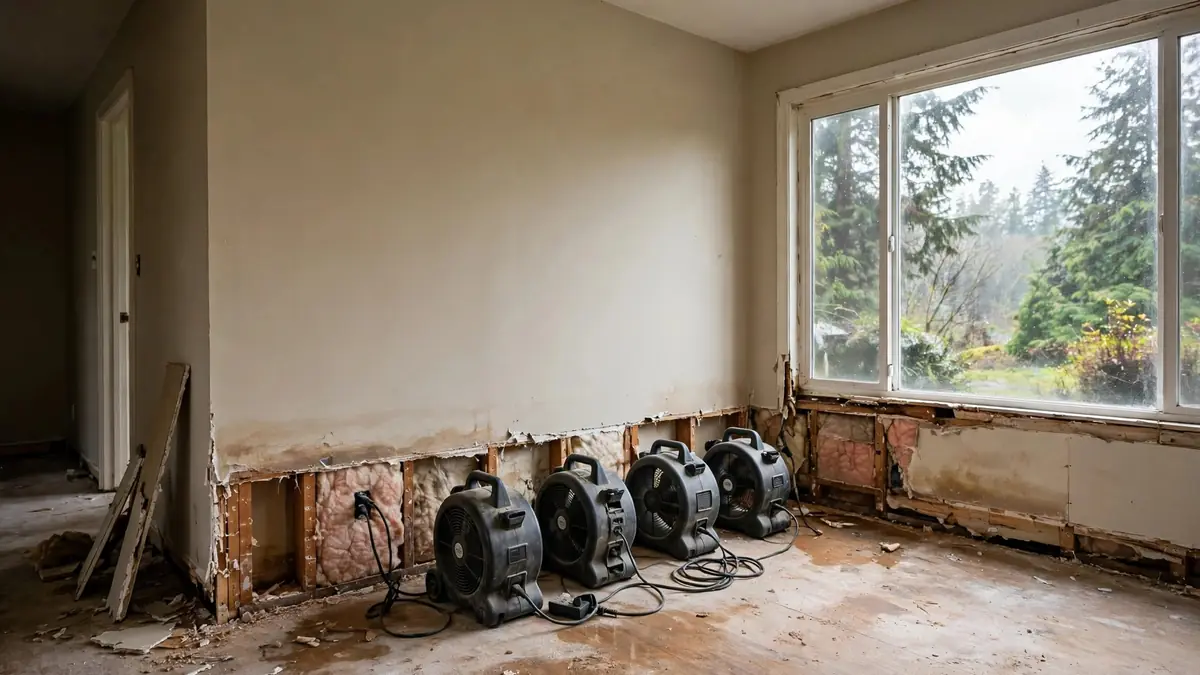
Key facts: How Long Drying Takes
What changes it
Why some jobs take longer
Drywall gives up water fairly quickly. Hardwood, plaster, concrete and fieldstone hold it much longer. Cold basements and humid regions slow evaporation, and so do closed wall cavities.
Contaminated water adds tear-out and cleaning before drying can start.
Why dense layers dry slowly
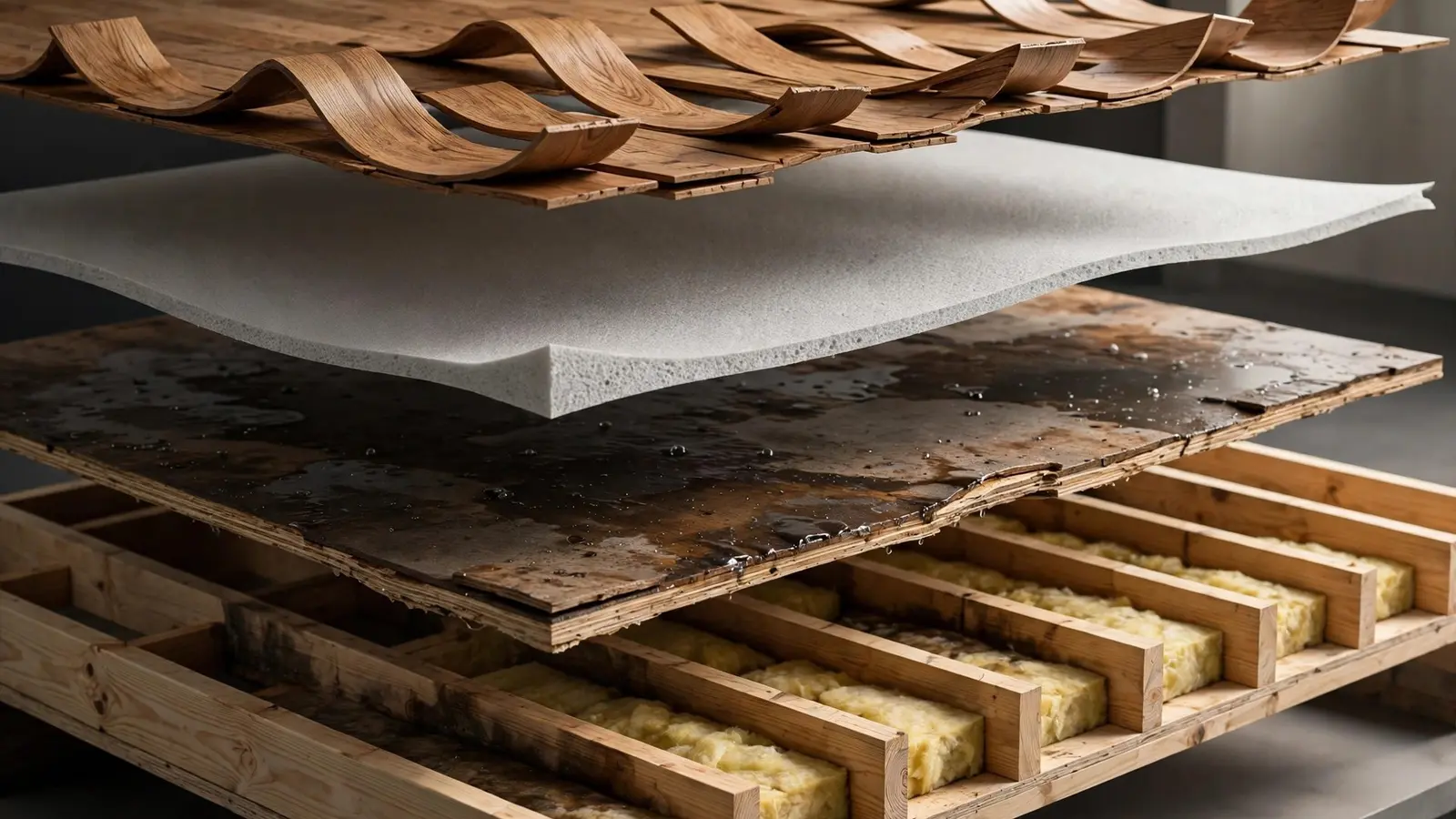
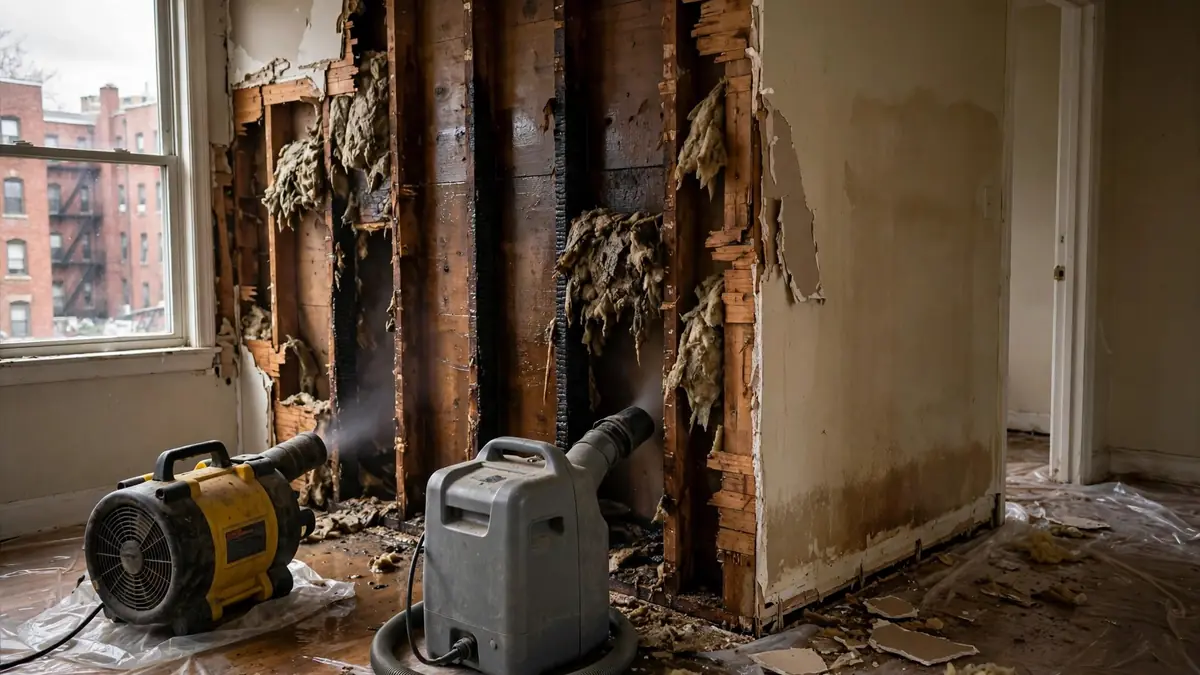
Opening a wall can shorten the wait
Knowing it is done
Dry means a reading, not a feeling
Good contractors compare wet materials against an unaffected reference spot and keep a log. Ask for it. Closing a wall too early is the most common source of later odor and mold. More on the process is on the structural drying page.
Answer first
The honest answer on drying time
A typical indoor leak that gets prompt attention often takes several days of equipment time. Larger losses, dense materials, and rooms with poor access can take much longer. Nobody can give you a real finish date until the wet materials have been measured, because the date depends on how much water went in and what it went into.
Two different clocks get confused. The first is EPA's 24 to 48 hour target for drying wet items, which exists to limit mold. The second is how long it takes the whole assembly, framing and subfloor included, to return to normal. You want drying to be well underway inside the first clock, but the second one will often run past it. EPA calls 48 hours only a guideline, since mold can show up sooner and may not show up after it.
Equally important: drying is rarely the only thing on the schedule. Removing wet materials, cleaning contaminated areas, waiting for an adjuster, and rebuilding each add their own time. Be sure you know whether someone is talking about drying alone or the whole job.
By material
What each material tends to do
Treat these as relative comparisons and not as promised durations. Actual time depends on conditions and on how the material was built in.
| Material | How it usually behaves | What slows it |
|---|---|---|
| Drywall, painted and open to air | Among the quicker materials to give up water | Vinyl wallpaper, gloss paint, wet insulation behind it |
| Wood framing | Moderate; thicker pieces take longer | Closed cavities, cold temperatures |
| Plywood and OSB subfloor | Moderate to slow; OSB edges can stay swollen | Finished flooring on top |
| Hardwood flooring | Slow, and must be dried with care | Moisture trapped under boards, cupping risk |
| Plaster on lath | Slow, with many layers | Multiple coats, old assemblies |
| Concrete slab or block | Slow; can release moisture long after the surface looks dry | Thickness, cold, sealed surfaces |
| Stone foundation walls | Slow and variable | Ground moisture, limited airflow |
| Insulation | Fiberglass and cellulose are often replaced rather than dried | EPA lists both as discard and replace in clean-water events |
Physics
The four conditions that set the pace
Drying is the movement of water from a material into the air and then out of the building. Four things control it: air movement across the surface, the humidity of the surrounding air, temperature, and how freely the material lets water travel to its surface. Change any one and the timeline changes.
Air movers break up the thin layer of damp air sitting on a surface. Dehumidifiers remove water from the air so that it keeps pulling more from the materials. Warmth speeds evaporation. A fan with no dehumidifier in a closed room simply spreads damp air around, and a dehumidifier with no airflow leaves damp pockets near the floor.
Material permeability is the part you cannot rush. Water moves through dense materials slowly, regardless of how hard air blows across the surface. That is why hardwood or concrete can be the last items left on a drying log. The structural drying page goes into equipment choices.
Delays
What adds days to a job
If your job is running longer than expected, one of these is commonly the reason.
- The source was not fully stoppedA slow leak still feeding the area can make drying look stalled. Readings that will not drop may point to this.
- Water got into closed spacesWall cavities, soffits, toe kicks under cabinets and crawlspaces get little airflow until opened or ventilated.
- Layered flooringEach added layer, such as tile over old vinyl over plywood, traps moisture and slows its escape.
- Wet insulation staying in placeIt keeps water pressed against framing and drywall, so it is often removed to let the rest dry.
- Humid or cold weatherOutdoor air in summer humidity or a cold basement slows evaporation. Open windows can help or hurt depending on the day.
- Contaminated waterRemoval and cleaning have to happen before drying can get going in earnest. See the water categories guide.
- Interrupted equipmentTurning units off overnight, unplugging them, or closing them in a room with the door shut resets progress.
- Waiting on approvalsSometimes the holdup is paperwork, or a question about what can be removed, more than the water itself.
Scale of the job
The S500 classes and what they suggest
Contractors may use the term 'class' to describe how much water has to evaporate. It is separate from water category, which describes contamination. The summary below is general, since the standard itself is the formal reference.
| Class | Rough meaning | What it tends to mean for drying |
|---|---|---|
| 1 | Least water; little absorbed | A smaller evaporation load and less equipment |
| 2 | A whole room affected, carpet and some wall wicking | More air movers and more dehumidification |
| 3 | Water has soaked in from above, or through walls and ceilings | A greater evaporation load |
| 4 | Water is bound in dense materials such as hardwood, plaster or concrete | Specialty drying, usually with longer timelines |
Day by day
What a normal drying week looks like
Your job may move faster or slower. This shows the rhythm of a clean-water job in a typical home, and is not a schedule for yours.
- 1
First visit
The contractor finds the wet boundaries, extracts water, removes what cannot be dried, sets equipment and takes starting readings.
- 2
Early days
The biggest drop usually happens early on, as surface water leaves and air humidity falls. The contractor checks readings and moves equipment.
- 3
The middle stretch
Progress slows as remaining water has to travel out of dense materials. Equipment may be repositioned or changed, and that is normal.
- 4
Final checks
Materials are compared with an unaffected reference. Equipment comes out room by room as areas reach target.
- 5
Handoff
You receive the final readings, then repairs can begin. If possible, ask for a copy of the moisture log for your records.
Middle of the job
Why the equipment can run for days with little visible change
Homeowners often worry during the slow middle. The carpet feels dry, the air seems fine, and the machines are still running. That can be perfectly reasonable, because a surface that feels dry may be covering a stud or subfloor that is still well above normal.
The fair way to judge is numbers over time. A moisture log should show each monitored point moving toward the reference reading. If numbers have stayed flat for several visits, ask why. The reasons can be legitimate, such as a thick material or an unopened cavity, but they may also mean a hidden source or poorly placed equipment.
Do not ask the contractor to remove equipment early because of noise or heat without first getting an explanation of what remains wet. If living with the noise is really not practical, ask about alternatives. The hidden moisture guide explains how those readings are taken.
Your part
How to help things along at home
Small choices during a drying job make a real difference.
- Leave equipment running and in place unless the contractor says otherwise.
- Keep the windows closed if dehumidifiers are running, unless you have been told otherwise.
- Keep interior doors in the position the contractor asked for.
- Keep your HVAC set the way you were advised. Ducts can spread contaminated air if the water was not clean.
- Do not add moisture by mopping or steam cleaning during drying.
- Move belongings off wet floors and away from walls so air can reach them.
- Report new wet spots, new smells or tripped breakers right away.
- Ask where the dehumidifier's drain hose goes and check that it is not kinked.
Harder spaces
Drying a basement, crawlspace or older house
Below-grade spaces take longer as a rule. Concrete and masonry walls are in contact with the soil, the air is cool, and there may be little ventilation. Moisture can keep arriving from outside even after the visible water has been removed. If a flooded basement is also getting groundwater, drying may not make real progress until the water source is under control.
Crawlspaces add limited access and exposed soil. Older homes bring plaster, thick framing and old finishes, which release water slowly and can be damaged by aggressive heat or airflow. EPA also warns to be careful using heat on hardwood floors. Older materials may contain lead or asbestos too, which affects what can be opened up for drying.
Climate plays a part. A humid coastal summer and a dry mountain winter call for different tactics, and that is one reason a good contractor adjusts the plan to what today's readings show.
When to ask
Warning signs that it is taking too long
Delays are not always a problem. These specific signs are worth raising, though.
- No written readings, or the contractor cannot tell you what target they are drying to.
- The same numbers on several visits with no change to the plan.
- A musty smell that grows stronger during drying.
- Visible mold, stains spreading or paint newly bubbling.
- Wall cavities that were never opened or checked despite wet readings at the base.
- Equipment that has sat unattended without any check-in.
- Repairs being scheduled before anyone has confirmed the area is dry.
Risk of rushing
What happens if drying stops too soon
Closing up damp materials is where most later trouble starts. New paint can peel, new flooring can cup or buckle, and an enclosed damp wall can grow mold with no visible sign for some time. EPA notes that mold may be hiding on the back side of drywall and under carpets and pads.
Rebuilding a little later is usually much easier than tearing out new finishes. If a drying schedule conflicts with a move-in date or a contractor's calendar, ask what the risk is, then write down the answer. A final dry record protects you with insurers and with the next contractor who works on the home, and it can be useful if you ever sell.
Questions
Timing questions people ask during drying
Can I just open the windows instead?
It depends on the air outside. Dry, breezy weather can help, but humid outdoor air can add moisture. Once dehumidifiers are running, windows usually stay closed.
Can the job be sped up by adding more machines?
Up to a point. More air and dehumidification help early on, but dense materials release water at their own speed. More machines do not change that much.
How long does it take after sewage or floodwater?
Longer overall, since contaminated materials must come out and be cleaned first. Drying is only one stage in the work.
How will I know it is done?
Ask for final readings on each affected area, compared with an unaffected reference spot in the same material.
Will a home dehumidifier be enough?
It can help with a damp spot or to maintain humidity afterward. EPA's humidity advice tops out at 60 percent, with 30 to 50 preferred. It is often not enough on its own for soaked structural materials.
Is living at home during a dry-out realistic?
Often yes after a clean-water loss, if the home is safe and power is working. After contamination or when mold is present, ask the contractor and a doctor if anyone in the house has health concerns.
Scenarios
How common leaks tend to compare
These comparisons show why two leaks in the same house can run on different schedules. They describe relative difficulty only, and your readings decide the actual length.
| Scenario | Why it is easier or harder |
|---|---|
| Sink overflow on tile, found right away | Little absorption, open room and few layers: usually among the simplest |
| Supply line leak behind a kitchen wall | Cabinets and toe kicks block airflow, so access takes most of the effort |
| Upstairs bath leak through a ceiling | Water travels through insulation and framing, and affects two levels |
| Slow leak under a floor for weeks | Materials are deeply wet and may already have damage or growth |
| Basement seepage on a concrete slab | Dense masonry, cool air, and possible continued moisture from the ground |
| Whole-floor pipe burst | Large evaporation load and many wet surfaces, so more equipment and more monitoring |
| Firefighting water | Water is mixed with soot and debris, and cleaning has to be coordinated with drying |
Promises
Why a contractor should not promise you a date
A confident promise made before any readings have been taken tells you little. A contractor can reasonably give you a working expectation, say what might change it, and update you after each set of readings. That's different from guaranteeing a finish. A useful phrase to listen for is: 'The next few readings will show how quickly these numbers are coming down.'
If you need dates for a hotel stay, a tenant's return, or an adjuster's schedule, ask for a range with assumptions spelled out. For instance: this range assumes that the wall stays open, that no new water arrives, and that the floor is removed. That lets you see what has changed if the schedule moves.
Remember the rebuild as well. Once things are dry, ordering materials, booking trades and getting approvals often takes longer than the drying did. Plan your living arrangements around the full job and not just the machines.
Practical
Living with the equipment
Most people have never lived with drying gear, and a few things come as a surprise.
- NoiseAir movers and dehumidifiers are loud and run around the clock. Ask if units can be repositioned away from where people sleep, without hurting the drying.
- HeatSome rooms get warm. That's often part of how dehumidifiers work, and you can ask what the room should feel like.
- PowerSeveral machines may draw heavily on your circuits. Tell the contractor if breakers trip, and do not move plugs around on your own.
- Dust and airMoving air can stir up dust. If the water was not clean, ask about containment and air filtration, and keep vulnerable people out of the area.
- Pets and childrenKeep curious hands and paws away from cords and intakes. Cover or block what you can.
- AccessCrews need to return to take readings. Agree on times, and on how they'll get in if you are not home.
Tracking progress
Keeping your own simple record
You do not need a meter to track a job. A notebook with dates, the rooms still under equipment, and the readings you were told is enough. Photograph the drying log whenever it is updated, and note anything new, like a smell or a stain. This takes a moment, and it lets you ask sharper questions, because you can see for yourself whether things are progressing.
When the crew removes the last machine, ask for the final numbers for each monitored spot and the reference used. Keep that document with your insurance file and your repair records, because a future buyer, adjuster or contractor may ask what was done. The adjuster guide explains how these records fit into a claim.
Slower items
Drying wood floors, cabinets and furniture
Hardwood floors follow their own timetable. Boards absorb water from below and cup at the edges, and EPA cautions about using heat on hardwood. Rushing a floor can lead to cracks and gaps, while drying it gradually may let some boards flatten again. Sanding or refinishing generally waits until the floor has stabilized, which can be well after the rest of the room is finished.
Cabinets are slow for another reason: they sit on the wet floor and hide the wall behind them. Particleboard boxes can swell and stay swollen, and solid wood usually does better. Contractors may remove the toe kicks and push air underneath, or they may take out the cabinets if readings behind them stay high. Upholstered furniture is also slow, since EPA says it may be hard to dry fully within 48 hours, and valuable pieces may be better off with a specialist.
If these items are holding up the rest of your job, ask whether they can be dried separately or moved. Taking a slow item out of a room may let the crew finish the structure, and it means you don't have to wait for the last dresser to reach its target before anything else can go ahead.
Service areas
How Long Drying Takes service areas
Climate and building age shape drying from region to region. See Oregon, Connecticut, Delaware, Kansas, Louisiana, New Hampshire, Chicago, Dallas, Colorado Springs, Cedar Hill, Lake Stevens, Norcross, Port Charlotte, Prosper, Atlanta, Indianapolis.