
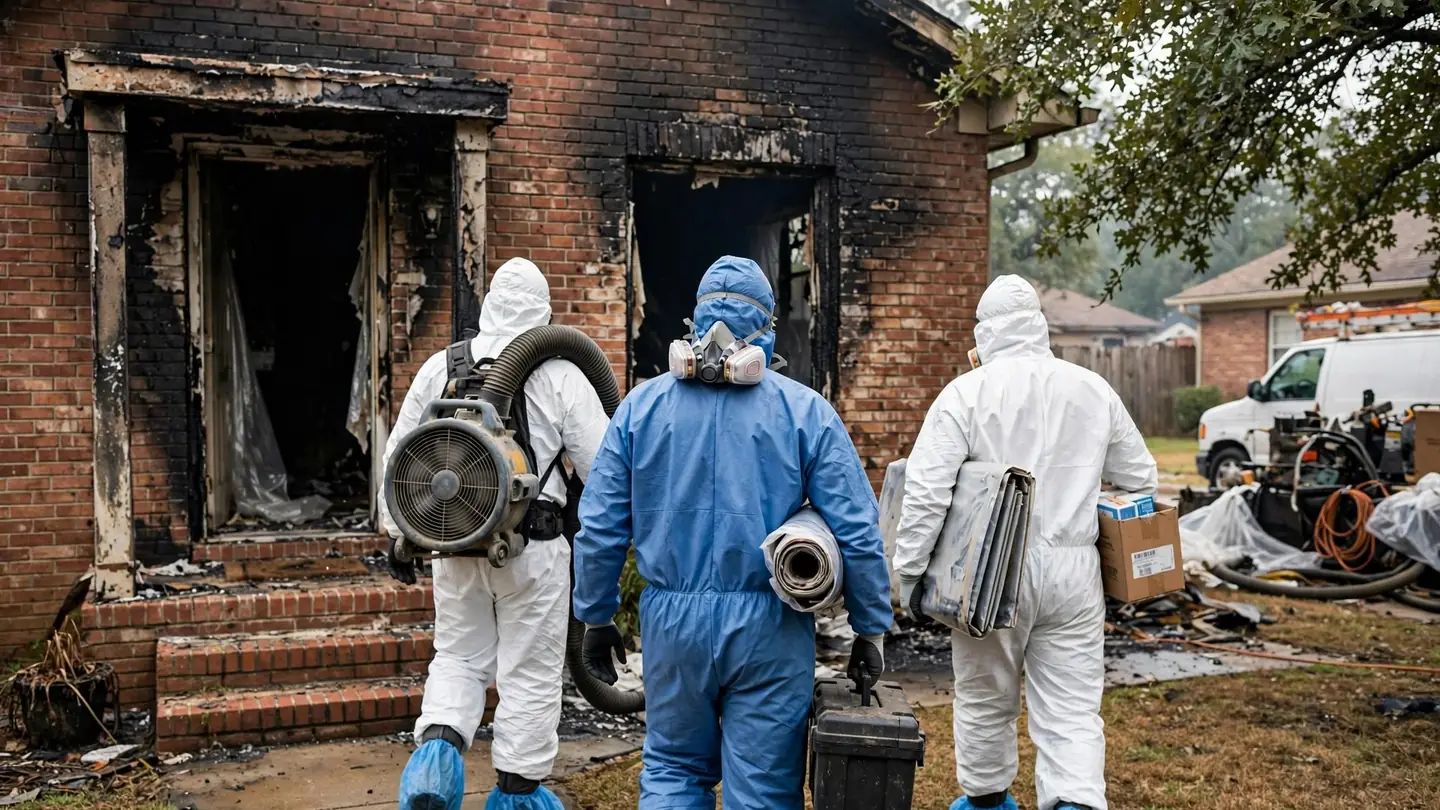
Key facts: Emergency Fire Damage Services
- Wait for clearance: The fire department decides when it is safe to go in.
- Call your insurer: Ask about temporary housing right away.
- Fire damage calls to (833) 610-0241 reach independent contractors, subject to availability where you live.
Right now
First steps for fire damage services
- 1
Wait for clearance
The fire department decides when it is safe to go in.
- 2
Call your insurer
Ask about temporary housing right away.
- 3
Leave utilities off
Have them checked before they are turned back on.
- 4
Do not start cleaning
Early wiping can set residue into surfaces.
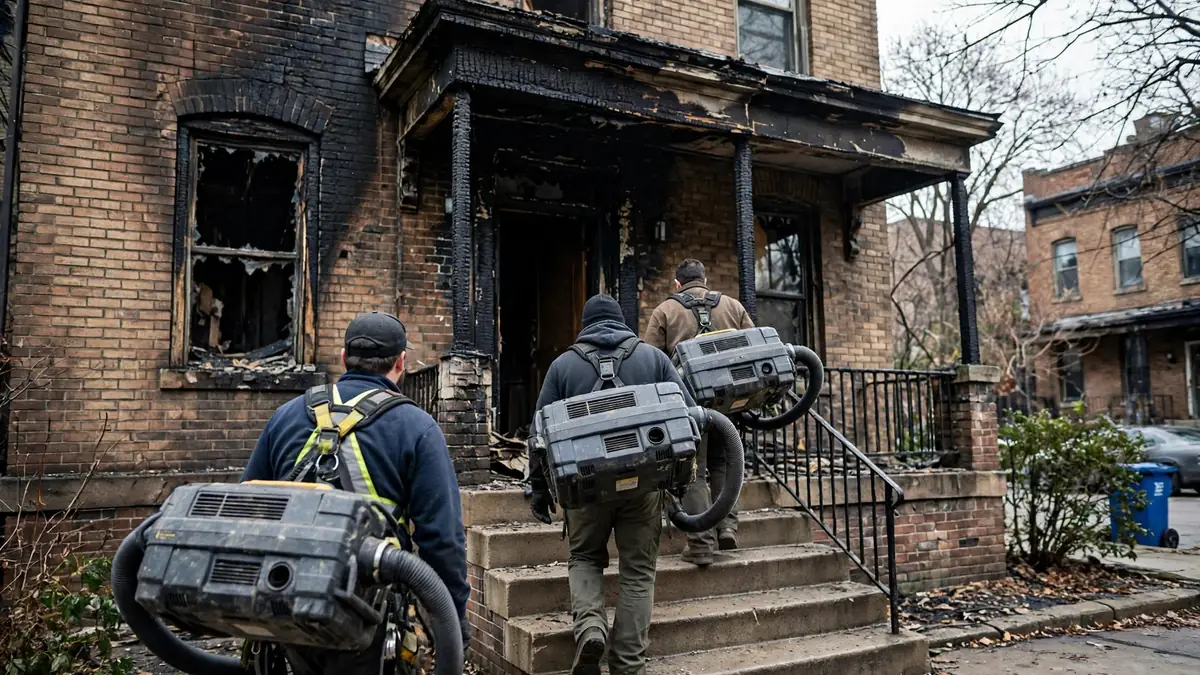
Equipment going in after clearance
If it is still burning
Get out first and call from outside
If the fire is still active, this page can wait. Get out, stay out, and call 911 from outside. NFPA advice is to leave quickly, close doors as you go, stay low under smoke, and go to your meeting place. Do not go back for belongings or pets. Ready.gov says to tell firefighters right away about any pets trapped inside, and to tell the 911 operator where anyone who needs help is.
Everything below applies once the fire department has put out the fire. Even then, the building may be dangerous, and the fire department or another official decides when anyone goes back in.
Clearance
Questions to ask the fire department before they leave
The officer in charge has information no one else will have later. Ask these while they are still on site, and write down the answers.
- May I go inside, and into which rooms?A clear yes or no from the fire department is what Ready.gov tells you to get. Find out who to call if the answer is no.
- Are utilities safe or disconnected?Ready.gov says not to reconnect them yourself and that the department should confirm utilities are safe or disconnected before leaving.
- How do I get the report?Ask for the incident number and the department's process. Your insurer may need it.
- Is the building secure?Ask whether doors, windows or holes in the roof need to be covered tonight, and whether anyone will stay on watch.
- Can I retrieve essentials?Ask about medications, documents and other necessities, and whether someone needs to accompany you.
- What should I watch for tonight?Ask what signs would call for another 911 call.
The first day
Decisions from the curb through the next morning
This is the order that tends to work. Your contractor's arrival depends on local availability, so concentrate on people, papers and the phone.
- 1
Right away
Count everyone. Get medical attention for burns or smoke exposure. Ready.gov says to cool a burn with water for three to five minutes, cover it with a clean, dry cloth, and get medical help right away.
- 2
First hour
Find shelter for tonight. Ready.gov points to disaster relief services such as the Red Cross for temporary housing, food and medicines. Tell friends and family you are safe.
- 3
First few hours
Call your insurer. Ask about temporary housing, what they want you to do to protect the property, and which steps need their approval. Ready.gov also says to tell your mortgage company.
- 4
When cleared to enter
Go in daylight, with someone else, and wear sturdy shoes and a suitable mask. Leave immediately if you hear shifting or see fresh smoke. CDC says to stay out until an inspector certifies the building is safe.
- 5
Same day
Photograph every room if you are allowed in, before anything moves. Do not try to reconnect utilities. Arrange for the building to be secured if it stands open.
- 6
That evening
Start a list of what you need to replace right away: medications, glasses, IDs, phone chargers, work clothes.
- 7
Next morning
Make the contractor calls. Ask your insurer before signing, and have any contractor explain what they plan to do first. Ask about residue, water left by firefighting and securing the property.
Calls after a fire
Who to contact and why
Ready.gov lists several of these parties directly. Keep the numbers in one place, since you will call most of them more than once.
| Who | What for | Have ready |
|---|---|---|
| Fire department | Report, clearance and safety questions | Address, date and incident number |
| Red Cross or relief service | Temporary housing, food and medicines | Number of people and any needs |
| Insurer | Claim, temporary living needs and approvals | Policy number and basic facts |
| Mortgage company | Required notice | Loan number and fire date |
| Utilities | Service status and reconnection | Service address and fire report |
| Board-up or tarp crew | Securing openings | Clearance status, and which openings |
| Fire restoration contractor | Residue, water, odor and rebuild scope | Rooms affected and what burned |
| Employer, school, doctor | Time off, records, prescriptions | Dates and what you need |
Not yet
Actions to delay after a fire
- Going in without clearanceFloors, stairs and ceilings can be weakened. Even if it looks stable from the door, wait for someone to clear you.
- Turning on the power, gas or waterLeave utilities to the utility and qualified people. Ready.gov is blunt: do not reconnect them yourself.
- Eating food that was in the houseFoodSafety.gov advises discarding foods exposed to flames or smoke fumes, and notes that packaging and refrigerator seals do not fully protect them. When in doubt, throw it out.
- Taking medicines exposed to fire or heatAsk your pharmacist or doctor about replacements. Medicines that need refrigeration may also be affected by a power cut.
- Cleaning walls or washing soot off yourselfResidue from burned plastics and furnishings is not ordinary dust. Ask before you wipe anything.
- Throwing things awayReady.gov says to inventory damaged property before discarding. If something is unsafe, photograph it first.
- Signing on the spotPeople may approach you within hours of the fire. Take your time, call your insurer, and read what you sign.
- Using a generator near the houseGive it 20 feet of clearance from doors, windows and any attached garage, per Ready.gov.
What survived?
First judgments about belongings
Do not throw anything away yet unless it is unsafe. Sort what you find into these groups, and take advice before deciding.
| Item | Usual concern | First step |
|---|---|---|
| Food, including canned and refrigerated | Heat, fumes, chemicals | Discard exposed food, and ask about cans |
| Medicines and cosmetics | Heat and fumes | Replace, and ask a pharmacist |
| Important documents | Heat and water | Keep flat and dry, ask about recovery |
| Photos and keepsakes | Fragile, residue-coated | Do not wipe; ask about specialist cleaning |
| Clothes and fabrics | Odor and residue | Do not launder yet; ask about textile cleaning |
| Electronics | Corrosive residue, water | Do not plug in; have them checked |
| Mattresses and soft furniture | Soot, odor, water | Bag only on advice; photograph first |
| Firearms and ammunition | Heat damage, safety | Tell the fire department or police; do not handle if damaged |
Paper trail
What a post-fire file should hold
- Fire report and incident numberThe foundation of the whole file.
- Dated photosExterior, each room, and items of value. A walkthrough video helps too, if you are allowed inside.
- InventoryRoom by room, with description, age and any records you can find, such as receipts or email confirmations. Ready.gov asks for this before anything goes out.
- ReceiptsReady.gov notes that receipts for fire-related spending may be needed by insurers and for tax filings. This includes hotels, meals and replacement clothing.
- Replacement documentsKeep a list of IDs, cards and titles you need to replace, and note the date of each request.
- Contact logKeep names, dates and what was agreed with everyone you speak with.
- Contractor scopeKeep a written description of work, and any changes as the job moves along.
Getting through it
Children, older adults and the days afterward
Fire is frightening, and children and older family members may feel it for a while. Keep them out of the damaged home. Ready.gov says children should not join in cleanup work, and CDC says to keep them and pets away from the affected area until it is complete. Red Cross volunteers may be able to help with shelter and with emotional support, so it is worth asking.
Smoke exposure can show up after the event. If a cough worsens or breathing or chest symptoms appear, get medical help. People with asthma or other lung conditions should take extra care. Keep them away from the damaged building while residue is being cleaned, even if the rest of the family can go back in.
For vacant homes, ask your insurer what to do about the coverage and the security of the building. Check on it regularly if you can, from the outside, and keep up with mail and any notices left at the property.
Questions
Fire Damage Services: quick answers
What should I take if I am allowed in?
Medications, identification and key documents, only if officials agree.
Where do I get the fire report?
Ask the responding fire department how to request it.
Can I go in if it does not look too bad?
Not until cleared. Smoke, weakened structure and damaged utilities may not be obvious from the door.
Who secures the house?
Usually a board-up or restoration contractor, arranged by you or through your insurer. Ask the fire department whether the building needs to be secured tonight.
Do I have to use the contractor my insurer suggests?
Ask your insurer what your policy says. You can compare options, but keep them informed before work starts.
My neighbor's fire damaged my home. Who do I call?
Your own insurer first. Photograph your side, and ask how they want it handled.
Next
After the first night
The fire damage restoration page covers cleaning and rebuilding. The first 24 hours guide adds detail on the day itself, and the adjuster guide helps with the claim conversations ahead.