Key facts: Portsmouth
- Colonists settled the harbor's west bank in 1630, and the Richard Jackson House dates to 1664 [1].
- The 1813 fire burned 244 buildings, and later new buildings in a fire district had to be brick with slate roofs [1].
- Portsmouth averages 50.65 inches of precipitation and 65 inches of snow a year [1].
- The Piscataqua is a tidal estuary with a swift current [2].
The city
A very old city on a tidal river
The Piscataqua is a tidal estuary with a swift current and forms the boundary with Maine. [2] Although the city's listed elevation is 66 feet, [1] low ground near the water is a different matter, and coastal storms can combine high tide with wind and rain. Check official flood maps if you are close to the harbor or a tidal creek.
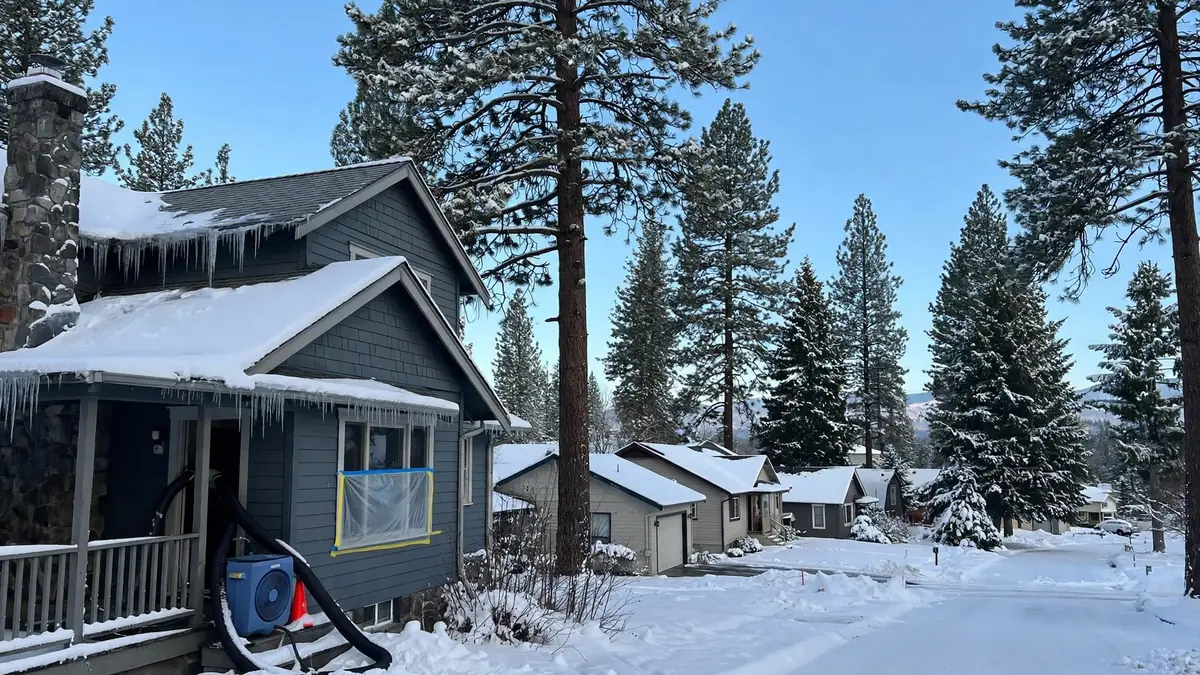
Precipitation averages 50.65 inches and snowfall 65 inches a year. [1] So Seacoast homes face heavy wet snow, ice dams and wind-driven rain as well as ordinary plumbing failures.
Old buildings
Working with very old houses
Strawbery Banke now preserves several dozen restored homes, [3] and many other historic houses stand across the city, including the Jackson House of 1664 and the Warner House of 1716. [1] Private homes of this age have hand-hewn timbers, wide boards and plaster. Rapid, aggressive drying can crack or warp them, so ask how your contractor would slow things down when needed.
After the 1813 fire burned 244 buildings, new construction within a fire district had to be brick with slate roofs. [1] Brick walls hold water and release it slowly, and slate roofs can leak through missing slates or flashing in ways that are different from asphalt roofs. Lead paint and older insulation are real possibilities. [4]
Common situations
Water damage in Portsmouth buildings
General patterns.
Roof and flashing leaks
Slate, chimneys and old flashing can let in wind-driven rain.
Downtown multi-use buildings
A leak upstairs can affect shops and homes below.
Read moreDamp old cellars
Stone foundations and high groundwater let in water.
Read moreWide boards that cup
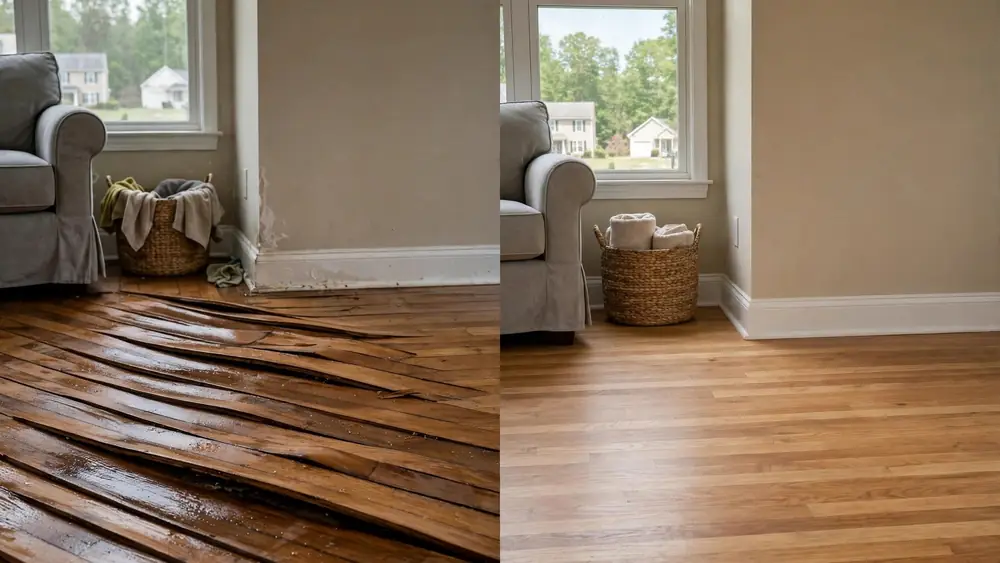
Old floors react to moisture from underneath.
Read more
Decide
Materials in old Portsmouth buildings
Generalized guidance to discuss with your contractor.
| Material | Concern | Approach |
|---|---|---|
| Plaster | Can loosen from lath | Dry slowly, keep sound areas |
| Wide pine | Cups and checks | Dry gradually, wait before sanding |
| Brick | Holds moisture | Allow time and check adjacent wood |
| Old paint | Lead | Test before disturbing |
How it usually runs
A careful approach to an older home
- 1
Record what exists
Photograph trim, floors and plaster before any work.
- 2
Stop the source
This may mean a roofer as well as a plumber.
- 3
Test
Check for lead and asbestos ahead of removal.
- 4
Dry gently
Monitor materials rather than chasing speed.
- 5
Keep what can stay
Save removed trim for reinstatement where you can.
Permits
The Historic District Commission
The city set up a Historic District Commission to protect its architectural legacy. [1] Interior drying rarely raises questions, but exterior changes may. Check with the city before replacing visible features, and note that nearby Dover, Durham, Exeter and Hampton have their own offices.
Nearby
Areas near Portsmouth
Inland lie Manchester and Concord. Coverage also includes other Seacoast towns listed on the areas page.
Coast
Tides, surge and salt in low-lying areas
The harbor's swift tidal current is one of its defining features. [2] Low streets near the water can be affected when a high tide coincides with a coastal storm, and any address near the harbor or a tidal inlet is worth checking on official flood maps. Portsmouth's general elevation of 66 feet [1] does not describe those low spots.
Salt water adds to the usual concerns. It corrodes wiring, fasteners and metal appliances faster than fresh water, and salts left in wood and masonry can attract moisture long after the surface seems dry, making readings harder to interpret. Rinsing surfaces with clean water after contamination is removed may help, so ask your contractor. Any electrical equipment touched by salt water should be looked at by an electrician before it is used again.
Wind
Nor'easters and wind-driven rain
Seacoast storms can drive rain sideways under clapboards, around window sashes and through old flashing. Water then appears on walls and ceilings far from any obvious roof damage. With 50.65 inches of precipitation a year on average, [1] old houses get regular soaking. Many have no housewrap or vapor control, so their walls rely on being able to dry out between storms.
That is a reason to take care with repairs. Adding plastic, spray foam or modern paint over old wall assemblies can trap moisture that used to escape. If you are rebuilding after a leak, ask someone familiar with old buildings how to keep the wall able to dry. Check your windows after a big storm, look for fresh stains at the upper corners and note the wind direction, as this can help explain a leak that only appears now and then.
Landmarks
What the city's old houses tell you about yours
Dates from public sources show how long these structures have stood. [1]
- Richard Jackson House, 1664Early timber framing with very old materials; dense old wood dries slowly.
- MacPheadris-Warner House, 1716A brick house, reminding us that masonry walls have long been part of the local stock.
- John Paul Jones House, 1758A wood-framed Georgian house, with plaster and paneling typical of the period.
- Governor John Langdon House, 1784A later high-style house whose details would be hard to replace.
Slate and brick
The fire district's legacy
The rule requiring brick and slate in the rebuilt fire district after 1813 [1] means downtown has a concentration of old masonry buildings with slate roofs, now often with shops below and apartments above. Water reaching a slate roof's underlayment or a built-in gutter can travel a long way inside a thick wall. Internal gutters and parapets are classic leak points, and they can stay hidden until plaster inside begins to fail.
Masonry walls can also carry moisture up from a damp cellar, or take on water through failed mortar joints. Mortar repairs should use a suitable soft mix, since hard modern mortar can damage old brick. Ask a mason with experience of historic buildings. Inside, expect brick to dry over weeks. Dehumidifiers can protect wood and finishes in the meantime, and these are usually the more urgent concern.
Rentals and shops
Mixed-use buildings and short-term rentals
A leak in a downtown building can affect a restaurant, a shop and an apartment at once. Each may have its own insurer, and business interruption questions may arise for shops. Agree on who is coordinating the response, and photograph each space. If you are the owner of a short-term rental, make sure a local person has keys and knows where the main shutoff is. A guest may not recognize a problem until it is serious.
Older buildings can have hidden shared plumbing and complicated access, sometimes with a single stair. Tell the contractor about parking and access, especially on narrow downtown streets. Equipment may need to come through a shop or be carried upstairs, and long hose runs are hard in tight spaces. Any exterior equipment or dumpsters on public streets may need city permission, so ask first.
Compare
Wood-frame houses and brick buildings
Broad differences in how they respond.
| Topic | Wood frame | Brick |
|---|---|---|
| How it gets wet | Roof, siding, plumbing | Parapets, gutters, mortar joints |
| How it dries | Faster, can warp | Slowly, over weeks |
| Main risk | Rot at sills and joints | Damage to plaster and embedded wood |
| Who to involve | Carpenter | Mason |
FAQ
Questions from Portsmouth
Can my old plaster be saved?
Often, if still attached. Ask for an assessment before anything is removed.
Do I need approval for repairs?
Possibly for exterior work in a historic district. Ask the city first.
Does salt water change things?
Tidal flood water is contaminated and salty, which can corrode metal and wiring. Treat it seriously.
Why is my slate roof leaking?
Slates and flashing can slip or crack. Ask a roofer who knows slate.
Is flood insurance relevant here?
It can be, especially near the water. Ask your agent, since homeowners policies generally exclude flood. [5]
Nearby
More around Portsmouth
Back to all of New Hampshire. Nearby pages: Concord, Keene, Laconia, Lebanon and Hanover, Manchester, Nashua.
Related help for Portsmouth: water extraction, structural drying, sewage backup cleanup, fire damage restoration and smoke damage cleanup. First time dealing with this? Read the first hours after water damage.