Key facts: Slidell
- Slidell sits about 13 feet above sea level and roughly 3 miles north of Lake Pontchartrain [1].
- During Hurricane Katrina, parts of the city saw surge over 10 feet, and nearby unincorporated areas saw 13 to 16 feet [1].
- Slidell averages about 66 inches of precipitation a year [1].
- A tornado struck southern Slidell in April 2024, and the city received 7 inches of snow in January 2025 [1].
Where this covers
Slidell and surrounding St. Tammany communities
Covered ZIP codes can change, so check on the call.
- City of SlidellThe incorporated city, chartered in 1888 and governed by its own mayor and council.
- Unincorporated areasLand to the south and east is often called Slidell but sits outside the city, under St. Tammany Parish government.
- Pearl RiverA covered community to the north, also in St. Tammany Parish.
The setting
How Slidell's location shapes water damage
The city's municipal area sits only about 2 miles inland, with a general elevation of about 13 feet. [1] That elevation is an average and hides lower ground closer to the water. Encyclopedic accounts describe Slidell as vulnerable to hurricanes because of its low elevation, [1] and residents who lived through 2005 hardly need convincing.
Rain is the everyday version of the same problem. With about 66 inches of precipitation in a typical year, [1] Slidell is wet by national standards, and the surrounding bayous and marsh leave limited room for water to go when the lake is pushed high by wind. When the lake is up and rain falls at the same time, drainage has to work against that high water.
The climate is humid subtropical, with mild winters and hot, humid summers. [1] For a wet house, that climate means little help from outdoor air for much of the year. A home closed up without power after a storm can turn damp very quickly, and that is often when the mold clock becomes the main concern.
2005
What Katrina changed about Slidell homes
On August 29, 2005, storm surge exceeding 10 feet reached parts of the city, and unincorporated areas to the south and east saw 13 to 16 feet. [1] Water at those depths damaged homes well beyond the waterfront. Rebuilding produced the mix visible today, with elevated homes standing on tall foundations next to older houses that sit close to the ground.
That variety matters when water comes in again. A home raised after 2005 may be safe from a moderate flood but could store things below, have mechanical equipment on platforms and have wet insulation or wiring beneath the floor. An older slab may flood at much lower water levels. Tell your contractor what kind of home you have, and if it has been raised, when.
Past floods can also leave behind hidden issues. Framing that was dried quickly under difficult conditions may show old stains, and it can be confusing to work out what is old and what is new. Photos, meter readings and your own memories help separate previous damage from the current event, and this matters for any insurance claim.
Common situations
What Slidell water damage often looks like
General patterns, drawn from local conditions rather than from particular jobs.
Water beneath a raised floor
Rising water can flood the space under a raised home, soaking insulation and duct work and leaving silt behind.
Surge or bayou water on a slab
Contaminated water moves across the floor and into walls. Most soaked soft goods will not be saved.
Wind and tornado roof damage
Torn roofing lets in rain long after the wind has passed. Ceilings and attic insulation take the worst of it.
Pipes in a rare hard freeze
South Louisiana plumbing is often not built with deep cold in mind, and exposed lines are vulnerable when it arrives.
Read more
Under the floor
Elevated homes and what happens below them
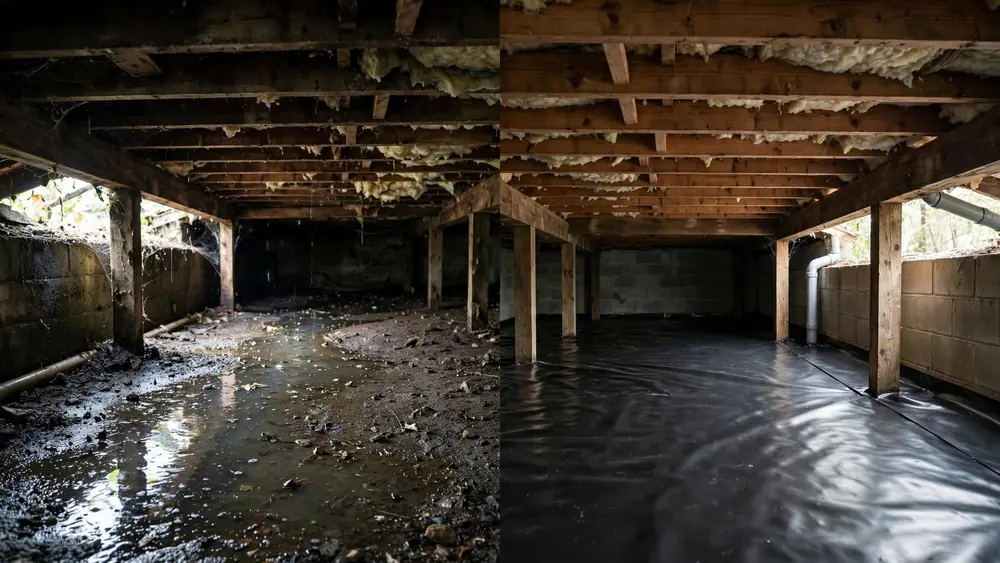
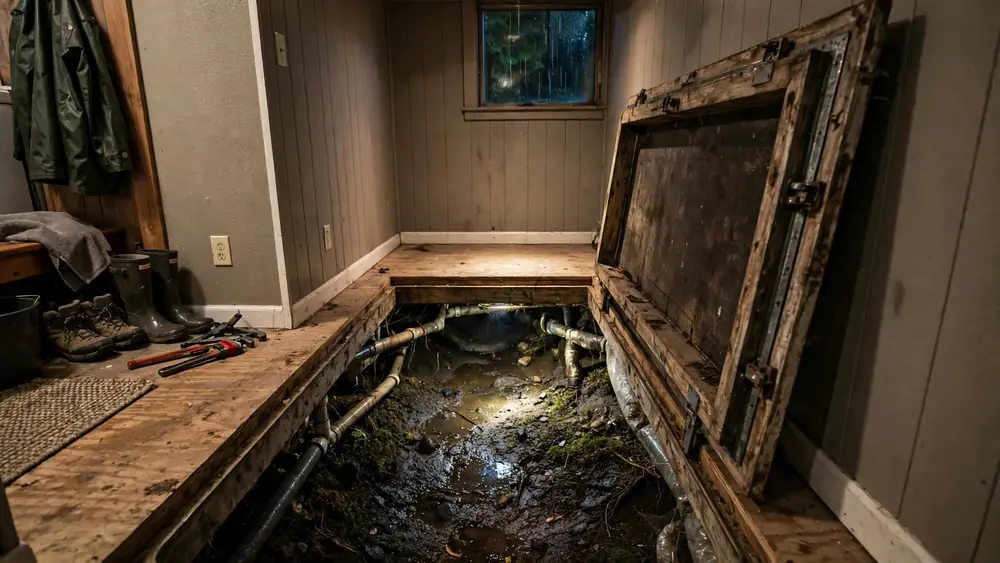
If your home is raised, water that reached the area below it may have done more than you can see from upstairs. Fiberglass insulation sags when wet, ducts can fill with water or come loose and wiring may have been underwater. Have an electrician check anything that was submerged before you use it.
After the water drops, silt coats the soil and piers, and that layer stays damp. Moving air through it without cleaning it first does little. Our crawlspace drying page explains how contractors deal with this, including removing wet insulation and laying a vapor barrier where it suits the home.
Enclosures below elevated homes also need a mention. Areas used for parking or storage are often built on the assumption that water may pass through them. If your enclosure has drywall or stored items, those may have soaked up flood water. Insurance for items below an elevated floor can be limited, so ask your flood carrier what applies.
Inland but not immune
Storms that are not hurricanes
Not all Slidell damage comes from the Gulf. A tornado struck the southern part of the city in April 2024, [1] and tornado damage opens up roofs and walls with little warning, often along narrow paths. Rain then enters through gaps that may be hard to see from the ground.
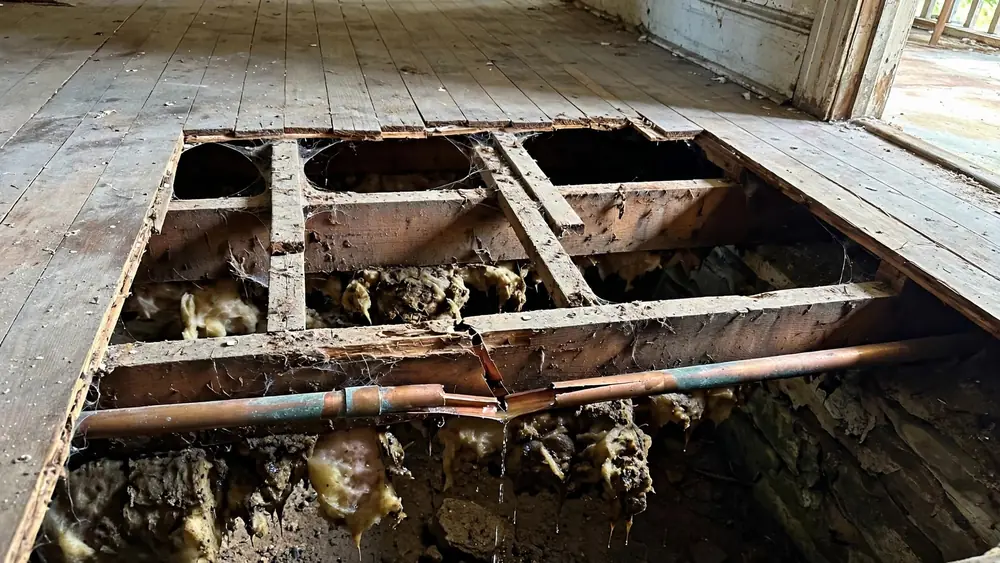
Cold is the other surprise. Slidell's record low is 8°F, and it received 7 inches of snow in the January 2025 Gulf Coast blizzard. [1] Pipes in attics, under raised floors and on outside walls may freeze during such rare events, and breaks often show up only as the thaw arrives.
Compare
Comparing Slidell's main water sources
A broad guide to help you explain things on the call.
| Source | Usually contaminated? | Main concern | Likely policy |
|---|---|---|---|
| Storm surge or bayou water | Yes | Contamination and silt | Flood |
| Rain through a torn roof | Sometimes | Ceilings and insulation | Homeowners |
| Frozen or broken pipe | Usually not at first | Water spreading unseen | Often homeowners |
| Sewer backup | Yes | Health risk | May need an endorsement |
| Slow damp under a home | Varies | Mold and rot | Often not covered |
How it usually runs
What to expect after flood water in a Slidell house
- 1
Wait for the all-clear
Return only when officials say it is safe, and watch for gas smells, snakes and live wires.
- 2
Photograph before you touch
Capture the water line, your belongings and anything below an elevated floor.
- 3
Notify your insurers
Report to the flood carrier and homeowners insurer if you had both wind and water. [2]
- 4
Remove wet, porous materials
Carpet, padding, soaked insulation and drywall below the line usually go, as EPA flood guidance describes. [3]
- 5
Clean surfaces
Hard surfaces are cleaned to remove silt, then dried.
- 6
Dry and verify
Equipment runs until moisture readings hit the dry goal, and records go into your claim file.
Boundaries
City of Slidell or unincorporated St. Tammany
Many addresses described as Slidell are outside the city limits. The surge figures for unincorporated areas to the south and east show how much this distinction is used, [1] and it matters in practice too. The city and the parish each handle their own building and floodplain matters, so your first step is to find out which applies to your address.
Substantial damage rules matter most here. In a mapped flood zone, a home damaged beyond a certain proportion of its value may have to meet current elevation standards when rebuilt. Mandeville's experience, also in this parish, suggests elevation and floodplain rules can sharply reduce repeat losses. [4] Talk with the relevant floodplain office before you rebuild; it is far easier to ask early than to redo work.
Drainage districts and homeowner associations can add further layers, for example on fill, fencing or exterior changes. Ask about these if your repair goes beyond restoring the home to its former state.
Safety
Slidell-specific points on safety and contamination
The city has some industrial history worth knowing, though it should not cause alarm. A former creosote plant polluted a nearby bayou and became an EPA Superfund site, which was cleaned up during the 1990s, with Heritage Park built on the site afterward. [1] That history is a reminder that flood water anywhere can carry whatever is upstream, from fuel to farm chemicals, and is one reason the EPA treats it with care. [3]
Keep to the basics. Wear boots and gloves. Wash hands before eating. Throw out food touched by flood water, and do not drink well water until it has been tested. Generators belong outdoors and far from windows, as carbon monoxide is a real danger in the days after a storm. [5]
Before the next storm
Preparing a Slidell home
A little groundwork makes recovery much easier.
- Store a document kitKeep policies, ID and home photos in a waterproof container or backed up online.
- Know your elevationFind your elevation certificate if you have one, and look up the flood zone on official maps.
- Keep the space below clearDo not store valuables or chemicals below an elevated floor.
- Insulate exposed pipesWrap lines in attics and under floors, and know how to shut off your main.
- Check roof and treesHave overhanging limbs and loose roofing looked at before storm season.
- Check your coverageRead your homeowners and flood policies well before the season begins, since many flood policies have a waiting period.
Mold
Why the days after a storm matter in Slidell
The EPA's 24 to 48 hour drying window [6] is hard to meet when roads are closed and the power is off. If you cannot get equipment running, opening up wet walls and removing soaked materials becomes your best defense. Our mold prevention page describes what is reasonable for a homeowner to do and when to stop.
Do not mistake a lack of visible mold for dryness. Growth can begin behind baseboards and under flooring where it cannot be seen. A persistent musty smell in a room that looks fine is worth following up, particularly in a home that was flooded before.
Nearby
Areas near Slidell
To the west along the Northshore are Covington and Mandeville, where rivers play a bigger part. Across the lake lie New Orleans and Metairie and Kenner. Each has its own local rules and flood history, so read the relevant page if your property is elsewhere.
Snow in 2025
What the January 2025 snowfall showed
Seven inches of snow is rare here, [1] and roofs, gutters and pipes were not built with it in mind. If you found a stain or a split line that week, keep your photos and dates, since a later leak may trace back to it. Look at attic lines and any plumbing under a raised floor, which were the most exposed to that cold, and check them again after the next hard freeze, since a cracked fitting may hold for a while before it finally starts to leak badly.
Early town
Railroad-era Slidell and its older blocks
Slidell was founded in 1882 and 1883 during construction of the New Orleans and Northeastern Railroad and chartered in 1888, [1] and NASA facilities in the 1960s nearly tripled its population within ten years. [1] Those two growth periods help explain the housing you see today: a small older core near the tracks, and large areas of later slab subdivisions built quickly around it. Older buildings near the railroad may have raised wooden floors and old finishes, so test for lead and asbestos before opening them up, while 1960s homes more often have water spreading across a slab and into drywall, where the wet drywall guide applies directly.
Living with the lake
How wind and tide change a Slidell rainstorm
Lake Pontchartrain is a shallow body of water, and strong winds can push it toward one shore or another. [7] When a persistent wind holds water against the northeast shore, drainage from nearby bayous and ditches slows down, even if the storm is not a hurricane. People near the marsh may see yards hold water longer than the rainfall alone seems to explain.
This matters for how you read a forecast. A heavy rain arriving during a high lake level is more of a concern than the same rain on a calm day. If your street has a history of holding water, watch both the rainfall forecast and any coastal flood notices from the National Weather Service. Lift stored belongings and move cars ahead of time, as these are simple steps that take minutes and can prevent a claim altogether.
A 13-foot average elevation [1] does not describe your lot. Find your own number from an elevation certificate or a surveyor, since flood policies, floodplain rules and your own planning all depend on it. Compare it with the depth reported in your neighborhood in 2005 if you can, and with the base flood elevation shown on official maps. That one comparison tells you more about your exposure than any general description of the city could.
Ida and Isaac
How more recent storms have reached St. Tammany
Katrina dominates local memory, but later storms have mattered too. Surges from Isaac in 2012 and Ida in 2021 reached the parish's lakefront, as Mandeville's record shows, [4] and Ida left many households without electricity for a long stretch. Nine people in St. Tammany Parish were hospitalized with carbon monoxide poisoning and one person died from lack of oxygen linked to the outage. [8]
Those numbers carry a plain lesson for anyone restoring a home after a storm. A wet house in the heat with no power is uncomfortable, and it can be tempting to bring a generator closer or to stay on when you should not. If anyone in the household relies on powered medical equipment, plan for somewhere else to go, well before a storm arrives and not after.
Rebuilt homes
Checking a home that was repaired after 2005
Plenty of Slidell homes went through a hurried rebuild while contractors, materials and inspectors were all stretched thin. Many of those repairs were done well, but it is reasonable to look closely if you bought one later without knowing its history. Ask the seller or look through permit records for what was done, and check for signs such as uneven drywall lines around 2 to 4 feet up the wall, which can show where a flood cut was patched.
When new water arrives, an old repair changes the assessment. Older framing may carry dark stains that read dry on a meter, and these are not a new problem in themselves. Conversely, a wall rebuilt with new board over framing that never fully dried may hold a pocket of older growth. Opening a small inspection hole answers the question with far less disruption than opening a whole wall, and it gives your insurer a clear picture of what belongs to the current event.
What to check
Parts of a Slidell house that tend to get missed
These are easy to overlook in the first days after water gets in.
Ductwork below the floor
Ducts under a raised house can fill with water or drop loose, and running the system then blows damp air and contaminants through the home.
Water heaters and air handlers on platforms
Equipment may sit above the expected water line and still be affected by wet wiring, so have it checked before use.
Door and window bottoms
Sills and jack studs below doors hold water, and rot can start there unseen.
Outside electrical panels and meters
Any electrical equipment that has been underwater needs inspecting by a qualified electrician before power is restored.
Yards and drainage
Water around the house after the rain has stopped
Low subdivisions near bayous can hold water in yards long after a storm has gone. That matters because a slab sitting in saturated ground and a crawlspace above wet soil will both keep taking up moisture from below. Look at where your downspouts empty, whether your neighbor's fill now sends water your way, and whether drainage ditches along your street are running or blocked.
Before changing grades or adding fill, ask the proper office, since fill can be regulated in floodplains and may shift water onto a neighbor. Simple steps such as extending downspouts and clearing a culvert are usually allowed and often help. If a drainage ditch is parish or city property, report the blockage instead of clearing it yourself.
Timing
What to expect in the weeks after a Slidell flood
A general sequence; each job and each storm differs.
| Stage | What happens | Your job |
|---|---|---|
| First days | Water recedes, safety checks, photos | Stay safe and report to insurers |
| First week or so | Removal of soaked materials and cleaning | Keep lists and receipts, and decide what stays |
| Following weeks | Drying and adjuster visits | Ask for readings and written estimates |
| After drying | Permit questions and rebuilding | Ask about elevation rules before repairs |
FAQ
Questions from Slidell homeowners
Is my Slidell address inside the city?
Not always. Areas south and east often carry the Slidell name but are in unincorporated St. Tammany Parish. Check your tax bill or with the parish, since it decides your permit office.
My home is elevated. Can it still have water damage?
Yes. Water can damage insulation, ducts and enclosures below, and roofs and pipes remain exposed to storms above. See crawlspace drying.
Do pipes really freeze in Slidell?
Rarely, but they can. The record low is 8°F, and January 2025 brought 7 inches of snow. [1] Breaks may only appear as the pipes thaw.
What should I do about silt left behind?
Wear protection and treat it as contaminated. It should be removed before drying starts, because damp silt keeps surfaces wet.
Is flood coverage worth reviewing even outside a high-risk zone?
It is worth a conversation with your agent, since flooding can occur outside mapped zones. Louisiana's insurance department says flood is separate from homeowners coverage. [2]
Nearby
More around Slidell
Back to all of Louisiana. Nearby pages: Baton Rouge, Covington and Mandeville, Denham Springs and Walker, Metairie and Kenner, New Orleans, Shreveport and Bossier City.
Related help for Slidell: water extraction, structural drying, sewage backup cleanup, fire damage restoration and smoke damage cleanup. First time dealing with this? Read the first hours after water damage.
Sources and citations
- [1]Wikipedia — Slidell, Louisiana
- [2]Louisiana Department of Insurance — Guidance on filing a claim after a storm
- [3]U.S. EPA — Flooded homes: cleanup and recovery
- [4]Wikipedia — Mandeville, Louisiana
- [5]U.S. EPA — Carbon monoxide's impact on indoor air quality
- [6]U.S. EPA — A brief guide to mold, moisture and your home
- [7]Wikipedia — Lake Pontchartrain
- [8]Wikipedia — Hurricane Ida