Key facts: Baton Rouge
- Baton Rouge averages 61.94 inches of precipitation a year, among the wettest of U.S. cities [1].
- In the August 2016 flood, rain peaked at 31.39 inches in Watson, northeast of the city, and eight rivers reached record levels [2].
- Hurricane Gustav struck on September 1, 2008, with winds over 100 mph and heavy tree damage to roofs [1].
- Baton Rouge is a consolidated city-parish, the seat of East Baton Rouge Parish [1].
Where this covers
Baton Rouge and capital-region communities
Check your ZIP code on the call.
- Baton RougeThe consolidated city-parish, with neighborhoods from Mid City and the Garden District to Highland Road and Goodwood.
- Zachary and BakerCovered cities in East Baton Rouge Parish, each with its own local government.
- Across the river and southPort Allen, Plaquemine, Gonzales and Prairieville appear on the list, in other parishes.
The land
A bluff to the west, river country to the east
The city's position explains a lot. The Istrouma Bluff, the first natural bluff upriver from the Mississippi Delta, keeps the business quarter safe from seasonal flooding, with a levee running south from it. [1] Moving east and south, land flattens toward the Comite and Amite rivers, and that is where most flood worries begin.
In August 2016, rain fell at 2 to 3 inches an hour in the hardest-hit areas and more than 20 inches accumulated across multiple parishes, with 31.39 inches recorded at Watson. [2] A flash flood warning covered areas along the Amite and Comite, and over 146,000 Louisiana homes were damaged in the event. [2] Five of the 13 confirmed deaths were in East Baton Rouge Parish. [2]
Only about 21 percent of Louisiana structures had NFIP coverage then. [2] That gap remains the lasting lesson: a home outside a high-risk zone can still flood, and a homeowners policy generally will not pay for it. [3]
Common situations
What Baton Rouge water damage tends to involve
General patterns from local conditions.
Rising water on a slab
Ranch homes on slabs take water across every room at once, and drywall wicks it upward.
Trees and roof openings
Gustav showed how mature trees can damage roofs across wide areas.
Moisture in older homes on piers
Older houses on piers hold damp below the floor, which can affect joists over time.
Mold after slow drying
With so much rain and humidity, wet materials need attention quickly.
Read more
Gustav
Wind and rain: what Gustav taught the city
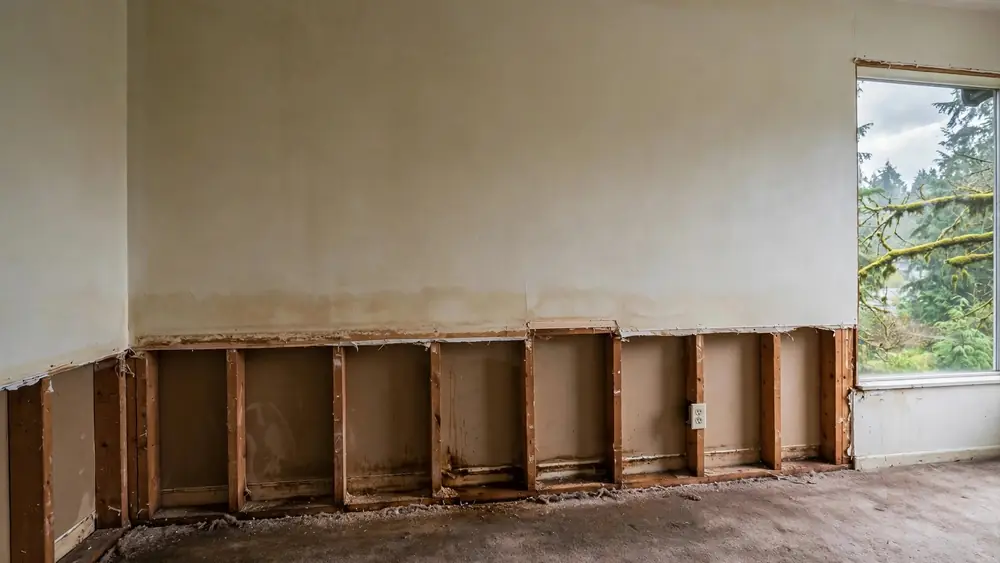
Gustav hit Baton Rouge on September 1, 2008, with winds over 100 mph. It is described as the worst hurricane ever to hit the area, and the city shut down for five days under a curfew. [1] Roofs in the Garden District, along Highland Road and in Goodwood were among those damaged by falling trees. [1]
Inland hurricane damage is largely about wind, rain and the long outage that follows. A roof open to rain in a house with no air conditioning is a recipe for mold. The EPA's advice to dry within 24 to 48 hours [4] may not be achievable, so remove soaked insulation and ceiling material when it is safe to do so, and document it all.
Compare
Baton Rouge housing and how it takes on water
Generalized for discussion; your home may differ.
| Home type | Where water goes | Key task |
|---|---|---|
| Slab ranch | Floors and lower walls | Flood cuts and closed drying |
| Older house on piers | Floor, insulation, soil | Drying from above and below |
| Two-story | Ceilings from upper leaks | Trace and open up the path |
How it usually runs
After a flood in a Baton Rouge home
- 1
Make it safe
Have power and gas checked before going in.
- 2
Photograph and report
File with your flood insurer and with your homeowners insurer if wind was involved. [3]
- 3
Clear soaked materials
Carpet, padding, furniture and wet drywall come out, and photos are kept.
- 4
Clean
Hard surfaces and framing are cleaned before drying starts. [5]
- 5
Dry
Equipment runs until readings reach the dry goal. See how long drying takes.
Permits
Permits in a consolidated city-parish
Baton Rouge and East Baton Rouge Parish share a consolidated government, led by a mayor-president. [1] Baker and Zachary run their own affairs, and Port Allen, Plaquemine, Gonzales and Prairieville sit in different parishes. Confirm your jurisdiction before rebuilding, especially if you are in a mapped flood zone, where repair of substantially damaged homes can trigger elevation requirements.
Nearby
Areas near Baton Rouge
East across the Amite lie Denham Springs and Walker, hit hard in 2016. Further east along I-12 you reach the Northshore, and New Orleans lies southeast.
Rivers
The Comite and Amite on the city's eastern edge
The Comite is a 56-mile tributary of the Amite that drains about 348 square miles, including parts of East Feliciana and East Baton Rouge parishes, and it meets the Amite just north of Florida Boulevard near the city's eastern boundary. [6] So rain falling well to the north, even in Mississippi, ends up passing Baton Rouge's outlying neighborhoods. Homes in the eastern suburbs can flood when it has not rained especially hard on their own street.
The Amite then continues past Denham Springs toward the south. [7] During a major event, water that cannot escape downstream backs up into tributaries and low subdivisions, which helps explain why flooding in 2016 extended so far beyond the river channels themselves. In Ascension Parish, nearly one-third of homes flooded after a levee was overtopped, [2] showing how far south the effects of the same storm reached into places such as Gonzales and Prairieville.
If you live in this part of the region, watch the river forecasts for more than one gauge. A crest at one location may take time to reach yours. Knowing how your own neighborhood behaved in 2016, whether from neighbors or from public flood maps, is useful background, but a future event could be higher or lower.
Neighborhoods
Mid City, the Garden District and postwar ranch streets
Baton Rouge's housing ranges widely. Older areas near downtown, such as the Garden District and Mid City, [1] include houses with raised floors, wood siding and old plaster or board walls. In these homes, a bathroom leak can drop straight through a floor into the space below, so insulation, sills and joists should be part of any inspection. Lead paint is a real possibility in houses built before 1978. [8]
Further out, many postwar neighborhoods have slab foundations and brick veneer. Those brick walls can look unaffected from outside while wet insulation and drywall sit behind them. Water that gets into the gap behind brick may drain slowly through weep holes, and blocked ones can trap moisture. Slab homes also tend to have water heaters in closets or garages, and when one fails it can wet a surprising area before anyone notices.
Student rentals around LSU and multifamily complexes across town add landlord and tenant questions. Report damage in writing and photograph your own belongings. If you are a landlord, think ahead about who your tenants should call, because a leak reported late in the evening may otherwise sit until morning.
Rain
Living with about 62 inches a year
Baton Rouge's average of 61.94 inches of precipitation places it among the wettest U.S. cities. [1] Much of this comes in heavy bursts, so gutters overflow, flat or low-slope roof sections pond, and window flashings face repeated tests. Most of the resulting damage is small but persistent: a recurring stain over a window, soft trim, a musty closet on an outside wall.
These slower problems matter because insurers often treat long-term leaks differently from sudden events, and because mold prefers exactly these conditions. Fix the entry point first, then dry what is wet. If you are unsure whether a stain is active, mark its edge in pencil and check it after the next rain, or ask for a meter reading. A home with chronic dampness may benefit from a look at its air conditioning size and bath fan venting too, since the EPA suggests keeping indoor humidity between 30 and 50 percent. [4]
After the flood
Lessons many Baton Rouge households learned in 2016
These are common-sense points that follow from what happened.
- Flood risk is not limited to mapped zonesMany homes in the affected area had not flooded before, and only about 21 percent of Louisiana structures carried NFIP coverage. [2]
- Move quickly on soft materialsCarpet, padding and mattresses hold contaminated water and heat up quickly in August. Photograph them, then get them out.
- Waiting for help can take a long timeWhen over 146,000 homes are damaged, [2] every trade is stretched, so doing safe first steps yourself can limit damage.
- Keep copies off siteStore policy documents and home photos online, since paper files in a flooded house may be lost.
- Beware of quick offersA large disaster draws people looking for signatures. Check licenses and read before you sign.
Inland hurricanes
What a storm does this far from the coast
Being inland does not keep Baton Rouge out of a hurricane's path. Gustav topped 100 mph here and shut down the city for five days. [1] Trees are the main threat, and the areas named in accounts of that storm, the Garden District, Highland Road and Goodwood, [1] are places with mature canopies over older roofs.
After such a storm, inspect the attic as soon as it is safe, since water may be reaching insulation without yet showing on ceilings. Cover openings to stop more rain from getting in, keeping photos and receipts as state guidance suggests. [3] If your power is out, consider that a closed-up house can reach humidity levels that promote growth within days. When conditions outside are drier than inside, ventilating may help for a while, but close up again before running dehumidifiers.
Decide
Which comes first after different Baton Rouge losses
A general order only.
| Loss | First priority | Then |
|---|---|---|
| River or street flooding | Safety, then photos | Remove soft goods, clean, dry |
| Tree through the roof | Cover the opening safely | Wet insulation out, then dry |
| Water heater failure | Shut off water and power to the unit | Extract and check nearby walls |
| Slab leak | Close the main and call a plumber | Lift flooring and dry |
Neighboring parishes
If your address is across a parish line
Port Allen lies in West Baton Rouge Parish across the Mississippi, Plaquemine is in Iberville Parish, and Gonzales and Prairieville are in Ascension Parish. Each parish and city has its own rules, and each has its own drainage arrangements. Ascension's experience in 2016 [2] gives people there a particular reason to check how levees and low ground affect their street.
When you call, give your ZIP code and parish. If you have a claim open, have your policy number nearby, because contractors may ask which adjuster is involved. Anything to do with permits should be confirmed with the local office instead of relying on advice from another parish.
FAQ
Questions from Baton Rouge homeowners
My home did not flood in 2016. Am I safe?
Not necessarily. A future storm may behave differently, so check your zone and talk to your agent about flood coverage.
Which rivers should I watch?
In the 2016 event, the Amite and Comite both reached record levels. [2] Check official river forecasts from the National Weather Service.
Does homeowners insurance cover tree damage?
State guidance says wind or tree damage that lets rain in is generally a homeowners matter. [3] Your policy wording decides.
Should I keep my air conditioning on during drying?
If it is safe and was not flooded, it often helps. Ask your contractor to check any wet ducts first.
How do I check a contractor?
Use the [Louisiana State Licensing Board for Contractors](https://lslbc.louisiana.gov/) [9] and ask for proof of insurance.
Nearby
More around Baton Rouge
Back to all of Louisiana. Nearby pages: Covington and Mandeville, Denham Springs and Walker, Metairie and Kenner, New Orleans, Shreveport and Bossier City, Slidell.
Related help for Baton Rouge: water extraction, structural drying, sewage backup cleanup, fire damage restoration and smoke damage cleanup. First time dealing with this? Read the first hours after water damage.
Sources and citations
- [1]Wikipedia — Baton Rouge, Louisiana
- [2]Wikipedia — 2016 Louisiana floods
- [3]Louisiana Department of Insurance — Guidance on filing a claim after a storm
- [4]U.S. EPA — A brief guide to mold, moisture and your home
- [5]U.S. EPA — Flooded homes: cleanup and recovery
- [6]Wikipedia — Comite River
- [7]Wikipedia — Amite River
- [8]U.S. EPA — Protect your family from sources of lead
- [9]Louisiana State Licensing Board for Contractors