Key facts: Grant Park
- Most Grant Park homes date from the 1880s and the first years of the 1900s; the district was listed on the National Register in 1979 [1].
- The park itself, about 131 acres, is Atlanta's oldest city park and is home to Zoo Atlanta [1].
- Together, Grant Park and Inman Park keep the city's biggest stock of Victorian-era houses [1].
- Houses of this era were usually connected with clay laterals, which develop root intrusion and cracked joints with age [2].
Coverage
Streets and blocks covered in Grant Park
Grant Park addresses fall mainly within ZIP codes 30312 and 30315, both part of this service's coverage. If you are near the edges, call and the contractor will confirm.
- Blocks facing the parkThe large two-storey houses that face Grant Park itself [1].
- Streets west of the parkModified Queen Anne houses on the blocks toward Boulevard and Oakland Cemetery [1].
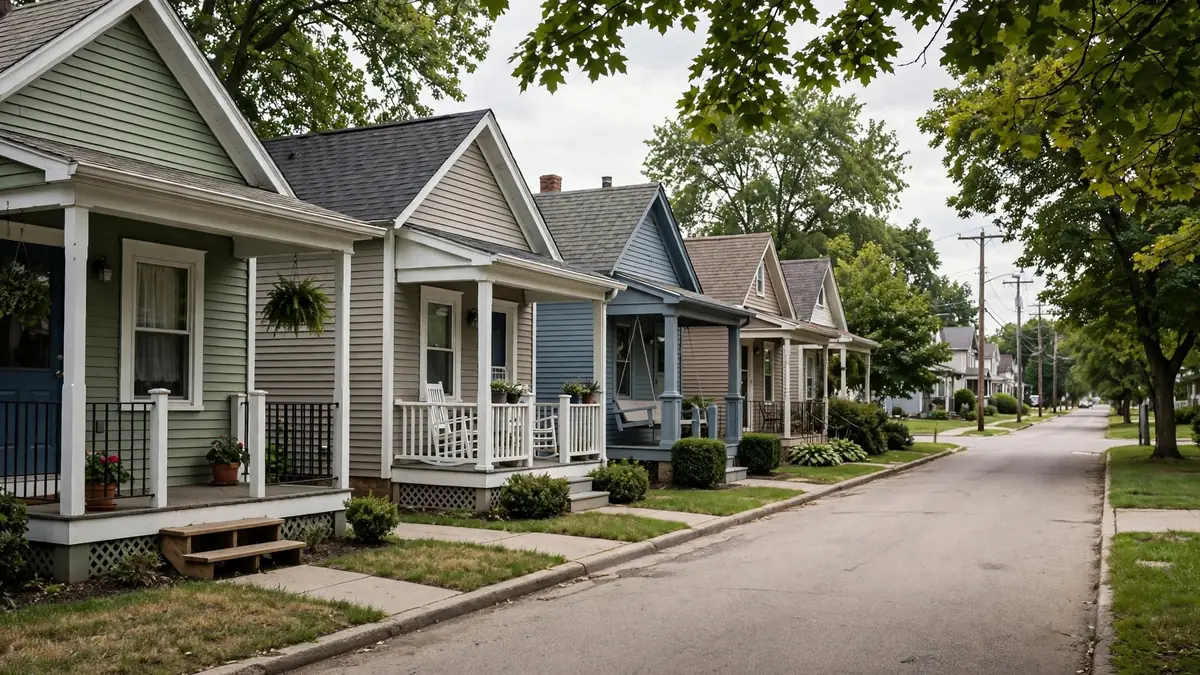
- Streets east of the parkOne-storey Victorian cottages and Craftsman bungalows [1].
- Southern blocks toward I-20 and beyondLater houses and infill; confirm your ZIP when you call.
Overview
A Victorian neighborhood on Victorian-era pipe
Grant Park takes its name from Lemuel P. Grant, who gave the city 100 acres for a park in 1883. The city added more land in 1890 and the Olmsted Brothers drew up a plan for the park in 1903 [1]. The neighborhood grew around it, and most of its houses were built between the 1880s and the first years of the twentieth century [1].
The housing follows a clear pattern. Large two-storey mansions face the park, modified Queen Anne houses line the streets nearby, and one-storey Victorian cottages and Craftsman bungalows fill the blocks east of the park [1]. Together with Inman Park, Grant Park keeps more Victorian-era houses than almost anywhere else in the city [1].
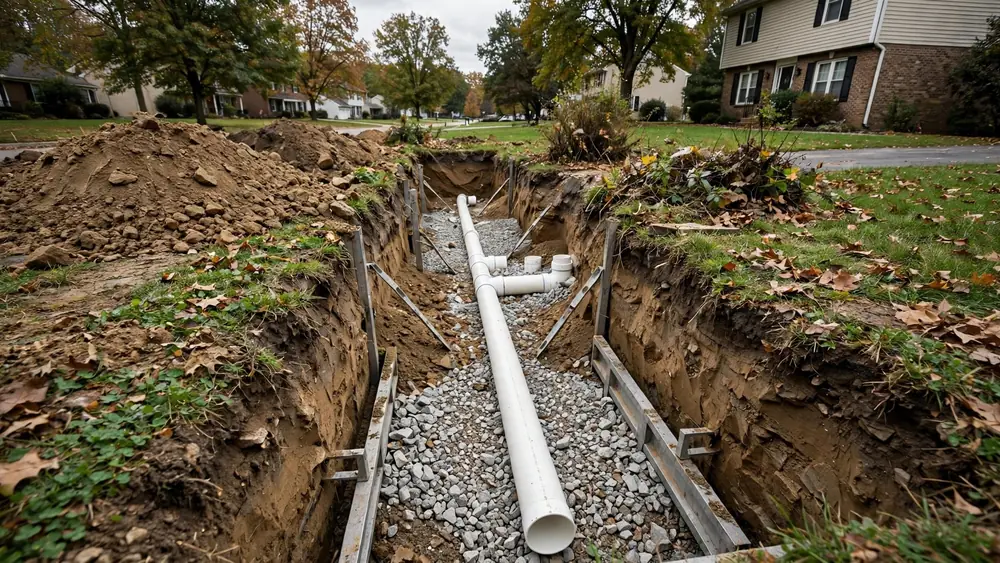
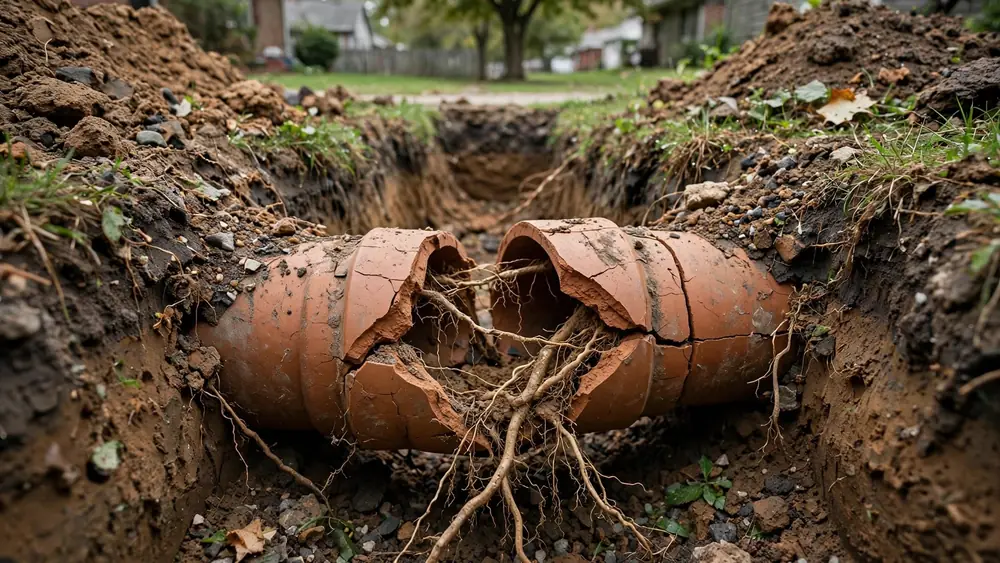
Under those houses, the sewer laterals reflect the same era. Clay pipe outside the foundation and cast iron inside were the norm, and many laterals in Grant Park have only been repaired in pieces over the decades. Roots, cracked joints, sags where old trenches settled, and corroded iron under raised floors are the problems contractors meet most.
The neighborhood's trees add to it. The park's own canopy spills onto the surrounding streets, and street trees and front-yard hardwoods shade most blocks. On compact lots, the lateral rarely escapes a root zone.
Common calls
What contractors see most in Grant Park
Roots in cottage laterals
Short clay lines under front-yard trees, with roots entering at several joints close to the house.
Corroded iron under raised floors
Cast-iron drains in crawl spaces, scaled and sometimes cracked along the bottom where water runs.
Sagging sections
Low spots where old repair trenches settled, holding water and debris.
Renovation connections
New kitchens and baths in restored houses tied into original drains at awkward angles.
Converted and multi-unit houses
Larger houses divided into apartments, with several households on one lateral.
Rear-lot sewer runs
Some lots drain toward alleys or sewers behind the house rather than the front street.
Housing
Cottages, Queen Annes and bungalows: what is under each
The one-storey Victorian cottages east of the park are simple houses with a raised wooden floor over a crawl space. The building drain runs under the floor to the front or side of the house and becomes the lateral outside the foundation. Access to the drain usually means crawling under the house, and many cottages have no exterior cleanout.
The modified Queen Anne houses west of the park are larger, with more bathrooms added over the years. Each addition tended to tie into the original drain, so the building drain under the house can be a patchwork of iron, newer plastic and fittings from several eras.
The big houses facing the park have the longest building drains and, sometimes, the most complex plumbing histories, including conversions to apartments and back. A camera run from an exterior cleanout, where one exists, is usually the quickest way to understand them.
Craftsman bungalows, built in the early 1900s, are the most straightforward: a short iron drain, a clay lateral and, often, a big tree between the porch and the sidewalk.
By house type
Common sewer layouts in Grant Park houses
| House type | Typical setup | What tends to fail |
|---|---|---|
| 1880s–1900s Victorian cottage | Iron drain in a crawl space, clay lateral | Roots, scaled iron, no cleanout |
| Modified Queen Anne | Iron drain with later additions, clay lateral | Patched connections, roots, sags |
| Two-storey house facing the park | Long building drain, clay lateral | Overloading after conversions, root intrusion |
| Early-1900s Craftsman bungalow | Short iron drain, clay lateral | Roots at joints near the street |
| Recent infill or rebuild | Plastic on the lot | Old street connection, construction damage |
Combined sewers
Grant Park and Atlanta's combined sewer history
Older parts of Atlanta, including much of the intown southeast, were served by combined sewers, in which storm runoff and household wastewater flow in the same pipes [3]. In heavy rain, combined systems can be overwhelmed and overflow into creeks, which is why the U.S. EPA treats combined sewer overflows as a major water quality issue [4].
Atlanta was placed under federal consent decrees to deal with these overflows and with spills from its separate sanitary sewers. The city separated parts of the combined system, built underground storage tunnels and disinfected overflows, finishing the combined-sewer work by its 2009 deadline; the deadline for the remaining sanitary sewer repairs was extended to 2027 [5].
For a Grant Park homeowner, two points follow. First, the public system around you has changed a great deal over the last few decades, so older stories about streets flooding with sewage may no longer apply. Second, none of that work replaced private laterals. If your house's line is original, it is still original.
If a contractor finds that your lateral is clear and the problem is in the public sewer, contact the City of Atlanta's Department of Watershed Management. Problems that appear only in heavy storms, or that affect several houses at once, are worth reporting.
Trees
Park trees, street trees and roots in Grant Park laterals
Atlanta's canopy is among the densest of any large American city [6], and Grant Park's streets show why. The park's mature trees extend onto neighbouring blocks, and many houses have a large oak or other hardwood in the front yard or right at the curb.
Those trees have had more than a century to work on clay joints [2]. Roots enter where joints have loosened, then fill the pipe with fine strands that catch paper and grease. On a short cottage lateral, a single tree can be responsible for roots at several joints.
Clearing the roots restores flow. Lining the pipe or replacing the worst sections removes the openings and keeps the roots out without harming the tree. Taking out a tree, by contrast, does not seal the pipe.
Warning signs
Early warnings in a Grant Park house
- A toilet that gurgles when the tub drains or the washer empties
- Slow drains everywhere after a stretch of wet weather
- A sewer smell in the crawl space or around the front of the house
- Water in a basement or lower-level drain after laundry
- Soft, sunken or unusually green ground over the line
- Backups that return a few months after the line was cleared
Historic district
Sewer repairs in the Grant Park Historic District
Grant Park gained National Register status in 1979 and is regarded as one of the city's oldest and most significant historic districts [1]. National Register listing does not usually regulate a private owner's buried utilities, but Grant Park's streetscapes, with low walls, granite curbs, original walkways and front steps, are part of why people live here.
Where a sewer runs under those features, trenchless methods are worth asking about. A liner installed from a cleanout, or a new pipe pulled in by pipe bursting, can leave walls and walks alone. If digging is needed, agree beforehand how features will be protected and rebuilt, and ask whether any local review applies to the restoration work.
Near the park
Living next to the park and Zoo Atlanta
Zoo Atlanta, founded in 1889 as the Grant Park Zoo, sits inside the park and draws more than a million visitors a year [1]. Houses near the park and zoo have to contend with event parking and busy streets, which matter when a repair needs a truck, a trailer or an open pit near the curb.
When you call, mention if your street is affected by zoo or park events. The contractor can plan access, and you can avoid scheduling a repair on a day the street will be full.
Oakland Cemetery, established in 1850, lies at the neighborhood's northwest corner [1]. Streets nearby have some of the area's oldest houses and laterals.
The visit
What happens on a Grant Park sewer call
- 1
Describe the house
Mention its age and style, whether it has a crawl space or basement, whether it is divided into units and what symptoms you see.
- 2
Locate access
The contractor looks for an exterior cleanout, then a crawl space fitting, a roof vent or a toilet.
- 3
Open up the blockage
Roots are cut or the line is jetted so it drains and the camera can see.
- 4
Inspect with a camera
A camera inspection records the pipe from the house to the public sewer.
- 5
Trace and mark the line
The camera head is located from the surface, showing the route under the yard, walk or steps.
- 6
Discuss what the footage shows
The contractor explains whether maintenance, a spot repair, lining or replacement fits, and why.
Options
Matching repairs to Grant Park conditions
| What the camera shows | Approach often considered | Notes |
|---|---|---|
| Roots at many joints, round pipe | Pipe lining | Seals all joints from small access points |
| One broken joint near the house | Spot repair | A small dig at one place |
| Line under a stone wall or historic walk | Lining or bursting | Leaves the feature in place |
| Sag where an old trench settled | Excavate and re-bed | Slope must be corrected in the ground |
| Corroded iron under the floor | Section replacement or descale and line | Depends on how much wall is left |
Digging safely
Utility marking on Grant Park lots
Before any pit or trench is dug, utility lines must be marked. Georgia 811 is the free locate service, and the contractor doing the digging normally submits the request in advance [8]. On older lots, gas services and water lines often run close to the sewer, and there may be abandoned pipes from earlier eras.
Private lines such as irrigation, garden lighting or a feed to a back cottage are not marked by 811. Point them out if you know where they are.
Prevention
Caring for an old Grant Park lateral
- Add an exterior cleanout at the next repair if the house has none.
- Keep a record of root clearings and camera findings.
- Keep grease, wipes and paper towels out of the drains.
- Make sure downspouts drain to the yard or a storm system, not the sewer.
- Have the line inspected before adding bathrooms or converting space.
- Keep the route of the sewer free of new trees.
Repair or replace
Repair or replace an original Grant Park lateral?
Original clay pipe can still be serviceable if it is round and holds its slope. In that case, clearing the roots and lining the line may be the most sensible long-term fix. If the camera shows collapsed sections, a sag or heavy damage, sewer line replacement is likely to be the better choice.
Whatever is recommended, ask to see the footage behind it, and ask how each option would affect your trees, walks and walls. The trenchless vs excavation guide sets out the trade-offs.
Buying here
Buying a Grant Park house with an old sewer line
A typical home inspection does not look inside the sewer lateral. In Grant Park, where the house and the line may both date from the 1890s or 1900s, a sewer camera inspection before closing is a sensible addition. It shows the pipe material, roots, cracks and sags, and whether earlier owners repaired or lined the line.
Ask the seller for any records of sewer work. Restored houses often have documentation, including camera footage from earlier repairs, which can save time.
Renovations
Restoring a Grant Park house without overloading the lateral
Many Grant Park houses have been restored over the last few decades, and restoration often means more bathrooms, a bigger kitchen and sometimes a finished basement or a rear addition. All of that flows into the same lateral. Before a major renovation, a camera inspection tells you whether the existing line can take the added flow and whether it is worth replacing or lining while the house is already under construction.
Renovation is also the easiest time to add an exterior cleanout and to replace old cast iron under the floor while walls and floors are open. Doing that work later, in a finished house, is far more disruptive.
Soil and slope
Red clay and gentle slopes under Grant Park
Grant Park sits on the rolling Piedmont, where a thin layer of topsoil covers a dense red clay subsoil that holds water and compacts poorly once it has been disturbed [9]. That matters for sewer lines in two ways. Clay soil stays damp around a leaking joint for long periods, which keeps roots active there. And trenches dug for earlier repairs, if they were not compacted well when they were filled, tend to settle over the years, leaving a dip in the pipe that collects debris.
Most Grant Park lots slope gently toward the street or toward the rear, so laterals usually have adequate fall. Where houses sit below the street, or where a lateral runs to a sewer behind the lot, depth and slope vary more. A camera inspection with a locator gives the depth at each point along the route, which is what any repair plan needs.
FAQ
Sewer questions from Grant Park homeowners
Who is responsible for sewer lines in Grant Park?
The City of Atlanta's Department of Watershed Management runs the public sewer. The private lateral from the house to the public sewer is generally the property owner's responsibility.
Why do Grant Park houses have so many sewer problems?
Most were built between the 1880s and early 1900s with clay laterals, under large trees. Roots, cracked joints and settled sections are common after more than a century.
Did the city's sewer projects replace my lateral?
No. Atlanta's consent decree work separated and rebuilt parts of the public system. Private laterals were not part of it.
My cottage has no outdoor cleanout. What happens?
Access may be through the crawl space, a roof vent or a toilet. Many contractors suggest adding an exterior cleanout during any repair.
Can a sewer line be fixed without removing my front steps?
Often. Lining or pipe bursting work from small pits that can be placed away from steps, walks and walls.
Why does my sewer back up only in heavy rain?
Rain can enter old pipes through cracks and connections, or the public system may be under strain. A camera inspection and a report to the city help sort out which.
Is a sewer inspection worth it before buying in Grant Park?
For houses of this age it is a sensible step, because home inspections usually do not look inside the lateral.
Do zoo events affect sewer repairs near the park?
Zoo and park events can affect parking and access for equipment. Mention it when you call so the job can be planned around busy days.
Can roots from the park's trees reach my sewer line?
Trees near the park edge, in the street and in front yards can all send roots into a leaking clay lateral. The source tree matters less than sealing the joints the roots are using.
What should I do if my Grant Park duplex shares one sewer line?
Treat a backup as a shared problem: everyone stops using water, the line is cleared and inspected, and the camera findings are shared with both units and the owner. The footage also shows where each unit's branch joins the lateral.
Is the pipe under my crawl space part of the sewer line?
It is the building drain, which connects to the lateral outside the foundation. In older Grant Park houses it is often cast iron and can be inspected and repaired along with the lateral.
Nearby
More around Grant Park
Back to all of Atlanta. Nearby pages: Brookhaven, Buckhead, East Atlanta, Inman Park & Candler Park, Kirkwood, Virginia-Highland & Morningside, West End.
Related help for Grant Park: water extraction, structural drying, sewage backup cleanup, fire damage restoration and smoke damage cleanup. First time dealing with this? Read the first hours after water damage.
Sources and citations
- [1]Wikipedia — Grant Park, Atlanta
- [2]Wikipedia — Vitrified clay pipe
- [3]Wikipedia — Combined sewer
- [4]U.S. EPA — Combined sewer overflows
- [5]U.S. EPA — Atlanta sewer consent decree modification (May 2012 news release)
- [6]Wikipedia — Atlanta tree canopy
- [7]Virginia Department of Health — Sewage backup fact sheet
- [8]Georgia 811 — How it works
- [9]Wikipedia — Cecil (soil)