Key facts: Cavalero Hill
- Cavalero Hill is one of the named neighborhoods and planning areas in the City of Lake Stevens.
- Much of the southwest part of the city joined in the December 2009 annexation of over 10,000 people.
- Housing units in the city rose from 10,414 in 2010 to 12,367 in 2020.
- The Cavalero Hill Park site was transferred to the city in 2025.
The area
What sets the hill apart from the lake
Lake Stevens sits on a plateau, with the Snohomish River delta on one side and the Cascade foothills on the other, and Cavalero Hill is one of its named neighborhoods and planning areas. The city's largest annexation, completed in December 2009, brought in more than 10,000 residents from unincorporated land to the southwest. Further growth since then is visible in the census, with 10,414 housing units in 2010 and 12,367 in 2020. [1] The city's comprehensive plan says large portions of the city developed within the past several decades, leaving a relatively new housing stock, and that much of it was built while recently annexed areas were still under the county. [2] The 35-acre Cavalero Hill Park was transferred to the city in 2025, and the plan measures traffic on the 20th Street SE corridor as far as Cavalero Road.
What this means for water is simple enough. Most of the lake-related material elsewhere on this site does not apply up here, as a house on higher ground will not take on lake water. The problems come from water moving downhill, from roofs and pavement, and from plumbing inside newer two-story homes. Because the area has been built up in recent decades, a lot of houses here are reaching the age where original appliance hoses, water heaters and fittings start to fail.
We should be clear about the limits of what is known. We have not found published street-level data on foundation types or construction years for this area. If your home differs from the general picture here, trust what you can see, and tell the contractor what you have.
What is common here
Common sources of water on the hill
Uphill water at the foundation
Runoff from a neighbor's lot or from a slope can collect behind the uphill wall of a house.
Upstairs laundry and bathrooms
Second-floor plumbing means that a single leak can reach two levels and the crawlspace.
Read moreOverflowing gutters
Young street trees and tall firs both drop debris that clogs gutters in autumn.
Read moreAttic and roof leaks
Wind-driven rain finds flashing and vent penetrations, and the first sign is often a ceiling stain.
The uphill side takes the water
Slopes
How water moves on a hillside lot
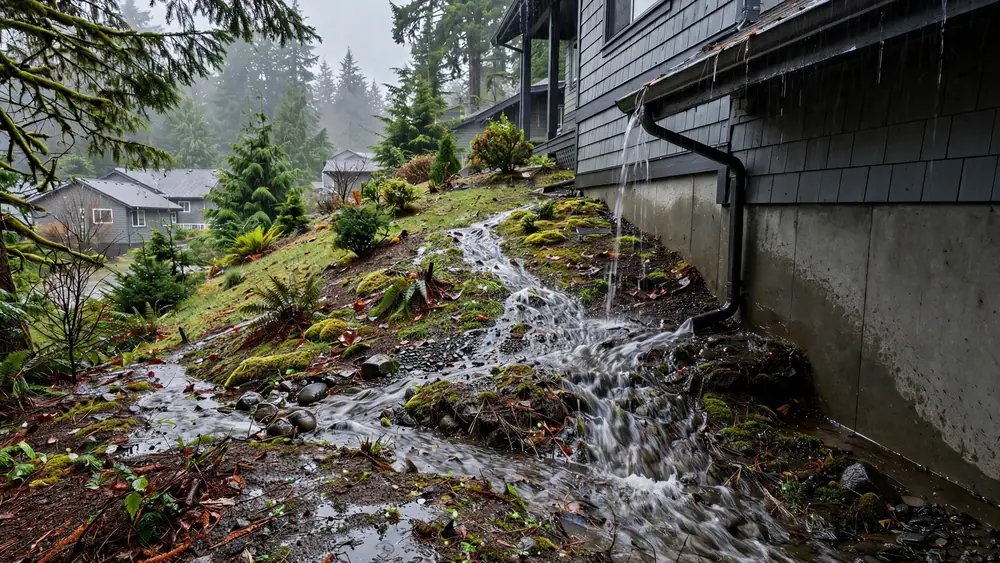
On a slope, ground water does not just soak straight down. It moves sideways through the soil, particularly where a denser layer stops it going deeper, and it comes out at cuts, retaining walls and foundation footings. Many hillside lots here were graded to make flat building pads, which means there may be a cut bank on the uphill side and fill on the downhill side. A home built into such a pad may be fine for years until a wet winter finally saturates the soil.
Watch for water that appears at the base of a retaining wall, a wet stripe along the uphill foundation or a crawlspace that is wet at one end and dry at the other. Each of these suggests water arriving from uphill, not rising from below. It is also worth looking at what has changed nearby. New construction, a neighbor's patio or a filled-in drainage swale can move water toward a home that never had trouble before.
Drainage features need upkeep. Footing drains, catch basins, tightlines and swales all do their job only if they stay clear and are properly connected. Downspouts tied into a buried line can clog where you cannot see them, so if a gutter overflows only at one downspout, a blockage underground may be the reason. Run a hose into that line during dry weather to see where it comes out, and how quickly.
Diagnosis
Finding the cause on a hillside home
| What you see | Likely cause | What to check |
|---|---|---|
| Wet uphill end of the crawlspace | Ground or surface water from upslope | Footing drain, swale and grading |
| Wet stripe on a lower wall during rain | Soil holding water against the wall | Downspouts and soil line |
| Ceiling stain after a windy storm | Roof, flashing or vent leak | Attic after rain with a flashlight |
| Ceiling stain with no rain | Upstairs plumbing | Bathroom, laundry and water meter |
| Wet carpet near a door after rain | Door flashing or surface water | Threshold and exterior grade |
| Water in the garage | Driveway drainage or water heater | Trench drain and tank base |
Two-story homes
When the upstairs laundry lets go
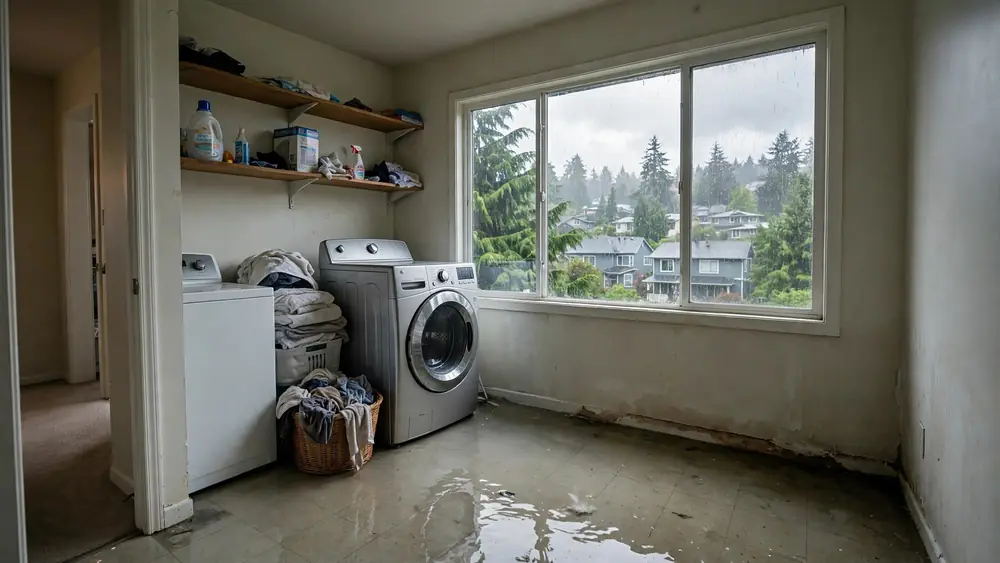
Second-floor laundry rooms are convenient and common in two-story homes, and they raise the stakes when a hose fails. A washer supply hose can flood at full pressure until someone closes the valve, and water travels through the floor to the ceiling and walls below, sometimes right down to the crawlspace. A drain pan under a washer helps only if the pan's drain line is connected and working, and it will not always stop a full-flow failure.
Think of what is directly below the laundry. Kitchens and living rooms often sit there, along with recessed lights and wiring, so check for water near any electrical fixtures, and stay clear of those areas. In a two-story house, this kind of loss normally affects a floor, a ceiling and a wall on each level, so a floor-by-floor moisture map is essential.
- Close washer valves when you are away
- Check the pan and its drain line
- Keep clear of wet light fixtures
The process
How a two-level water loss is usually worked
- 1
Close the valve and check electrics
Close the supply and stay away from any wet ceiling fixtures until someone has checked them.
- 2
Start at the top
Water removal starts where the leak happened, and follows the water down.
- 3
Open the ceiling if needed
Wet insulation and sagging drywall below a laundry or bath usually come down.
- 4
Trace the wall cavities
Moisture readings on the lower level show where water ran down inside the walls.
- 5
Check the crawlspace last
Insulation and joists below the first floor may hold water that nobody can see from upstairs.
- 6
Dry and verify each level
Equipment runs on each floor, with moisture readings repeated until materials are dry.
- 7
Put it back from the top down
Repairs usually follow, once all the levels are confirmed dry.
Do it yourself
What you can do yourself on a hillside lot
- Walk the lot in the rainNote where water runs, where it pools and where it disappears. Take a video.
- Clean gutters and downspoutsCheck them before November and again after the big leaf drop.
- Test underground linesA hose test in dry weather shows if a tightline drains.
- Clear swales and catch basinsRemove leaves, soil and bark mulch that may have washed into them.
- Keep mulch below the sidingSoil or bark built up against the house can bring water to the wall.
- Stop if the slope movesCracks in the ground, leaning walls or new bulges call for a geotechnical professional, and call 911 if a home is at risk.
Weather
Weather on the plateau
Rainfall figures for the hill are the same kind of estimate as for the rest of the city. The Everett station's 1991-2020 normals total about 40 inches a year, with a wet stretch from November to January and very dry summers. [3] Modelled figures from Open-Meteo for Lake Stevens read closer to 71 inches a year long term, and may overstate it. [4] On a slope, what counts is intensity and duration. A long soaking fills the ground, and then a burst of heavy rain runs off quickly, which is when surface water finds its way to foundations and garage doors.
The dry summer plays a part as well. Ground and gutters collect debris through the dry months, and clay-rich soil can dry and shrink, opening gaps along foundations. The first big autumn storm then finds everything at its least prepared. It is a good idea to do your gutter and drain check in early October, before that first storm arrives.
Permits
Permits and drainage rules on Cavalero Hill
Most of this part of the city came in through annexation, and you will generally deal with the City of Lake Stevens for building, mechanical and plumbing permits, which are handled online through its permit center. Check the address, though, as nearby land may still be under Snohomish County. Exterior drainage changes can raise separate issues. Moving water onto a neighbor's lot can cause disputes, retaining walls of a certain size can require permits and work near slopes can trigger critical area review. Ask before you dig. Homeowner associations in newer subdivisions may also have rules on drainage easements and landscaping, and some drainage features are shared.
The visit
Planning a contractor visit on the hill
Getting to the house is rarely the issue here, since streets in newer subdivisions tend to be wide enough for trucks. Steep driveways can make it harder to run hoses and carry equipment, and front-to-back height differences can mean a long route to a crawlspace hatch. Tell the contractor where your hatch is, particularly if it is in a closet or a garage. Let them know of any association parking rules, and if you have plans or drawings for your drainage system from when the home was built, have them to hand. These can show where tightlines run and where the footing drains go.
Prevention
Keeping water away from a hillside home
- Extend every downspoutMove water well away from the foundation, and do not let it dump on the uphill side.
- Keep a clear slope away from wallsSoil and landscaping beds should fall away from the home on all sides.
- Maintain drainsHave footing drains and tightlines checked if your crawlspace becomes wet.
- Replace aging hosesCheck washer, refrigerator and sink lines once a year, and replace them as needed.
- Use a leak sensorPlace them near upstairs washers and water heaters.
- Check roof detailsLook at flashing and vents after big wind events.
- Know your shutoffEveryone at home should be able to close the main in a hurry.
Order of work
Interior or exterior: which job comes first
| Problem | Do first | Do later |
|---|---|---|
| Water in the crawlspace from upslope | Pump and dry, and remove wet insulation | Drainage improvements once the ground is workable |
| Roof leak with a wet ceiling | Temporary roof protection, then drying | Permanent roof repair, then ceiling |
| Appliance leak upstairs | Close valve, then dry | Replace hose and repair finishes |
| Siding leak with wet wall | Stop water if possible, open and dry | Repair flashing before closing the wall |
| Blocked downspout line | Clear or reroute it | Replace the line if it keeps failing |
Bigger decisions
Fix the drainage or live with some damp?
You may not need major drainage work just because there was one wet winter. If water shows up rarely, in small amounts and stays away from the wood, simple changes to gutters and grading can be enough. Larger projects, such as a curtain drain or a sump system, make sense where water keeps coming back, where it reaches framing or where it has caused repeated damage. Get the crawlspace dry and take dated photographs through a whole wet season if you can. A single winter's record can help you decide whether a larger project is really needed.
Shared drainage
Subdivision drainage and who looks after it
Newer neighborhoods often have shared stormwater features, including ponds, swales, catch basins and easements running along back fences. Who maintains them depends on the plat and any homeowner association, and it is not always clear from just looking. If water is collecting on your lot because a shared feature is blocked, find out who owns it before you clear it or change it. Your association, your closing documents or the city can help with that.
Be careful about fences and landscaping in drainage easements. Something as small as a raised planter or a run of solid fence can redirect water along a slope and into the next house. The same applies to your own improvements. A new patio or a poured walkway may send water back to the foundation it used to soak away from. Check the slope after any yard project by running a hose or watching the next rain.
Outside the house
Signs on the outside of the house to look for
A walk around the outside in steady rain takes ten minutes and shows you most of what matters.
- Water spilling over a gutterLook for a clog or a downspout that cannot keep up. Water will land right against the wall.
- Splash marks on lower sidingThese show water bouncing back from the ground or a patio.
- Soil touching the sidingThis can wick moisture to the wall framing and hide any rot.
- Wet stripes at retaining wallsWeep holes that run after rain are doing their job, whereas a bulging wall is not.
- Stained deck ledgersThe joint where a deck meets the house is a frequent entry point.
- Pooled water at window wells or stairsLow exterior spots need a working drain.
Photos
What to photograph on the hill
Photograph water at the uphill wall, gutters overflowing and any puddles along the foundation while the rain is falling, because all of it disappears within hours.
FAQ
Questions from homeowners on Cavalero Hill
Can a house on a hill have a wet crawlspace?
Yes. Ground water moves downhill through soil and can collect behind uphill foundation walls. Runoff from pavement and roofs adds to this. Being on higher ground removes the lake concern, but it does not remove drainage concerns.
Why does my crawlspace only get wet at one end?
That is a strong clue about where the water is coming from. A wet uphill end points to ground or surface water from the slope. A wet spot beneath a bathroom or kitchen points to plumbing, particularly if it stays wet in dry weather.
Does a newer house need to worry about plumbing leaks?
Yes. Appliance hoses, water heaters, fittings and shower seals wear with age, and some fail within a house's first few decades. Check under sinks and behind the washer once or twice a year, and know where your main valve is.
My neighbor's yard drains onto mine. What can I do?
Talk with them first, and take photographs during rain. Water disputes can become legal issues, so check with the city about any drainage requirements for your plat. A drainage professional can suggest how to manage water on your own lot.
Is an upstairs leak worse than a downstairs one?
It often affects more of the home because it travels through a floor, ceiling and walls, and sometimes into the crawlspace. It also creates electrical concerns at ceiling fixtures. Quick shutoff and a floor-by-floor moisture check are the keys.
Does insurance cover water from a slope or yard?
Often not. Surface or ground water is usually treated differently from a sudden pipe break, and a typical home policy excludes flood, the state regulator says. [6] Read your policy, and ask your agent how they would treat water entering from outside.
Do I need a permit for drainage work on my lot?
Sometimes. Work near steep slopes, large retaining walls and connections to public drainage can require review. Ask the Lake Stevens permit center, or Snohomish County if your address is outside the city, before you dig.
Why did my roof leak appear only in a windstorm?
Wind pushes rain sideways and upward under flashing and vents, so a roof that is fine in steady rain can leak in a storm. Check the attic soon after with a flashlight, and take photos of wet spots for the roofer.
Nearby
More around Cavalero Hill
Back to all of Lake Stevens. Nearby pages: Frontier Village, Hartford, Lakeshore.
Related help for Cavalero Hill: water extraction, structural drying, sewage backup cleanup, fire damage restoration and smoke damage cleanup. First time dealing with this? Read the first hours after water damage.
Sources and citations
- [1]Lake Stevens, Washington (Wikipedia)
- [2]2024 Comprehensive Plan (City of Lake Stevens)
- [3]Everett climate normals 1991-2020, NOAA station data (Climate-Zone)
- [4]Open-Meteo historical weather model (modelled data)
- [5]A brief guide to mold, moisture and your home (US EPA)
- [6]Flood insurance (Washington Office of the Insurance Commissioner)
- [7]Building permits (City of Lake Stevens)
- [8]Permit center (City of Lake Stevens)
- [9]Flood cleanup (Washington State Department of Health)
- [10]Verify a contractor, tradesperson or business (Washington L&I)