
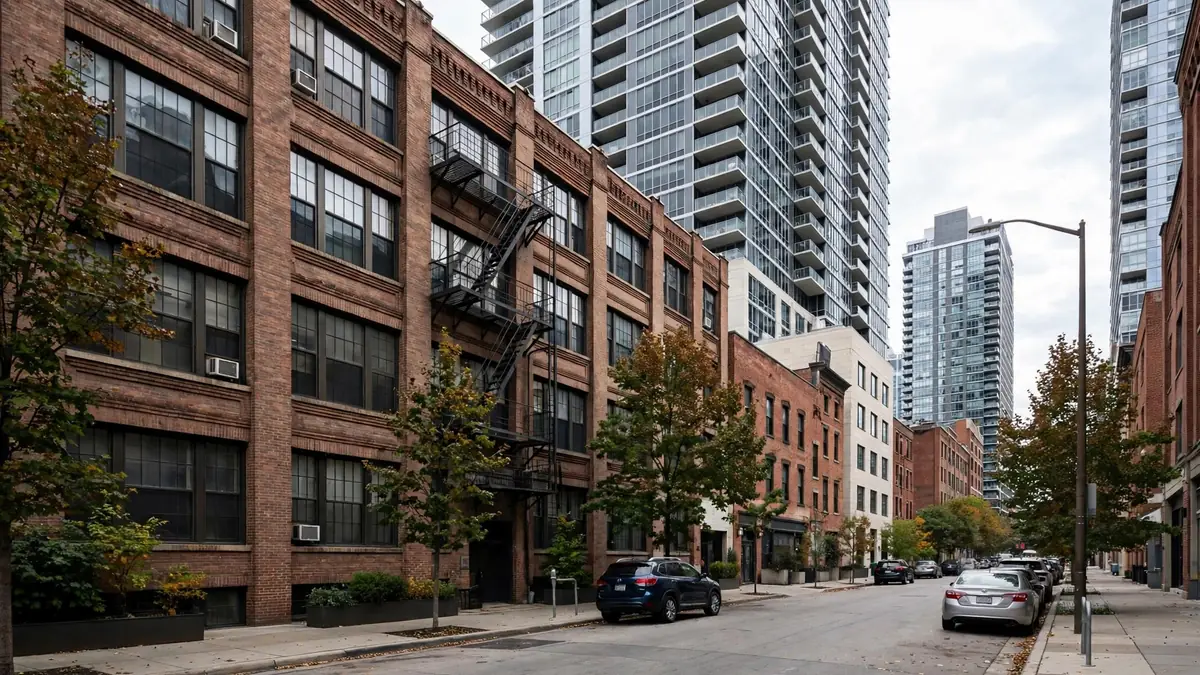
Key facts: Loop and South Loop
- The Loop is Chicago Community Area 32, bounded by the Chicago River, Lake Michigan and Roosevelt Road [1].
- The Loop's resident population grew from 16,244 in 2000 to 42,298 in 2020, an increase of about 158% [1].
- Printers Row buildings date mostly from 1886 to 1915 and many were converted to residential lofts [1].
- Former rail yards in the South Loop were redeveloped into residential areas such as Dearborn Park and Central Station [1].
- Illinois insurance guidance says to document damage before cleaning and keep damaged items for the adjuster [2].
Covered here
Downtown neighborhoods covered on this page
These downtown areas in ZIP codes 60601 to 60606 and the eastern part of 60607 are covered by the contractors you reach through this site.
- The LoopResidential towers and converted office buildings inside the river and Roosevelt Road.
- New Eastside and Lakeshore EastHigh-rise condos and rentals east of Michigan Avenue near the river.
- Printers RowConverted loft buildings along Dearborn Street south of Ida B. Wells Drive.
- South LoopTowers, lofts, Dearborn Park townhomes and Central Station south of the Loop.
- West Loop GateLofts and towers just west of the river in the eastern part of 60607.
Downtown living
How downtown housing changes fire restoration
The Loop has been dominated by tall buildings since early in its history, but for most of the twentieth century few people lived there. That changed. Between 2000 and 2020, the Loop's resident population grew from 16,244 to 42,298, about 158 percent, faster than any other community area since 1950 [1]. Much of that growth came from new high-rise residences, conversions of older industrial and office buildings, and redevelopment of former rail yards [1].
The result is a downtown where most homes are units inside large buildings. When there is a fire, the building's construction and fire protection systems usually keep it within one unit or one floor, but smoke can reach corridors and neighboring units, and water from sprinklers or hoses can spread to several units and floors below.
That makes downtown restoration a team effort: the unit owner or tenant, the building's management or association, the building's insurer, each affected household's insurer and the restoration contractor. Getting everyone working from the same photographs and plan is half the job.
Common calls
Downtown fire damage calls we hear about
Sprinkler water from a unit above
A sprinkler activated by a small fire floods the unit and runs down into units below.
Kitchen fire in a condo
A stovetop fire that set off the sprinkler and alarm, with smoke and water in the unit.
Smoke in the corridor
Smoke from one unit filling the hallway and seeping into neighboring units.
Odor through shared ventilation
Smoke smell reaching other units through exhaust risers or corridor air systems.
Loft fires in converted buildings
Fires in Printers Row or West Loop Gate lofts with exposed brick, timber and open plans.
Townhome fires in Dearborn Park
Fires in attached townhomes that affect the homes on either side.
Sprinkler water
When the sprinkler, not the fire, does most of the damage
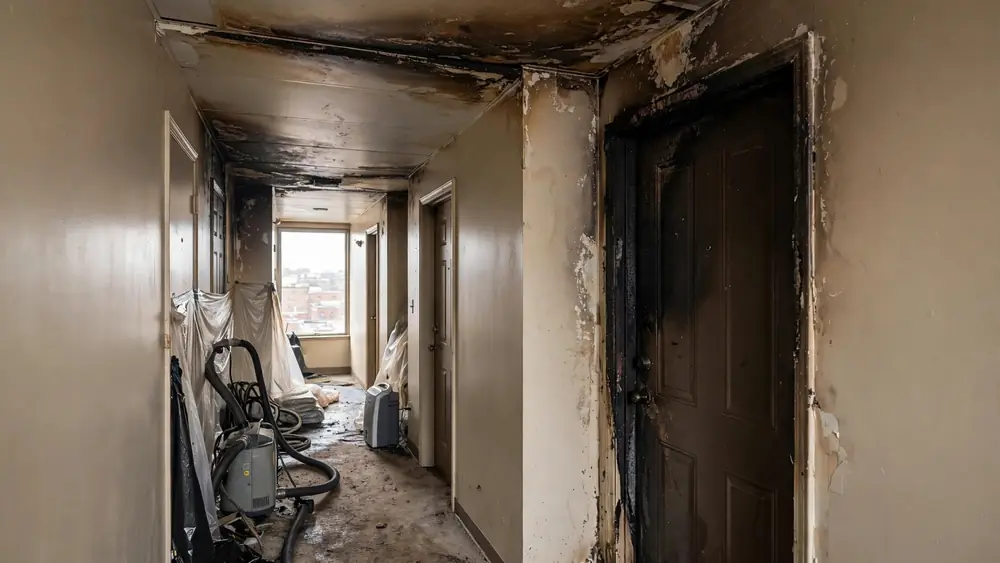
In a sprinklered building, a small fire often activates one or two sprinkler heads, which put the fire out or hold it in check. Sprinklers save lives and limit fire spread, but each head releases a steady flow of water until the system is shut off, and that water does not stay in the unit. It runs under walls, through floor penetrations and into the units below.
It is common for the fire damage itself to be limited to a kitchen while the water damage covers the whole unit and two or three floors beneath. Drywall soaks up the water, engineered and wood floors cup, and ceilings below sag. Drying needs to start quickly in every affected unit, not only the one with the fire.
Building engineers usually know how to shut off the affected sprinkler zone and will want the system restored promptly, since a building with part of its sprinkler system off is less protected. Coordinate with management so the restoration does not interfere with getting the system back in service.
High-rise units
Restoring a condo or apartment in a downtown tower
Inside a high-rise unit, fire restoration looks like it does anywhere else: cleaning smoke and soot, drying water, removing damaged materials, deodorizing and repairing. What changes is the logistics. Crews have to book the freight elevator, use the loading dock at agreed times, protect corridors and elevators from debris, and follow the building's rules on work hours and noise.
Most buildings require contractors to provide proof of insurance and sometimes other documents before they can work. The association or management may also have a preferred vendor for common-area work. You still choose who works inside your unit, but coordination with the building's contractor is often needed.
Responsibility is usually split by the condo declaration: the association handles common elements and the structure, and owners handle unit interiors, finishes and contents. In rental towers, the owner handles the building and the unit, and tenants handle their belongings through renter's insurance [2].
Printers Row
Converted printing lofts in Printers Row
Printers Row, grouped along Dearborn Street, running south from Ida B. Wells Drive to Polk Street, was built mostly between 1886 and 1915 for printing and publishing businesses; many of its buildings have since become residential lofts, and part of the area is a Chicago landmark district [1].
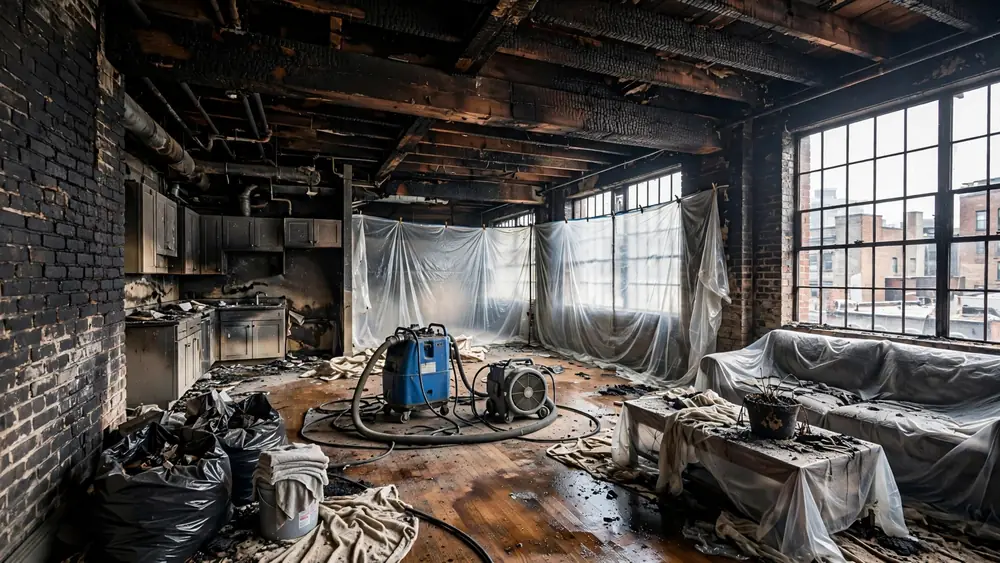
Loft units have open plans, high ceilings, exposed brick, heavy timber or iron columns and large windows. Smoke spreads quickly through an open plan and settles on rough surfaces like brick and old timber, which are harder to clean than painted drywall. Soot on exposed brick should be cleaned with methods that will not erode the old masonry, and heavy timber that is charred on the surface may need assessment.
Because part of Printers Row is a landmark district, exterior repairs on designated buildings may need review by the Commission on Chicago Landmarks as part of the permit [3].
By building type
Downtown building types and fire restoration focus
| Building type | Main issue | Restoration focus |
|---|---|---|
| Modern high-rise condo | Sprinkler water in units below; corridor smoke | Multi-unit drying; coordination with association |
| Rental tower | Same as condo, with tenants' belongings | Owner-led structure work; tenants' contents claims |
| Printers Row loft | Smoke on exposed brick and timber; open plan | Masonry-safe cleaning; landmark review for exterior |
| Converted office building | Shared systems, long corridors | Corridor and ventilation cleaning |
| Dearborn Park or Central Station townhome | Shared walls with neighbors | Neighbor units, attic and party walls |
Rail-yard neighborhoods
Townhomes and low-rise homes in Dearborn Park and Central Station
Not all of the South Loop is towers. Former rail yards were redeveloped into residential neighborhoods such as Dearborn Park and Central Station [1], with townhomes, low-rise condos and some single-family homes alongside newer towers.
Attached townhomes share party walls with their neighbors. A fire in one can send smoke through the attic and the wall into the next, and water may reach the adjoining units. Townhome associations usually handle roofs and exteriors, while owners handle interiors.
These homes are newer than most of Chicago's housing stock, so lead paint is less likely in the newest construction, but drywall, engineered floors and ducted HVAC systems behave differently from plaster and hardwood after a fire. Soaked drywall is more often replaced, and duct cleaning is usually part of the job.
Fire systems
Alarms, sprinklers and building systems after a fire
High-rise buildings have fire alarm systems, sprinklers in many cases, standpipes, fire doors and smoke control features, all maintained by the building. After a fire, the building will want these systems inspected and returned to service. Restoration work inside a unit should not disable smoke detectors or cover sprinkler heads without the building's knowledge.
Odor that keeps coming back in a unit may be coming from a shared system: a kitchen or bathroom exhaust riser, the corridor ventilation or a trash chute. Those systems are the building's responsibility. Report persistent odor to management and ask how shared systems will be cleaned.
The visit
How a downtown restoration job usually unfolds
- 1
Fire department release and management contact
Wait for the Chicago Fire Department to release the area [4], then contact management about access.
- 2
Book the freight elevator and dock
The contractor schedules equipment delivery and debris removal with the building.
- 3
Assess every affected unit
The fire unit, the corridor and units above and below are checked and photographed.
- 4
Start drying immediately
Water from sprinklers or hoses is extracted and drying equipment runs in every wet unit.
- 5
Clean smoke and soot
Units and corridors are cleaned, with containment to protect elevators and common areas.
- 6
Coordinate scopes and insurers
Photos and scopes are shared with the association and each household's insurer [2].
First steps
First steps for common downtown fire situations
| Situation | First step | Then |
|---|---|---|
| Sprinkler water coming through your ceiling | Turn off power to wet areas; tell management | Photograph; drying starts quickly |
| Smoke odor from another unit | Photograph staining; note where odor is strongest | Report to management and your insurer |
| Fire in your own unit | Wait for release; contact management | Secure the unit; book contractor access |
| Smoke on exposed brick in a loft | Do not scrub or pressure wash | Masonry-safe cleaning |
| Fire in an attached townhome | Check shared walls and attic | Coordinate with neighbors and the association |
Renters
Renting downtown after a fire
Many downtown residents rent, often in large professionally managed towers. After a fire, the building owner handles the structure and the unit's finishes, but not your belongings. The Illinois Department of Insurance points out that a landlord's insurance does not cover a tenant's personal property [2]. Your renter's insurance covers your belongings and often extra living expenses if you have to move out temporarily.
Document your unit thoroughly, including smoke-affected clothing and furniture, and keep receipts. Ask management in writing about repair timelines and whether you will be moved to another unit while yours is restored, which some large landlords offer.
Permits
Permits and approvals for downtown repairs
Repairs after a fire in a downtown unit, such as replacing drywall, electrical work, plumbing or flooring, may require permits from the Chicago Department of Buildings [5], and the building itself will have its own approval process for contractors working in units.
In Printers Row and other landmark districts, exterior work on designated buildings may need landmark review [3]. Ask your contractor who will handle permits and building approvals, and build the time into the schedule.
Access
Getting equipment and crews into downtown buildings
Downtown streets are busy, and street parking for a work truck is rarely available. Crews rely on building loading docks, which management schedules, and freight elevators that may be shared with move-ins and deliveries. Some buildings restrict work to weekdays during business hours.
Mention the building name and address when you call, along with any management contact. That lets the contractor arrange access quickly, which matters most when water needs to be extracted and dried.
Prevention
Preventing fires in downtown apartments
Cooking is the leading cause of home fires [6], and in apartments a kitchen fire that sets off a sprinkler can damage several units. Stay in the kitchen while cooking on the stovetop, keep a lid nearby to smother a pan fire, and keep flammable items away from the range.
Never cover or hang anything from sprinkler heads, and do not disable smoke detectors. Know your building's fire evacuation instructions, which can differ from those for a house.
Before the call
Helpful details for a downtown fire call
- Building name, address and unit number
- Building management contact and loading dock information
- Whether sprinklers activated and which units are wet
- Whether the fire was in your unit or another
- Building type: tower, loft, converted office or townhome
- Your insurer and claim number, if available
Coverage
Downtown ZIP codes covered
This page covers downtown ZIP codes 60601, 60602, 60603, 60604, 60605 and 60606, plus the eastern part of 60607. The West Loop ZIP 60661 is also covered. North of the river, River North and Streeterville are covered on their own page.
Downtown coverage is tied to the contractors who accept work in these ZIP codes and may be updated. Give your building's address when you call and you will hear right away whether it is covered.
Drying high-rise units
Drying several stacked units at the same time
Water from a sprinkler or hose line in a tower moves straight down through the floor assembly into the units below, often following plumbing risers and electrical penetrations. The ceiling of the unit below and the floor of the unit above are the same assembly, so drying one without the other leaves moisture trapped between them.
The most effective approach is one drying plan covering every affected unit, with a moisture map that follows the water's path from the fire unit down. Each unit gets dehumidifiers and air movers, and readings are taken daily in all of them. Management usually needs to grant access to units whose owners or tenants are away.
Ceilings in many towers are concrete slab with drywall or plaster below, while floors may be wood or engineered flooring over a concrete slab. Concrete holds moisture for a long time, so flooring is often removed or lifted to let the slab dry.
Electrical and mechanical
In-unit systems after a downtown fire
Downtown units usually have their own fan coil or heat pump units, a water heater or connection to a central system, and an electrical panel inside the unit. Water and heat can damage all of them. Keep the unit's HVAC off until it has been inspected, since running it can spread smoke residue and damage wet components.
Electrical circuits that got wet should be checked by a licensed electrician before use; the Illinois Department of Insurance advises having electrical equipment checked by a professional after a loss [2]. Many buildings require their own engineering staff to be involved in any work on in-unit systems that connect to building systems.
Contents
Moving belongings out of a downtown high-rise
When a unit needs heavy cleaning or drying, belongings are often packed out to a facility. In a high-rise, that means scheduling the freight elevator and loading dock, protecting corridors and elevator cabs, and working within the building's move hours. Larger pack-outs may take several elevator reservations.
Tell the contractor about any building limits on work hours or elevator use before they schedule. If you are displaced, ask whether items you need, such as work clothes or a laptop, can be cleaned first and delivered to you.
Converted offices
Apartments in converted Loop office buildings
Some downtown residences are in older office or commercial buildings converted to apartments or condos, part of the redevelopment that drove the Loop’s population growth [1]. These buildings often have long corridors, shared mechanical systems that were adapted for residential use, and older structural materials behind new finishes.
After a fire, those shared systems can carry smoke between units in ways a purpose-built residential tower might not. Ask management how the ventilation is arranged, and expect the contractor to check corridors and shared ducts as well as your unit. Older materials behind the finishes, such as plaster or old insulation, may need testing before demolition in the oldest buildings.
FAQ
Questions from Loop and South Loop residents
A small fire in a unit above set off the sprinkler and my ceiling is leaking. What now?
Turn off power to the wet area if you can safely, tell building management, photograph the damage and get drying started quickly. Sprinkler water often damages several units below the fire.
Who pays for damage to my condo from a neighbor's fire?
It depends on your declaration and the policies involved. Usually your unit-owner policy covers your interior and contents, the association handles common elements, and the insurers sort out responsibility between them.
Can soot be cleaned from exposed brick in my Printers Row loft?
Usually, with HEPA vacuuming and masonry-safe cleaning methods. Avoid scrubbing with water or pressure washing, which can drive soot deeper and erode old brick.
Why does my apartment smell of smoke when the fire was on another floor?
Smoke can travel through corridors, exhaust risers and building ventilation. If odor persists after your unit is cleaned, the source may be a shared system that management needs to address.
Do I need building approval for a restoration contractor?
Most downtown buildings require contractors to register, provide proof of insurance and schedule elevators and docks. Contact management early.
Is my Dearborn Park townhome affected by a fire next door?
Attached townhomes share walls and sometimes attic space, so smoke and water can cross into your home. Document any damage and tell your insurer and association.
How long does it take to restore a high-rise unit after a fire?
Drying often takes days to a couple of weeks, and repairs follow. Building approvals, permits and coordination with other units can add time.
Why did the flooring in my tower unit have to be lifted after sprinkler water?
Water trapped between flooring and the concrete slab dries very slowly and can cause mold or warping. Lifting the flooring lets the slab dry and allows accurate moisture readings.
Can my contents be packed out of a downtown high-rise?
Yes. The contractor schedules the freight elevator and loading dock with management, protects corridors and elevators, and moves items to a facility for cleaning and storage.
Does the building’s insurance cover my condo interior after a fire?
It depends on the declaration and the master policy. Many associations insure the structure and common elements while owners insure their own interior finishes and contents. Check your declaration and talk to your own insurer early.
Can I stay in my unit while it is being dried?
Sometimes, if the fire damage is limited and the power and air are safe. Drying equipment is noisy and runs around the clock, and heavy smoke cleaning usually requires the unit to be empty.
Nearby
More around Loop and South Loop
Back to all of Chicago. Nearby pages: Lakeview, Logan Square, Portage Park and Jefferson Park, River North and Streeterville, Uptown and Edgewater.
Related help for Loop and South Loop: water extraction, structural drying, sewage backup cleanup, fire damage restoration and smoke damage cleanup. First time dealing with this? Read the first hours after water damage.