Key facts: Fountain Square
- Much of Fountain Square was platted between 1870 and 1873, with Virginia Avenue as its commercial spine [3].
- Three Fountain Square historic districts gained National Register status in 1983 [3].
- Interstate construction in the late 1960s and early 1970s demolished a large part of the original neighborhood [3].
- Lateral repairs, lining and replacements need a Citizens Energy Group permit; the owner maintains the lateral to the main [1].
Covered area
Fountain Square addresses on this page
This page covers Fountain Square on the southeast side of Indianapolis, in ZIP code 46203: the area around the Virginia Avenue, Shelby Street and Prospect Street intersection, south toward Pleasant Run Parkway and east of Fletcher Place. Calls from these addresses are connected with an independent contractor who works on sewer laterals in this part of the city.
Neighboring ZIP codes including 46201, 46202 and 46225 are covered too. The rest of the covered neighborhoods are listed on the areas page. If your address is outside the covered ZIP codes, the call may not connect you with a contractor.
History
Fountain Square's layers of building
The land that became Fountain Square was a farm bought by Calvin Fletcher and Nicholas McCarty in 1835. Virginia Avenue, a diagonal street from the original 1821 plan of Indianapolis, became a southside commercial street by the 1860s, and the area was platted again and again between 1870 and 1873 [3]. German immigrants drove much of the growth, and a streetcar line ending at the fountain gave the district its nickname, The End [3].
For roughly three decades after 1920, Fountain Square was where Indianapolis went out for theaters and dancing, and the population topped out around mid-century. Then building the interchange where I-65 meets I-70, in the late 1960s and early 1970s, cleared a large part of the neighborhood, including many flats and apartments [3]. In 1983, three Fountain Square districts gained National Register status [3].
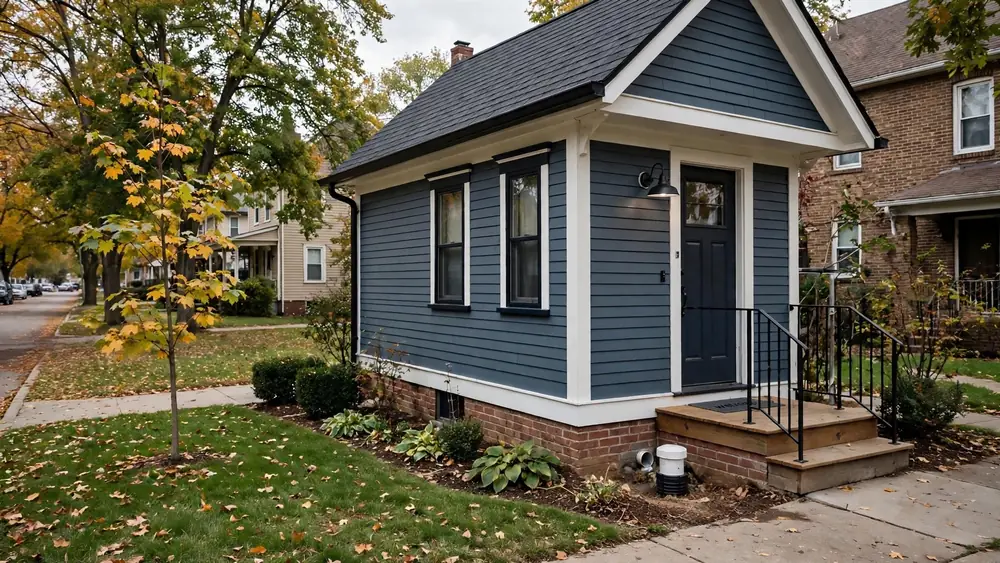
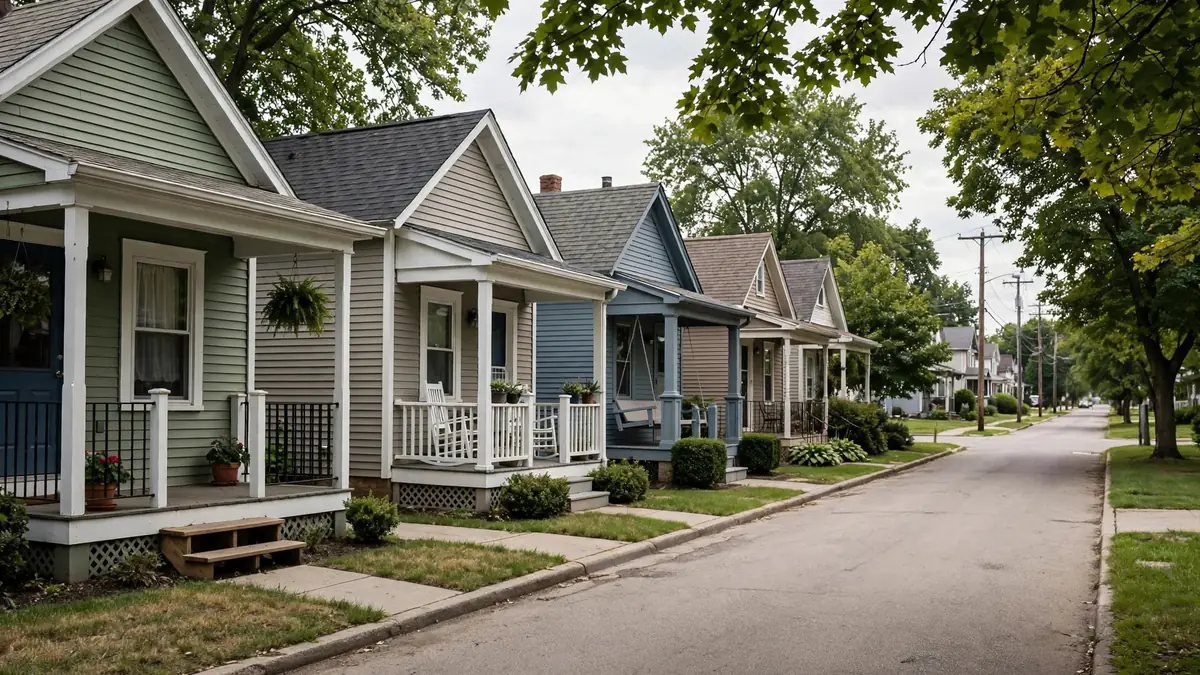
For sewers, that history means variety. Some homes date to the 1870s and 1880s, others to the early twentieth century, and many have been rehabbed in recent years. Infill houses stand on lots cleared decades ago. Old commercial buildings along Virginia Avenue and Shelby Street have long, heavily used lines. The pipe under each property can be very different from the one next door.
Common calls
Fountain Square sewer problems contractors see
Original laterals under rehabs
Beautifully renovated interiors draining into a century-old clay line that has not been touched.
Roots at old clay joints
Trees in small front yards and tree lawns send roots into joint gaps; see root intrusion removal.
Commercial grease
Restaurants and bars along Virginia Avenue load their laterals with grease.
Infill on old taps
New houses on cleared lots sometimes reuse an old connection at the main.
Abandoned laterals
Lots where houses were demolished can leave old laterals in the ground that confuse later work.
Crawlspace and shallow basements
Smaller cottages may have crawlspaces, putting the cleanout outside or under the floor.
Rehabs and old pipe
Why rehabbed Fountain Square houses still back up
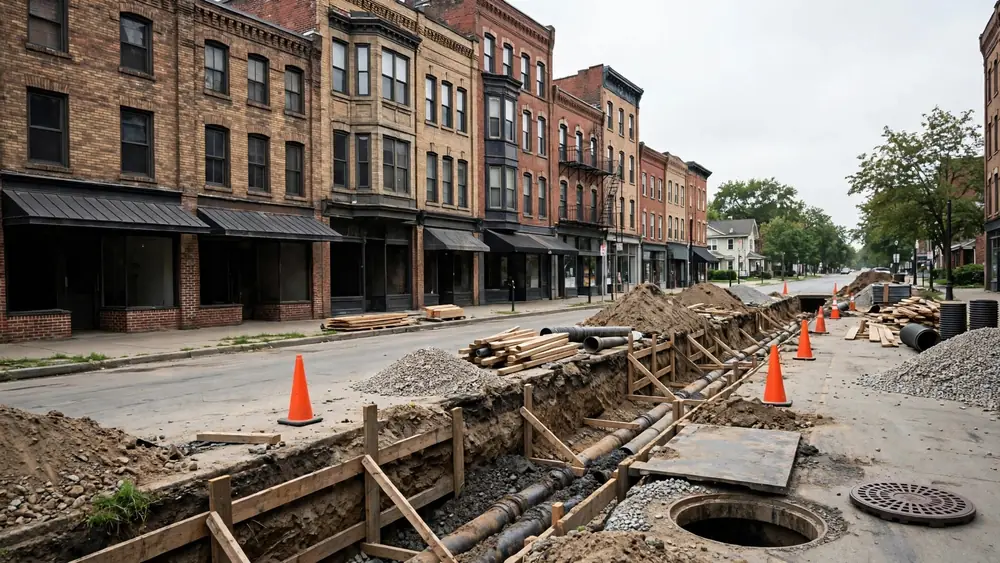
Fountain Square has seen a lot of renovation. Kitchens and bathrooms are new, supply pipes are new, and interior drains are often replaced too. But the lateral, the pipe from the foundation to the main, is underground and out of sight, and it is often left alone. In a house from the late 1800s or early 1900s, that lateral may be original clay laid in short sections with mortar joints [5].
After a renovation, the house may also be used more heavily than it was for years: more bathrooms, a dishwasher, a high-efficiency washer, more people. An old lateral that coped with light use can start to struggle. The first sign may be a gurgle in a new tub or water at a basement floor drain.
If you are buying a rehabbed house, ask whether the lateral was replaced or lined, and ask for a video if it was. If no one knows, a sewer camera inspection before closing is a sensible step. If you are rehabbing a house yourself, film the lateral before the new finishes go in.
Cleared lots
Interstate clearance, vacant lots and forgotten laterals
When large parts of the neighborhood were cleared for the interstate interchange, and as other houses were demolished over the years, laterals were not always removed or properly capped. Some old pipes remain in the ground, connected to the main or abandoned partway. New houses built on those lots may connect to a new tap, or to an old one.
This history can make sewer work in Fountain Square less predictable. A camera inspection sometimes reveals a second lateral, an old wye with nothing attached, or a connection in an unexpected place. Utility locates through Indiana 811 mark public utilities [6], but old private laterals are not part of that, so contractors rely on cameras and locators to sort them out.
If you are building or rebuilding on an infill lot, ask the contractor and Citizens Energy Group about the connection point before construction. Whether the old tap can be reused depends on its condition and on the utility's standards [1].
Virginia Avenue
Commercial and mixed-use lines along Virginia Avenue and Shelby Street
Fountain Square's main streets have restaurants, bars, music venues, shops and apartments, many in buildings more than a century old. Their sewer lines carry kitchen grease, high volumes on busy nights and sometimes flow from several tenants. Grease is a leading cause of sewer blockages [4], and it builds up faster on the rough walls of older pipe.
For these buildings, regular hydro jetting and grease interceptor maintenance are the backbone of prevention. When the camera shows structural problems, lining is often favored because it can be done without long sidewalk closures. Lines that run under the sidewalk or into the street to reach the main bring right-of-way work into any excavation.
Building owners should keep a record of cleanout locations, who shares the line and when it was last cleaned and filmed.
Pleasant Run
Storms and Pleasant Run on Fountain Square's southern edge
Pleasant Run Parkway forms Fountain Square's southern boundary [3]. Like other streams in the older city, Pleasant Run historically received overflow from combined sewers during heavy rain [7]. Citizens Energy Group's DigIndy tunnel system, finished in 2025, now stores much of that overflow underground until it can be treated [2].
For homeowners, the question is whether a backup happened on a dry day or during a storm. Dry-day backups are almost always the private lateral. Storm-only backups, particularly in lower spots and when neighbors are affected too, can be backflow from the public sewer, and a backwater valve is the device made for that.
A typical job
How a sewer repair usually goes in Fountain Square
- 1
Find the access
Basement cleanout, outside cleanout, crawlspace access or a toilet if nothing else exists.
- 2
Clear and film
The line is opened and filmed from the house to the main, noting material changes and any extra connections.
- 3
Sort out the layout
On lots with history, the contractor confirms which pipe is yours and where it joins the main.
- 4
Choose the fix
Lining, bursting, a spot repair or replacement, based on the video and what sits above the line.
- 5
Permit and locates
The Citizens permit and an Indiana 811 locate request come before digging [1][6].
- 6
Final video and inspection
The finished line is filmed and inspected before any excavation is backfilled.
Property types
Fountain Square properties and what to expect underground
| Property | Likely lateral | Watch for |
|---|---|---|
| 1870s to 1900s cottage | Original or patched clay | Roots, cracked joints, offsets |
| Rehabbed historic house | New interior drains, old lateral | Old lateral struggling with new loads |
| Infill house on a cleared lot | New pipe, possibly old tap | Problems at the main connection |
| Commercial building on Virginia Ave | Long, heavily used line | Grease narrowing and backups |
| Double or small apartment | Shared lateral | One blockage affecting several units |
Before the visit
Getting a Fountain Square property ready for a sewer call
- Find the cleanout; in cottages without basements, look outside near the foundation or under the house.
- If the house was rehabbed, gather any records of what plumbing was replaced.
- Mention if the lot once had a different house or was combined with a neighboring lot.
- For businesses, schedule work outside service hours where possible.
- Plan parking; streets near the commercial core fill quickly in the evening.
- Tell any tenants sharing the line about the visit and ask them to hold off on water use.
- Share any earlier camera video or purchase inspection.
Choosing a repair
Repair approaches that fit Fountain Square lots
Fountain Square's lots are often small, with houses close to the sidewalk and to each other. Trenchless methods are a natural fit: CIPP lining can rebuild a round clay lateral from the cleanout, and pipe bursting can replace a deformed or badly cracked line with only two pits.
Where the camera shows a sag, a collapsed section or a damaged connection at the main, digging is usually needed for that part. On short front yards that may be a modest excavation, though street connections bring extra coordination.
If your house has no outside cleanout, adding one during the repair is worth considering. It makes the next visit much simpler.
Prevention
Prevention habits for Fountain Square homes and businesses
- Film the lateral during any renovation, before new finishes go in.
- Keep grease out of drains; businesses should keep interceptors on schedule.
- Only flush toilet paper, especially in rentals and short-term rentals.
- Schedule root clearing before the season your line usually clogs.
- Keep a record of the lateral's route, material and condition.
- Consider a backwater valve if storm backups have happened.
Nearby
Neighborhoods near Fountain Square
To the south, Garfield Park shares Pleasant Run and similar older housing. To the east, Irvington has some of the oldest laterals on the east side.
Historic districts
Sewer work inside Fountain Square's historic districts
Fountain Square has three National Register districts, all added in 1983: Laurel and Prospect, State and Prospect, and Virginia Avenue, the last described as Indiana's first commercial historic district [3]. National Register listing on its own recognizes significance; it does not usually control what an owner does with a private sewer lateral underground.
Where local historic or conservation rules apply, the parts of a sewer job that tend to matter are the visible ones: historic sidewalks, steps, stoops, retaining walls and storefront details near an excavation. Trenchless methods leave most of those untouched, which is one reason they are popular in older commercial districts. If a dig will disturb a visible historic feature, ask the contractor whether any local review applies and plan to restore the feature faithfully.
The utility rules are unchanged by historic status. Citizens Energy Group's lateral permit still applies to repairs, lining and replacement, and the work is inspected before backfill [1].
Short-term rentals
Short-term rentals and Fountain Square sewer lines
Fountain Square's popularity with visitors has brought short-term rentals into many older houses. Guests do not know a house's quirks, and they are more likely to flush wipes, paper towels and other items that a long-term resident would bin. In an older clay lateral with root-caught joints, that is a fast route to a backup, often on a weekend.
Owners of short-term rentals can reduce the risk with clear signs in each bathroom, a lidded bin beside every toilet, and a lateral that has been filmed and, if needed, cleared or lined before the busy season. Keeping the contractor's number and the cleanout location in the host's notes means a cleaner or co-host can act quickly if the floor drain starts to rise between guests.
Clues
Signs your Fountain Square lateral is the problem
- Multiple fixtures slow at onceTub, toilet and sink all draining slowly together points past the branch drains to the main line.
- Floor drain or lowest fixture backing upWater appearing at the lowest opening when other fixtures are used is a classic lateral sign.
- Wet ground between house and streetA soggy spot in a small front yard can mean a break below it; see sewer smell in the yard.
- Recurring clogs after clearingLines that need clearing more than once a year usually have roots or structural damage.
- Sewer odor outdoorsA sewage smell near the foundation or curb can point to a cracked lateral or a missing cleanout cap.
After a repair
What to keep after a Fountain Square sewer repair
Keep the permit details, the final camera video, a photo of the route marks and the invoice describing what was done and where. In a neighborhood with this much history underground, a clear record of your own lateral is valuable to you, to future contractors and to whoever buys the house next.
Interstate edge
Living next to the interstate and the sewer below
Streets on Fountain Square's northern and eastern edges sit close to the I-65 and I-70 corridors that were cut through the neighborhood. Construction on that scale disturbed soil, removed blocks of houses and changed how surrounding streets were laid out. Some surviving houses near the highways ended up on altered streets or with altered utility arrangements, and occasionally their laterals take routes that do not match the current street layout.
For homeowners near the highway edge, that is another reason to trust the camera and locator over assumptions. A lateral that seems to head toward the street in front may actually join a main in a side street or an alley. Ask the contractor to trace and mark the full route before choosing a repair method.
Heavy traffic vibration is sometimes blamed for cracked laterals near highways. It is difficult to prove for any single house, and age, roots and soil movement are far more common causes. The video will show what is actually wrong.
Buying
Questions for sellers of Fountain Square homes
Ask whether the lateral was replaced or lined during any rehab, whether there have been backups, whether the house has a cleanout and where it is, and whether any camera video exists. Ask if the lot ever had a different building. The answers, along with a sewer scope during your inspection period, give you a realistic picture of what is under the yard.
Basements and cottages
Floor drains and crawlspaces in Fountain Square houses
Fountain Square's housing ranges from cottages on crawlspaces to two-story houses with full basements. In basement houses, a blocked lateral announces itself at the floor drain. In crawlspace cottages, it may show first in a bathtub or shower on the main floor, and sewage can spread unseen under the house. If a crawlspace cottage has slow drains everywhere, ask the contractor to check the crawlspace for leaks or standing water as well as clearing the line.
FAQ
Fountain Square sewer questions
My Fountain Square house was just rehabbed. Why is the sewer backing up?
Renovations often replace interior plumbing but leave the original lateral outside. If that lateral is old clay with roots or cracks, it can back up even into brand-new fixtures. A camera inspection will show its condition.
Can an old lateral from a demolished house affect my sewer?
It can complicate things. Abandoned laterals and old connections sometimes remain in the ground, and a camera may be needed to confirm which pipe serves your house and where it joins the main.
Who maintains the sewer for a Fountain Square business?
The property owner maintains the lateral from the building to the main under Citizens Energy Group's rules. Leases may assign day-to-day maintenance like interceptor service to the tenant.
Do I need a permit to line my Fountain Square sewer?
Yes. Lining, repairs, cleanouts and replacements of a lateral need a Citizens Energy Group permit. Routine cleaning and root removal do not.
Does Pleasant Run cause sewer backups in Fountain Square?
Not directly, but heavy storms can fill older sewers in the area. If your basement backs up only in big storms, ask about a backwater valve and report it to Citizens.
Is Fountain Square's ZIP code covered?
Yes, 46203 is covered, along with neighboring southeast-side ZIP codes. Calling is the quickest way to confirm your address.
Is trenchless repair possible on a small Fountain Square lot?
Often, yes. Lining from a cleanout needs no trench, and pipe bursting needs only two small pits. The camera decides whether the old pipe is suitable.
Should I scope the sewer before buying in Fountain Square?
It is a sensible step for most older or rehabbed homes, since the lateral is often original and a general home inspection does not usually include it.
Nearby
More around Fountain Square
Back to all of Indianapolis. Nearby pages: Broad Ripple, Butler-Tarkington, Garfield Park, Irvington, Meridian-Kessler.
Related help for Fountain Square: water extraction, structural drying, sewage backup cleanup, fire damage restoration and smoke damage cleanup. First time dealing with this? Read the first hours after water damage.