
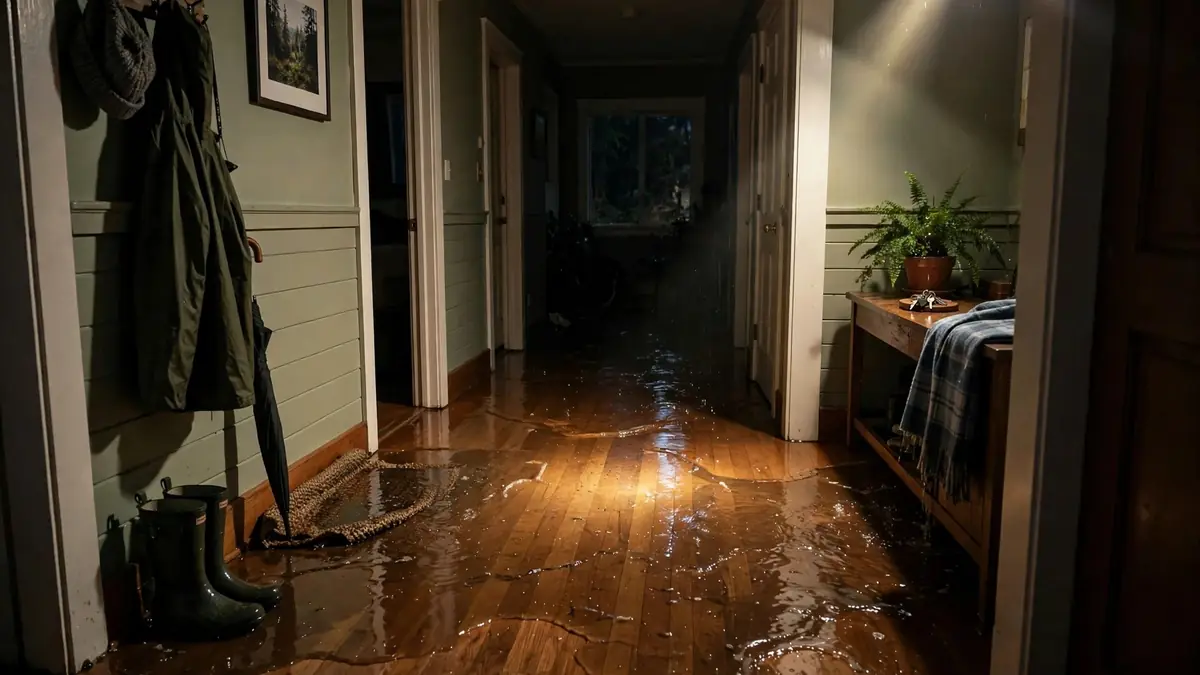
Key facts: Emergency Water Damage Services
- Close the main valve: Most homes have it where the line enters, near the meter or a basement wall.
- Cut power to wet rooms: Only do this if the panel is dry and you can reach it without crossing water.
- Calls go to independent contractors rather than a single company, and who can take the job differs from place to place.
Right now
First steps for water damage services
- 1
Close the main valve
Most homes have it where the line enters, near the meter or a basement wall.
- 2
Cut power to wet rooms
Only do this if the panel is dry and you can reach it without crossing water.
- 3
Photograph everything
Record rooms and belongings before anything is moved.
- 4
Lift what you can
Move rugs and small furniture off the floor.
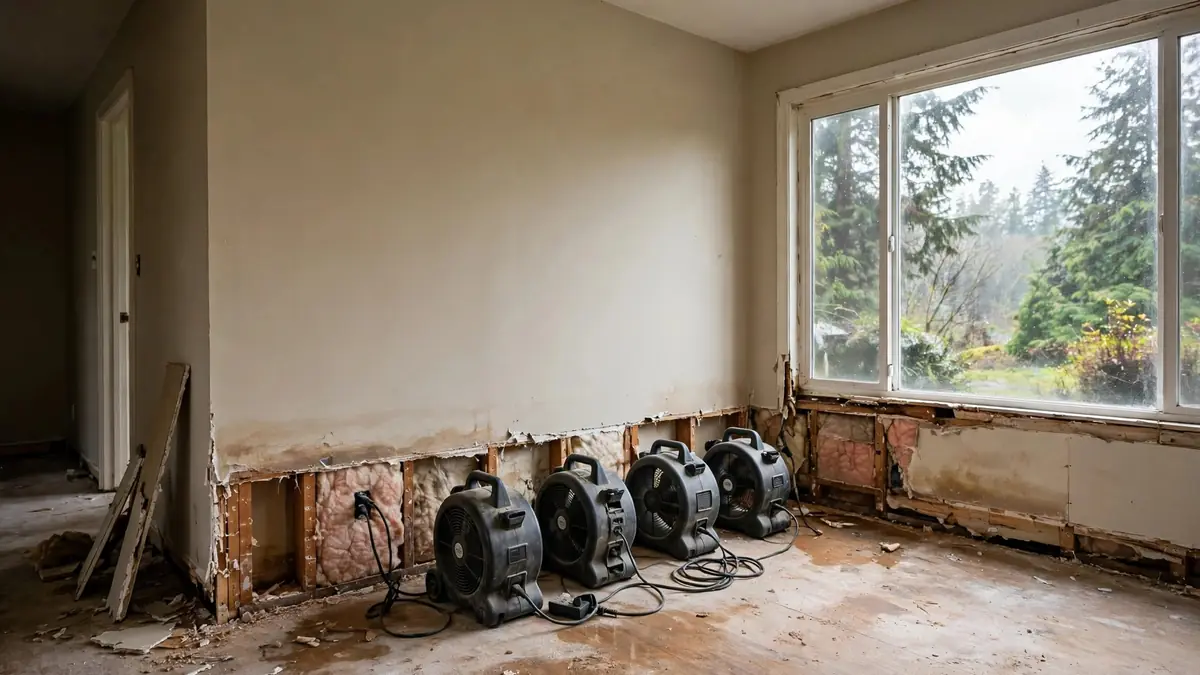
A wet room partway through drying
Triage
Sorting a water emergency by what can hurt you
When water is moving through a house, the instinct is to save the sofa. Put people first, then the source, then the building, then belongings, in that order. A soaked rug can wait five minutes. A person walking barefoot into a room where water has reached a power strip cannot.
Ask four questions as you move. Is there any sign of electricity or gas involved? Is the ceiling or floor changing shape? Is the water still coming in? Does it smell of sewage or fuel? Your answers tell you whether you stay and act, go outside and phone, or call emergency services.
Quick sort
What you see and what it means for the next five minutes
This table is deliberately cautious. If two rows apply, follow the more careful one.
| What you notice | Treat it as | Do this now |
|---|---|---|
| Gas smell or hissing | Possible gas leak | Leave without touching switches, then call emergency authorities from outside |
| Water at outlets, panel or cords | Shock hazard | Stay out of the water; shut power only from a dry place, or call an electrician |
| Sagging or cracking ceiling | Collapse hazard | Clear the room and close the door |
| Sloping floor, shifting noises | Structural danger | Get out and stay out until an inspector clears it |
| Sewage smell or dark water | Contaminated water | Keep everyone away and stop using all drains |
| Clear water, power safe, source known | Clean water loss | Close the valve, document, start moving belongings |
| Water rising from outside | Flood | Follow local orders, and leave if told to |
The clock
From first drip to day two in a home with a water loss
Availability varies, so nobody can promise you when help will come. These are the jobs that stay useful whether a contractor is on the line, on the way or still unconfirmed.
- 1
The moment you find it
Stop, look, and listen from the doorway. Water may be coming from above, from a wall, or through a floor. If nothing rules you out on safety grounds, go to the source.
- 2
Within minutes
Close the main valve or the fixture stop. For appliance leaks, use the stop behind the machine. If the water comes from outdoors, you cannot close it, so concentrate on safety and moving things up.
- 3
Within the first half hour
Deal with power. CDC guidance says to turn off the main breaker or fuse if circuits got wet, and to call an electrician if you would have to step into standing water to reach it.
- 4
By the end of hour one
Have photographs and a short video of each affected room, plus your first phone calls under way. Send someone to meet a contractor at the door if one has been arranged, so the rest of you can stay out of wet rooms.
- 5
Hours two to six
Move what you can to a dry room. Blot wood furniture and prop it up. Hang wet fabrics rather than piling them. Take books and paper to a dry space and stand them open if they are damp.
- 6
That evening
Decide where everyone will sleep. Bedrooms over or next to wet rooms may be damp, noisy with equipment, or without power. Anyone with asthma or a weak immune system should plan to be elsewhere.
- 7
The next morning
Walk the house with a flashlight. Check closets, cabinets, the rooms beneath the leak, and the far side of shared walls. New stains and warped baseboards point to where the water went overnight.
- 8
Day two
Two days is the outer limit in EPA guidance for getting wet things dry. If wet carpet, drywall or insulation is still sitting untouched, this is the time to press for a decision.
Stop
Moves that feel helpful and are not
- Walking through water to "just grab" somethingReady.gov warns against touching wet electrical equipment or anything electric while standing in water. Things can be replaced.
- Plugging in wet appliances to test themUnplug from a dry position and leave them off until someone qualified has looked. Ask an electrician about anything that got wet inside.
- Using a gas or charcoal device for heat or dryingGenerators, pressure washers and charcoal or propane devices must not run indoors, in garages or basements, or near open windows and vents, according to CDC. Carbon monoxide is odorless.
- Closing up the room to "keep it contained"Without airflow, a sealed wet room stays wet. Keep doors shut only for a contamination, sewage or mold reason.
- Throwing out damaged items before anyone has recorded themReady.gov advises making an inventory before discarding, which applies to water losses too. If health reasons force something out quickly, photograph it first.
- Pulling up carpet by yourself in a rushTack strips, staples and unknown older materials can injure you. Ask the contractor before pulling up flooring, especially in an older house.
- Signing anything in the heat of the momentRead every page, ask what it authorizes, and take time if you need to. See the contractor questions further down.
Sources
Where it came from changes who you need
The cause sets the trade you need and how the wet material is handled.
| Source | First contact | Point to raise on the phone |
|---|---|---|
| Pipe or fitting | Plumber | Whether the leak is before or after the main valve |
| Washer, dishwasher, refrigerator line | Plumber or appliance technician | Which valve stopped it and how long it ran |
| Water heater | Plumber | Fuel type and whether the unit is off |
| Roof or storm opening | Roofer or tarp crew | Whether rain is forecast and where the water enters |
| Drain or toilet overflow | Plumber or sewer contractor | Whether the water looks or smells contaminated |
| Rising floodwater | Local emergency officials first | Any evacuation orders in your area |
| Firefighting water | Fire department, then insurer | Whether the building has been cleared for entry |
First call
How to describe the problem so the person on the phone can help
Short specifics beat a long story. Say the type of building and how many floors. Say what is wet: carpet, hardwood, drywall, ceiling, basement. Say when it began, or when you found it if you were away. Say whether the source has stopped and whether the power is on in the wet area. Mention anyone in the home who is older, very young or medically vulnerable, and say whether you own or rent.
Then ask your own questions. Who actually does the work? Are they able to serve your address? What should you do before they get there? Is there anything you should stop doing? When someone cannot take the job, ask them what you should prioritize while you look for help elsewhere. The site is a referral line and the work is done by independent contractors, so your questions about credentials and scope belong with the contractor who will be in your home.
Check
Questions to put to any contractor at the door
Being in a hurry is no reason to skip these. They take a few minutes, and a reputable contractor will not mind.
- What licences or registrations does your state require, and do you hold them?Rules differ between states and even trades. Check with the state or local body if you are unsure.
- Can I see your insurance certificate?Ask for general liability and workers' compensation documents, and note the policy dates.
- What will you remove, and why?Ask them to show you the wet material and readings that back up each removal.
- How will you measure dryness?Moisture readings taken against an unaffected area of the same material are the usual approach. Ask for copies.
- What am I signing?Find out whether a document is a work authorization, an assignment of insurance benefits, or something else. Ask your insurer if you are uncertain.
- Who supervises the job?Get a name and a phone number, plus the name of the company that will send the paperwork.
Keep
A record that holds up later
- The timelineA dated list of what happened and who was called. Add to it daily until the job is over.
- Before picturesWide and close-up, room by room, ideally before anything is moved. Include the ceiling and the floor.
- A damaged-goods listFor each item, give a description, rough age, and where it was. A photo with a label in view is ideal.
- Daily readingsIf equipment is running, ask for moisture and humidity logs. They show progress and support any claim.
- Every receiptHotel rooms, meals, and supplies bought because of the event. Ready.gov notes that insurers may want them after a fire, and the same habit makes sense here.
- Notes from each conversationInclude what the adjuster, contractor or landlord told you, with the date. Ask for important instructions by email.
Health
Who should not be in the house during cleanup
Ready.gov rules children out of cleanup work and steers anyone with lung disease or low immunity away from leaking or mold-affected buildings. CDC adds that children and pets should stay away from the affected area until cleanup is complete. Plan around that on day one, instead of waiting until someone starts coughing.
If you are doing any safe work yourself, wear rubber boots and gloves, wash with soap and water when you finish, and clean any open cut that touched the water. Follow local officials on whether your water is safe to drink, particularly if an advisory has gone out after a storm. If you get hurt or feel sick, get medical attention rather than pushing through.
Keep lifts below 50 pounds per person, and work in pairs. Exhaustion is a hazard in its own right during a long day of hauling. In hot weather, drink water often and take breaks somewhere cool.
Questions
Water Damage Services: quick answers
Is it an emergency if the water has stopped?
Often yes. Materials keep absorbing it, and EPA guidance sets a 24 to 48 hour drying target.
What should I tell the contractor?
Say where the water came from, when it began and which rooms it reached.
Can I stay in the house?
Often yes, if there is no structural, electrical, gas or contamination concern and the affected rooms are closed off. Ask the contractor, and consider who in your home is most vulnerable.
Should I use my insurance?
That is your decision after reading the policy. Report the loss promptly so you keep the option, and ask your insurer what they expect you to do in the meantime.
What if I rent?
Tell the landlord in writing right away. The building usually belongs to them, but your belongings usually depend on your own renters policy.
Is it fine to run my air conditioning?
Only if the system stayed dry and is not suspected of contamination. CDC lists fans, air conditioners and dehumidifiers among the tools for drying a home, but the EPA warns against running a system you suspect holds mold.
My neighbor offered a wet vacuum. Should I use it?
Only for a small, clean spill, with safe power and no standing-water risk to you. Use a protected outlet in a dry room, and stop if anything feels wrong.
The water stopped hours ago and everything looks fine. Am I done?
Not necessarily. Moisture may remain behind baseboards and under flooring. A moisture meter gives a real answer in places your eyes cannot.
Next
When nobody is in danger any more
The water damage restoration page describes the work from assessment to rebuild. The first hours guide goes deeper on early decisions, and hidden moisture detection helps once things look dry but may not be.