
Key facts: Downtown Prosper
- Prosper formed in 1902 when Rock Hill and Richland merged around the railroad, and it incorporated in 1914 [1].
- The town adopted a Downtown Master Plan in 2022, focused on the historic commercial core [2].
- A community-based advisory committee has been working on implementing the plan, according to 2024 reporting [3].
The buildings
How downtown differs from the rest of Prosper
The Town of Prosper traces its founding to 1902, when the Rock Hill and Richland communities joined as a rail line, the St. Louis & San Francisco, came through, and it incorporated in 1914 with around 500 residents [1]. Its historic commercial core is the focus of the Downtown Master Plan adopted in 2022, and the town's work on Broadway, Coleman and nearby streets has continued since [2] [3].
What this means for a building owner is variety. Downtown contains older commercial buildings, older houses and brand-new infill all within a few blocks. Unlike the master-planned sections, you cannot assume slab construction, particular pipe materials or a modern shutoff arrangement. Some older buildings may have pier-and-beam floors with a crawlspace, while others have been remodeled more than once. We have not surveyed these buildings, and we describe possibilities here rather than facts about any one address.
We have no local job record to cite and do not claim to have worked on any downtown property. Treat this page as a list of the right questions, and check your own building's records.
Common calls
Water problems typical of an older, mixed core
Ask which of these fit your building.
Roof and parapet leaks
Flat or low-slope commercial roofs ponding water can leak well away from the entry point.
Old supply and drain lines
Older buildings may have mixed pipe materials from many years of repairs.
Sewer line issues
Longer service, older drains and shared arrangements are worth checking.
Read moreTenant and owner overlap
A leak in one suite can reach another, which raises questions about who handles what.
Commercial
Shops, offices and restaurants after a leak
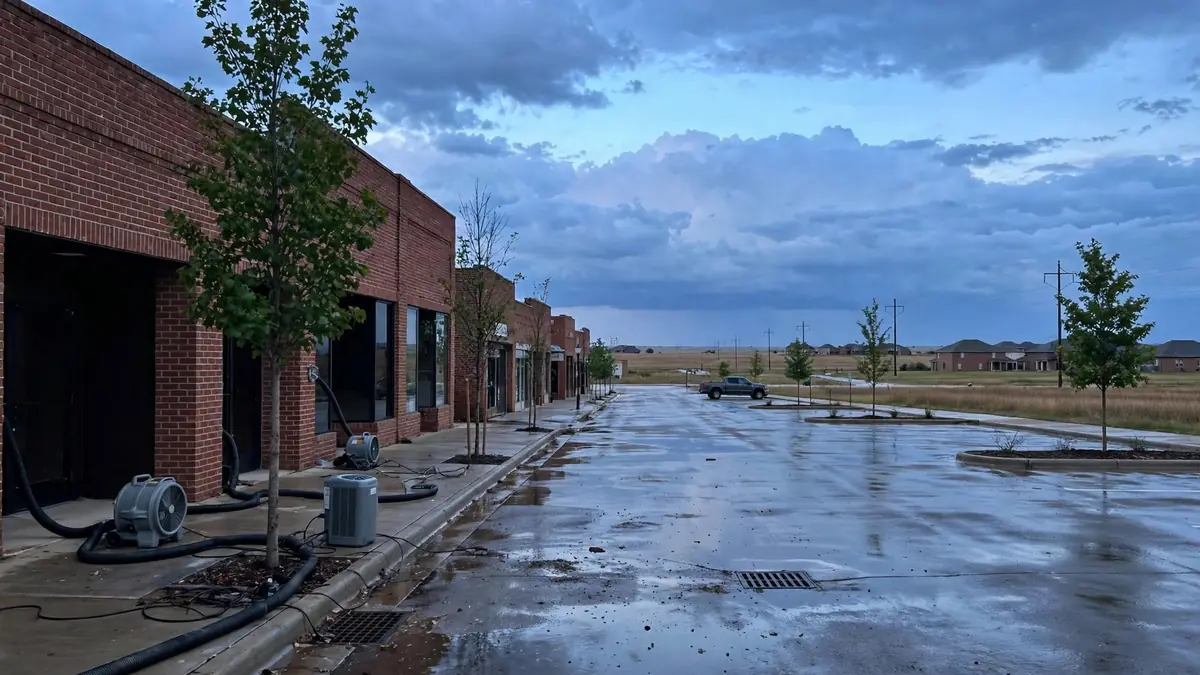
A water loss in a small business is different from one at home. The questions include how quickly you can reopen, who has access, what is covered by the lease and how to protect stock and records. Tell the contractor if the premises include food preparation, because cleaning and health requirements may affect the order of work, and speak to your local health authority if food areas are involved. Ask about working around business hours, because loud equipment runs continuously and may make it hard to stay open.
If you lease, notify your landlord right away, photograph the area and read the lease to see who handles what. Building owners generally handle the building's structure and shared systems, while the tenant's insurance may cover stock and improvements, but this varies, so read yours. A business policy is not the same as a homeowner's policy, and the general guidance we quote from the Texas Department of Insurance is written mainly for home and renter policies.
Shared walls
When a leak crosses a property line
Buildings built side by side may share a wall or have tightly adjoining roofs. Water can move through a shared wall, along a parapet or beneath floors, and a problem that begins in one unit may show up in the next. Tell your neighbor quickly, and ask them to check their side. If you own the building, check adjoining suites as well, even when they seem dry. Moisture readings on both sides of a shared wall are the best evidence of how far it spread, and that evidence can matter if insurers end up discussing it with each other.
Who handles what
Common downtown scenarios and who to notify
| Scenario | First step | Also notify |
|---|---|---|
| Water coming from upstairs tenant | Find that tenant or owner, close the valve | Landlord, your insurer |
| Roof leak in rain | Move stock, contain water | Building owner, roofer |
| Sewage in a restroom | Stop water use, close the room | Plumber, owner, health authority if food is served |
| Pipe break after hours | Close building main | Owner, alarm company if a flow alarm rings |
| Fire sprinkler discharge | Call 911 if there is any fire; follow alarm procedure | Fire department, sprinkler contractor, owner |
| Street or utility work near building | Report to the town | Your insurer if water enters |
Redevelopment
Living with construction and new utility work
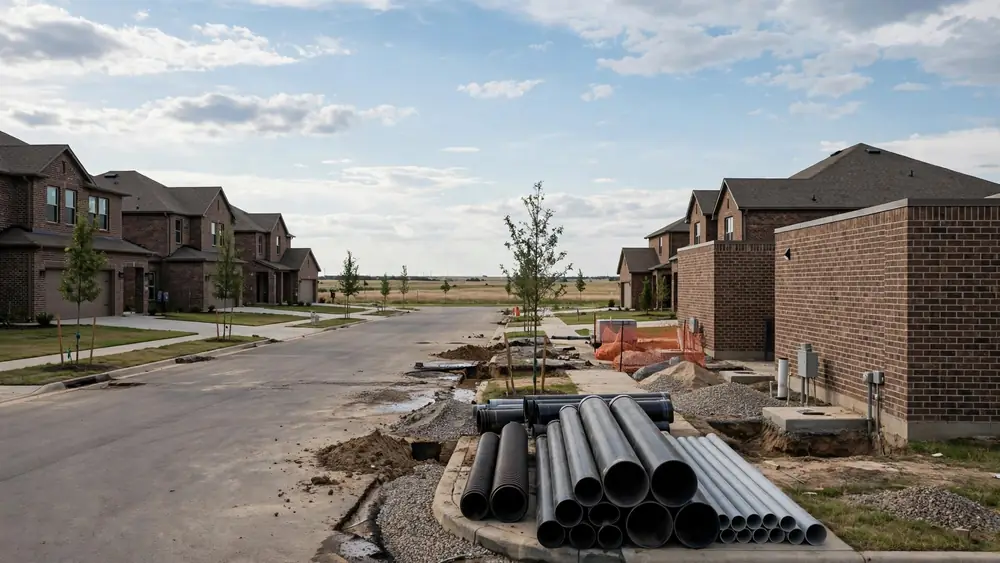
The town's Downtown Master Plan aims to shape new development in the historic core, and later plans have called for gateway work along Broadway at streets such as Coleman, Main, Crockett and McKinley [2]. Where streets and utilities are being rebuilt, older buildings may see changes in drainage, in water pressure, or simply vibration. Those are possibilities, and we have no reports of any linking construction to water damage downtown.
If water appears during nearby work, take dated photos, note what work is going on and call the town. Do not jump to conclusions about cause. Before renovation, ask your contractor to look at drain lines and roofs. Opening an old wall is a good moment to see what is inside it.
- Date your photos during nearby work
- Report drainage changes to the town
- Check lines when you renovate
Older construction
Pier and beam, plaster and mixed pipe
Some older structures may sit on piers with a crawlspace rather than a slab. Water behaves differently there. It can pool on the ground under the floor, soak insulation and raise humidity in the whole building, and drying must take place from below too. Plaster or older finishes also hold water longer than drywall and may need more careful handling. Older paint and materials may contain lead or asbestos, depending on age, and disturbing them requires care. Ask the contractor how they check for this before any demolition. These are not issues in most of Prosper's new subdivisions, which makes them easy to overlook.
Roofs
Low-slope roofs and summer storms
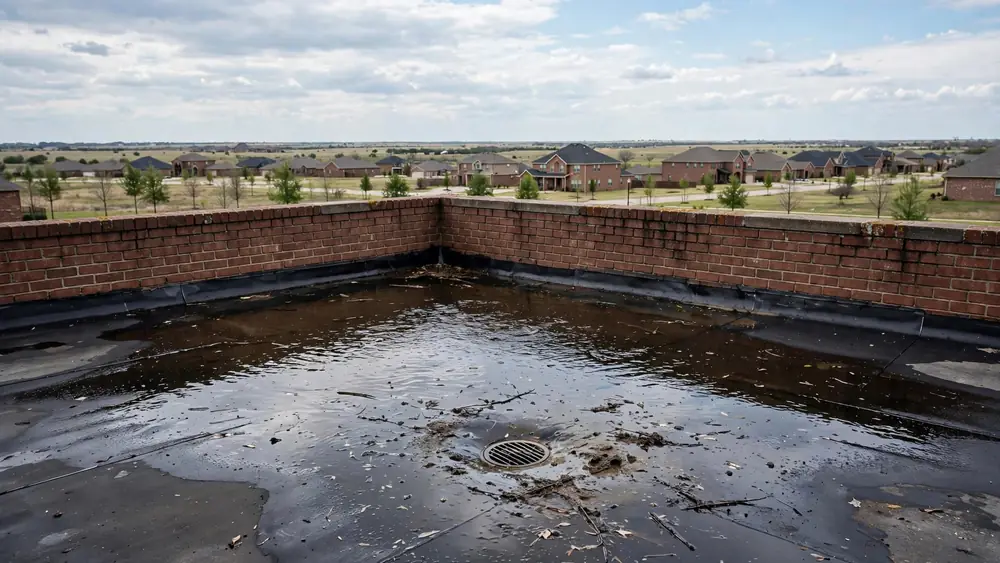
Low-slope roofs rely on drains, scuppers and flashing that have to be kept clear. Rain can pond, find a small opening and travel along a deck before appearing somewhere unexpected inside. Local rainfall peaks around May in nearby McKinney's record [4], so a pre-storm check in early spring is sensible. Clear leaves from drains, look at parapet caps and check that rooftop equipment has not been leaking condensate. Ask a roofer to find and fix the entry point, because no amount of drying will help if water keeps coming in.
Sewer and drains
Older drains in the historic core
Prosper's wastewater system has grown rapidly, with the Doe Branch plant serving Prosper and Celina [5], but it is the local drain that usually causes the trouble. Older buildings can have older lines, and restaurants add grease. Ask about a camera inspection if drains slow down, and keep cleanouts accessible. When sewage backs up in a commercial building, follow the sewage backup steps: stop water use, close the room and keep staff and customers out.
Local list
Downtown building owner's preparation list
- Know where each main valve is, including any for tenants
- Share a contact list with tenants: owner, plumber, roofer, alarm company
- Clear roof drains and scuppers before spring storms
- Keep records of past leaks, repairs and renovations
- Raise stock and records off the floor in back rooms
- Read your lease and your insurance policy together
When it happens
Handling a water problem in a downtown building
- 1
Stop water and protect people
Close the main; clear the area if there is any electrical risk.
- 2
Tell the people affected
Notify the owner, tenants and neighbors right away.
- 3
Record it
Photos of stock, finishes and the source, with the time.
- 4
Call
You are connected with an independent contractor on your call.
- 5
Plan around business
Discuss hours, noise and what can stay open.
- 6
Check for older materials
Ask about testing before any demolition.
- 7
Dry and verify
Readings on both sides of shared walls.
Permits
Town review and downtown building rules
The Town's Building Inspections division reviews plans, issues permits and carries out inspections, with applications going through the online portal [6]. Downtown may also have zoning or design rules connected with the master plan, and these matter most for exterior repairs and for storefront changes. Ask the town before altering a façade or a roof feature visible from the street. For interior restoration, your contractor should be able to tell you what is needed, but confirm it with the division if in doubt.
Insurance
Commercial and mixed-use policies
Home and commercial policies differ, and a building with both an apartment and a shop might involve more than one policy. The Texas Department of Insurance's distinctions between sudden and gradual water damage are written for home and renter policies [7]. Ask your agent how your policy treats water, sewer backup, business interruption and mold. Record lost trading days and spoiled stock as they happen, since it is harder to reconstruct them later.
Flood
Low spots, creeks and flood maps downtown
Older town centers were not laid out with modern stormwater standards in mind, and streets can pond in heavy rain. Do not assume your building's risk from either its age or its neighbors'. Enter your address at FEMA's Flood Map Service Center [8]. Note that maps change, and that floods are excluded from standard home policies [7]; commercial policies differ, so ask.
Older homes
Downtown residences and tenants
Not everything downtown is commercial. Older houses near the core may have been updated in stages, and they may have an old shutoff at the street and a newer one inside. Find out which works. Check under the floor if you can and note whether any supply lines are old galvanized steel, which can corrode from the inside; a plumber can advise you. If you rent, tell your landlord in writing and keep copies, and check whether your renters policy covers your belongings [7].
Choosing help
What to ask about an older building
Ask whether the contractor has experience with buildings of this age and with commercial work, and whether they will test for older hazardous materials before demolition. Ask how they keep neighbors' spaces from being affected. Ask how they handle business hours and access outside of them. Ask who handles the plumbing, roof and mold portions, and whether you can look up any licences [9] [10]. You should expect plain answers, and you can decline if you do not get them.
Basement-free buildings
Back rooms, storage and stock on the floor
Small commercial spaces tend to pack valuable things at floor level in rooms nobody looks at closely: boxes of stock, paper files, spare equipment and a water heater in a closet. A slow drip in a back room can run over a weekend without anyone noticing, and cardboard wicks water up quickly. Shelving that keeps goods at least a few inches off the floor is the simplest protection you can get. Storing papers and valuable items in closed plastic containers helps too, and it makes it much easier to get stock out of the way if you have to.
Closed-weekend risks are specific to businesses. A leak that begins on Friday evening has two days before anyone sees it, and the same goes for a tripped sump, an overflowing mop sink or a dripping cooler drain. Leak sensors that alert your phone are simple and work well here. Before long closures, have somebody check the building, and turn off water to appliances you do not need. Restaurant equipment, ice machines and beverage lines deserve a place on that list, because each is a separate water connection often hidden behind other equipment.
Fire sprinklers
When sprinkler systems are part of the water story
Commercial buildings may have fire sprinklers, which change how a water event plays out. A broken head or a frozen line can discharge a large volume of dirty water that has been sitting in the pipes for years. This water is often black and smelly, and it stains. Do not shut down a sprinkler system unless you know there is no fire and you are authorized to; follow the building's procedure and call the fire department or alarm company as required. Afterward, the sprinkler contractor needs to restore the system before the building is considered protected again.
For the cleanup, tell the restoration contractor that the water came from a sprinkler line, because it will affect what can be saved. Take photos of stained goods and ceilings early. Notify your insurer and the building owner promptly. If the system discharged because of freezing, ask what can be done to protect that run in future, since a sprinkler system in an unheated space needs specific freeze protection decided by a qualified fire protection contractor.
Building type
How water problems differ across the historic core
| Building type | Usual concern | What to ask about |
|---|---|---|
| Older commercial storefront | Roof drains, shared walls, older drain lines | Parapet flashing, camera inspection, materials testing |
| Restaurant or café | Grease, floor drains, equipment lines | Grease trap and health rules |
| Office suite | Ceilings, HVAC condensate | Who controls the main and the HVAC |
| Older house | Possible crawlspace, older supply lines | Under-floor inspection, pipe materials |
| Newer infill | Modern plumbing, recent warranty | Builder documents and warranty notice |
| Mixed use | Tenants above and below | Which policy and which owner respond |
Records and stock
Protecting business records and inventory
Water damage to a small business is often less about the building than about what is inside. Move records, computers and cash-handling equipment first, once it is safe. Back up data off-site as a matter of routine, so a wet server does not become a second disaster. Photograph inventory before you move it, including labels and quantities, and keep any invoices that help show value. Ask your insurer before throwing out damaged stock, unless it is a clear health hazard. Food exposed to contaminated water has to be handled according to food-safety rules, so ask your local health authority rather than guessing.
Tell your staff what to do. A short written plan pinned in a back room saves time: where the main valve is, who to call, where the fuse panel is and who has authority to approve emergency repairs. Tell them not to touch wet electrical equipment and to stay away from water coming from drains. A plan like this is a five-minute job to write, and a new employee on a Saturday might be the only person in the building when something goes wrong.
Historic character
Handling older finishes with care
Older buildings can have finishes worth keeping: wood floors, pressed metal, old plaster and original trim. These do not always respond well to the usual approach of cutting and replacing. Ask about drying in place where possible, and label and store any trim that must come off so it can go back in the same position. Wood that has been wet can warp if dried too fast, so controlled drying is better. Keep samples and take close-up photos of anything you may want to reproduce. A local carpenter or conservator could be a useful addition for a building with real character.
We should be clear about what we do not know. We have not confirmed whether any specific building downtown holds a historic designation or is subject to design review. Ask the Town of Prosper before you change anything visible from the street. A contractor can dry the inside of a building, but they cannot tell you what the town's rules allow for its façade.
Coverage note
What to say when calling from downtown
Calling the number on this site connects you with an independent contractor, if one is available for your address. Start by saying whether this is a house, shop, office or mixed-use building, whether you own or rent and whether others are affected. Mention food service, older materials and any fire sprinkler involvement. Ask whether they handle commercial work, because some restoration firms focus on homes. Any arrangements you make are between you and the contractor; this site does not dispatch, schedule or supervise anyone.
Questions
Downtown Prosper water damage questions
How old are the buildings in Downtown Prosper?
The town dates to 1902 and incorporated in 1914, but individual buildings vary widely, and some are new. Check property records for your building's actual age and past renovations before opening walls.
Who handles a leak in a leased shop?
It depends on your lease. Building owners usually handle the structure and shared systems, and tenants often handle stock and their improvements. Tell the owner at once, and read the lease and your policy.
Can my business stay open during drying?
Sometimes, if the area is contained and safe. Equipment is noisy and needs power, and contaminated water changes everything. Discuss it with your contractor on the call, along with any health authority rules for food businesses.
Do I need to test for asbestos before demolition?
It is wise to ask, especially in older buildings, because older materials can contain asbestos or lead. Rules vary by project type, so ask your contractor and check with the relevant Texas agency.
What if water comes from the unit next door?
Tell your neighbor and the building owner at once, take dated photos and ask them to shut off the source. Notify your insurer as well. Moisture readings on both sides help show how far it spread.
Does the Downtown Master Plan affect repairs?
Interior repairs are unlikely to be affected, but exterior or façade changes may be subject to town rules. Check with the Town of Prosper before altering anything visible from the street.
Why does a roof leak show up far from where it entered?
Water runs along decks, joists and insulation before dripping. On low-slope roofs it can travel some distance. A roofer can trace the entry point, and interior readings show how far the moisture spread.
Nearby
More around Downtown Prosper
Back to all of Prosper. Nearby pages: Gentle Creek Estates, Star Trail, Windsong Ranch.
Related help for Downtown Prosper: water extraction, structural drying, sewage backup cleanup, fire damage restoration and smoke damage cleanup. First time dealing with this? Read the first hours after water damage.
Sources and citations
- [1]Town of Prosper: History
- [2]Town of Prosper: Downtown Master Plan 2022
- [3]Community Impact: Revitalizing downtown Prosper (2024)
- [4]Wikipedia: McKinney, Texas (climate, citing NOAA)
- [5]Community Impact: Doe Branch wastewater plant expansion
- [6]Town of Prosper: Building Inspections
- [7]Texas Department of Insurance: When are water damage and mold covered?
- [8]FEMA Flood Map Service Center
- [9]Texas State Board of Plumbing Examiners
- [10]TDLR: Mold assessors and remediators FAQ